• Fri frakt över 249 kr
  • •
  • Snabba leveranser
  • •
  • Billiga böcker
Kundservice

Du är på sajten för privatpersoner.

Företag, bibliotek eller offentlig verksamhet?

Du handlar på classic.bokus.com, där alla dina funktioner finns intakta.
Till classic.bokus.com
Bokus logotyp. Gå till startsidan.
  • Erbjudanden
  • Student
  • Topplistor
  • Barn & ungdom
  • Bokus Play
  • E-böcker
  • Ljudböcker
  • Pocketböcker
  • Spel och pussel

Upp till 25% på utvalda nyheter →

Sidfot

Mina sidor

    Hjälp

    • Kundservice
    • Vanliga frågor och svar
    • Frakt och leverans
    • Retur vid ångerrätt
    • Reklamera vara
    • Betalning
    • Köpvillkor
    • Allmänna villkor
    • Information om webbplatsens tillgänglighet

    Om Bokus

    • Om oss
    • Pressrum
    • För studenter
    • För företag
    • För bibliotek och offentlig verksamhet
    • För leverantörer
    • Hållbarhet

    Populärt

    • Aktuella erbjudanden
    • Presentkort
    • Studentlitteratur
    • Nya böcker
    • Topplistor
    • Signerade böcker
    • Engelska böcker

    Inspiration

    • Boktips
    • BookTok
    • Barnbokskaraktärer
    • Populära författare
    Logotyp för Bokus
    Följ oss på Facebook (extern länk)Följ oss på Instagram (extern länk)Följ oss på YouTube (extern länk)Följ oss på TikTok (extern länk)
    bokus @ CookiesAnpassa cookiesIntegritetspolicyKöpvillkor
    Till Citymail hemsida (extern länk)Till Budbee hemsida (extern länk)Till Postnord hemsida (extern länk)Till Schenker hemsida (extern länk)Till Early Bird hemsida (extern länk)Till Walleys hemsida (extern länk)
    1. Psykologi och pedagogik
    2. Psykologi

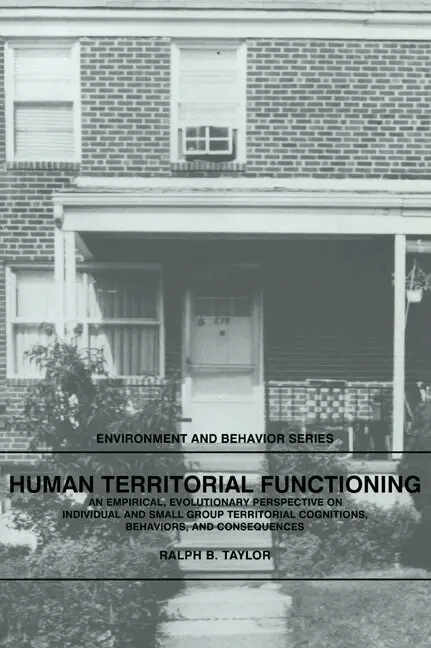
    Human Territorial Functioning

    An Empirical, Evolutionary Perspective on Individual and Small Group Territorial Cognitions, Behaviors, and Consequences

    AvRalph B. Taylor,Daniel Stokols

    Häftad, Engelska, 1988

    Del i serien Environment and Behavior

    647 kr

    Beställningsvara. Skickas inom 7-10 vardagar. Fri frakt över 249 kr.

    Beskrivning

    'Territorial functioning' refers to an interlocked system of sentiments, cognitions, and behaviors that are highly place-specific, and socially and culturally determined and maintaining. In this book, Ralph Taylor explores the consequences of human territorial functioning for individuals, small groups, and the ecological systems in which they operate. His exploration is illuminated by his evolutionary perspective, and grounded in empirical studies by social scientists and in theoretical work on the evolution of social and spatial behaviors. He systematically reviews the related research and theory, and indicates the importance of territorial functioning to current social and environmental problems. Contrary to popular wisdom, he argues that territorial functioning is relevant only to limited locations, such as street blocks, and not to neighborhoods or nation states, and that it reduces conflicts and helps maintain settings and groups. His theoretically focused examination of all that has been discovered about human territorial functioning will interest a wide variety of environmental psychologists and designers, urban sociologists, social psychologists, planners, and ethologists, and their students.

    Produktinformation

    • Utgivningsdatum:1988-08-26
    • Mått:152 x 228 x 17 mm
    • Vikt:502 g
    • Format:Häftad
    • Språk:Engelska
    • Serie:Environment and Behavior
    • Antal sidor:380
    • Förlag:Cambridge University Press
    • ISBN:9780521313070

    Utforska kategorier

    • Psykologi inom Psykologi och pedagogik

    Recensioner i media

    "...new and refreshing look at a set of issues that have theoretical and applied implications for environment-behavior relations in many context. It will inform any reader and stimulate propositions for many years to come." Contemporary Psychology

    Innehållsförteckning

    • 1. Introduction; Part I. Origins of Human Territorial Functioning: 2. Territorial Functioning and Related Processes in Different Species; 3. The Origins of Human Territorial Functioning; 4. Theoretical Perspectives on Interpreting Territorial Functioning: Exactly How did it Evolve?; Part II. A Conceptual Model of Human Territorial Functioning: 5. A Perspective on Human Territorial Functioning; 6. Clarifying Psychological and Ecological Consequences; Part III. Territorial Functioning in Settings of Varying Centrality: 7. Interior Residential Settings; 8. Territorial Functioning in Outdoor Residential Spaces Close to the Home; 9. Regular Use Settings; 10. Minimal Territorial Functioning; Part IV. Applications to Social Problems: 11. Disorder; 12. Resource Conservatism; Part V. Review and Prospects: 13. Summary of the General Line of Argument and its Implications; 14 Future Directions for Research and Application.