• Fri frakt över 249 kr
  • •
  • Snabba leveranser
  • •
  • Billiga böcker
Kundservice

Du är på sajten för privatpersoner.

Företag, bibliotek eller offentlig verksamhet?

Du handlar på classic.bokus.com, där alla dina funktioner finns intakta.
Till classic.bokus.com
Bokus logotyp. Gå till startsidan.
  • Erbjudanden
  • Nyheter
  • Student
  • Topplistor
  • Barn & ungdom
  • Bokus Play
  • E-böcker
  • Pocketböcker
  • Spel & pussel

10% rabatt på allt med kod: NYSTART10 →

Sidfot

Mina sidor

    Hjälp

    • Kundservice
    • Vanliga frågor och svar
    • Frakt och leverans
    • Retur vid ångerrätt
    • Reklamera vara
    • Betalning
    • Köpvillkor
    • Allmänna villkor
    • Information om webbplatsens tillgänglighet

    Om Bokus

    • Om oss
    • Pressrum
    • För studenter
    • För företag
    • För bibliotek och offentlig verksamhet
    • För leverantörer
    • Hållbarhet

    Populärt

    • Aktuella erbjudanden
    • Presentkort
    • Studentlitteratur
    • Nya böcker
    • Topplistor
    • Signerade böcker
    • Engelska böcker

    Inspiration

    • Boktips
    • BookTok
    • Populära bokserier
    • Barnbokskaraktärer
    • Populära författare
    Logotyp för Bokus
    Följ oss på Facebook (extern länk)Följ oss på Instagram (extern länk)Följ oss på YouTube (extern länk)Följ oss på TikTok (extern länk)
    bokus @ CookiesAnpassa cookiesIntegritetspolicyKöpvillkor
    Till Citymail hemsida (extern länk)Till Budbee hemsida (extern länk)Till Postnord hemsida (extern länk)Till Schenker hemsida (extern länk)Till Early Bird hemsida (extern länk)Till Walleys hemsida (extern länk)
    1. Ekonomi och Ledarskap
    2. Nationalekonomi

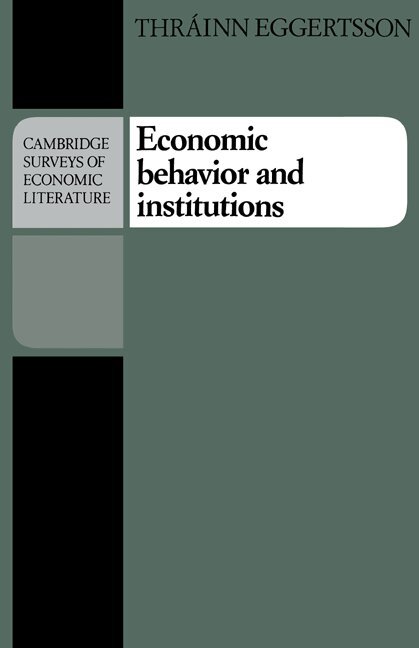
    Economic Behavior and Institutions

    Principles of Neoinstitutional Economics

    AvThrainn Eggertsson,John Pencavel

    Häftad, Engelska, 1990

    Del i serien Cambridge Surveys of Economic Literature

    590 kr

    Beställningsvara. Skickas inom 10-15 vardagar. Fri frakt över 249 kr.

    Beskrivning

    An important research programme has developed in economics that extends neo-classical economic theory in order to examine the effects of institutions on economic behaviour. The body of work emerging from this line of inquiry includes contributions from various branches of economic theory, such as the economics of property rights, the theory of the firm, cliometrics and law and economics. This book is a comprehensive survey of this research programme which the author terms 'neoinstitutional economics'. The author proposes a unified approach to this research, integrating the work of various contributors and emphasising the common principles of inquiry that tie the work together. The theoretical discussion is accompanied by empirical studies dealing with a range of institutions and economic systems. This book will serve as the primary resource for economists and students who want to learn about this important branch of economic theory.

    Produktinformation

    • Utgivningsdatum:1990-06-29
    • Mått:140 x 216 x 23 mm
    • Vikt:510 g
    • Format:Häftad
    • Språk:Engelska
    • Serie:Cambridge Surveys of Economic Literature
    • Antal sidor:404
    • Förlag:Cambridge University Press
    • ISBN:9780521348911

    Utforska kategorier

    • Nationalekonomi inom Ekonomi och Ledarskap

    Recensioner i media

    'The survey succeeds in my view precisely in presenting and linking in a convincing way quite disparate material.' Arthur Denzau, Washington University

    Innehållsförteckning

    • Part I. Introduction to the Theory: 1. Generalising neoclassical economics: new tools and concepts; 2. Property rights, agency and economic organisation; 3. Explaining the rules; Part II. Property Rights and Economic Outcomes: 4. The economics of exclusive rights; 5. The ownership structure of firms and equilibrium outcomes; Part III. Explaining Economic Organisation: 6. The contractual nature of the firm; 7. The logic of economic organisation; Part IV. Explaining Property Rights: 8. The emergence of property rights; 9. Property rights in stateless societies; 10. The state in neoinstitutional economics.