• Fri frakt över 249 kr
  • •
  • Snabba leveranser
  • •
  • Billiga böcker
Kundservice

Du är på sajten för privatpersoner.

Företag, bibliotek eller offentlig verksamhet?

Du handlar på classic.bokus.com, där alla dina funktioner finns intakta.
Till classic.bokus.com
Bokus logotyp. Gå till startsidan.
  • Erbjudanden
  • Nyheter
  • Student
  • Topplistor
  • Barn & ungdom
  • Bokus Play
  • E-böcker
  • Pocketböcker
  • Spel & pussel

10% rabatt på allt med kod: NYSTART10 →

Sidfot

Mina sidor

    Hjälp

    • Kundservice
    • Vanliga frågor och svar
    • Frakt och leverans
    • Retur vid ångerrätt
    • Reklamera vara
    • Betalning
    • Köpvillkor
    • Allmänna villkor
    • Information om webbplatsens tillgänglighet

    Om Bokus

    • Om oss
    • Pressrum
    • För studenter
    • För företag
    • För bibliotek och offentlig verksamhet
    • För leverantörer
    • Hållbarhet

    Populärt

    • Aktuella erbjudanden
    • Presentkort
    • Studentlitteratur
    • Nya böcker
    • Topplistor
    • Signerade böcker
    • Engelska böcker

    Inspiration

    • Boktips
    • BookTok
    • Populära bokserier
    • Barnbokskaraktärer
    • Populära författare
    Logotyp för Bokus
    Följ oss på Facebook (extern länk)Följ oss på Instagram (extern länk)Följ oss på YouTube (extern länk)Följ oss på TikTok (extern länk)
    bokus @ CookiesAnpassa cookiesIntegritetspolicyKöpvillkor
    Till Citymail hemsida (extern länk)Till Budbee hemsida (extern länk)Till Postnord hemsida (extern länk)Till Schenker hemsida (extern länk)Till Early Bird hemsida (extern länk)Till Walleys hemsida (extern länk)
    1. Historia och arkeologi
    2. Historia
    3. Amerikas historia

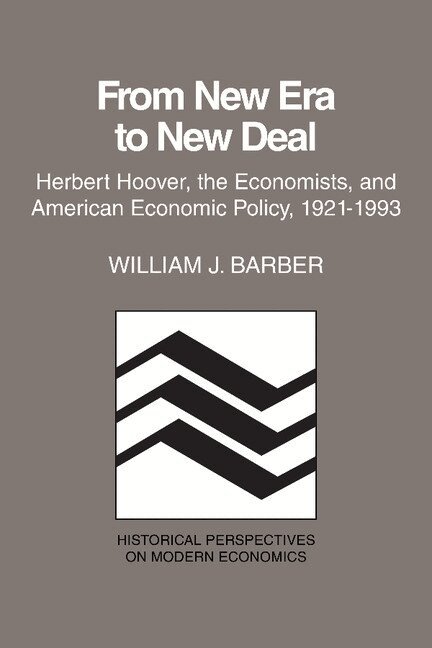
    From New Era to New Deal

    Herbert Hoover, the Economists, and American Economic Policy, 1921-1933

    AvWilliam J. Barber,Craufurd Goodwin

    Häftad, Engelska, 1989

    Del i serien Historical Perspectives on Modern Economics

    463 kr

    Beställningsvara. Skickas inom 10-15 vardagar. Fri frakt över 249 kr.

    Beskrivning

    In popular imagery, Herbert Hoover is often stereotyped as a 'do-nothing' president who offered only nineteenth-century slogans for the greatest economic catastrophe in twentieth-century American history. Nothing could be further from the truth. This study examines the properties of an innovative approach to economic growth and stability formulated by Hoover and his associates during his years as secretary of commerce (1921-9) and inspects his deployment of this strategy from the White House following the Great Crash in the autumn of 1929. Attention is then focused on Hoover's attempts to reformulate his macro-economic programme as the depression deepened in late 1931 and 1932. Archival materials provide arresting insights into Hoover's aspirations for a new institution - the Reconstruction Finance Corporations - as a vehicle for stimulating investment through a novel form of 'off-budget' financing. To complement the discussion of Hoover's theories of economic policy in their various manifestations, the views of contemporary economists on problems of the day are surveyed.

    Produktinformation

    • Utgivningsdatum:1989-01-27
    • Mått:152 x 228 x 16 mm
    • Vikt:413 g
    • Format:Häftad
    • Språk:Engelska
    • Serie:Historical Perspectives on Modern Economics
    • Antal sidor:252
    • Förlag:Cambridge University Press
    • ISBN:9780521367370

    Utforska kategorier

    • Amerikas historia inom Historia och arkeologi

    Recensioner i media

    'Barber has written an exciting, well crafted and important book that succeeds in what it sets out to do. It deserves a careful reading by all serious students of the Hoover period, American economic thought, and American economic policy.' The Journal of Economic History

    Innehållsförteckning

    • Preface; Prologue; 1. The ingredients of a model of a new economics; 2. Challenges to the new economics of the 1920s; 3. The new economics at center stage in 1929; 4. Activating the stabilization model in late 1929 and 1930; 5. Preliminary readings of the results of the stabilization strategy; 6. The unraveling of the first official model in 1931; 7. Shifting course in late 1931 and early 1932; 8. Renewing the offensive in February and March; 9. The economists and their views on policy for 1932; 10. Official model II as shaped in May 1932 and the aftermath; Epilogue; Notes; Selected bibliography, Index.