• Fri frakt över 249 kr
  • •
  • Snabba leveranser
  • •
  • Billiga böcker
Kundservice

Du är på sajten för privatpersoner.

Företag, bibliotek eller offentlig verksamhet?

Du handlar på classic.bokus.com, där alla dina funktioner finns intakta.
Till classic.bokus.com
Bokus logotyp. Gå till startsidan.
  • Erbjudanden
  • Nyheter
  • Student
  • Topplistor
  • Barn & ungdom
  • Bokus Play
  • E-böcker
  • Pocketböcker
  • Spel & pussel

10% rabatt på allt med kod: NYSTART10 →

Sidfot

Mina sidor

    Hjälp

    • Kundservice
    • Vanliga frågor och svar
    • Frakt och leverans
    • Retur vid ångerrätt
    • Reklamera vara
    • Betalning
    • Köpvillkor
    • Allmänna villkor
    • Information om webbplatsens tillgänglighet

    Om Bokus

    • Om oss
    • Pressrum
    • För studenter
    • För företag
    • För bibliotek och offentlig verksamhet
    • För leverantörer
    • Hållbarhet

    Populärt

    • Aktuella erbjudanden
    • Presentkort
    • Studentlitteratur
    • Nya böcker
    • Topplistor
    • Signerade böcker
    • Engelska böcker

    Inspiration

    • Boktips
    • BookTok
    • Populära bokserier
    • Barnbokskaraktärer
    • Populära författare
    Logotyp för Bokus
    Följ oss på Facebook (extern länk)Följ oss på Instagram (extern länk)Följ oss på YouTube (extern länk)Följ oss på TikTok (extern länk)
    bokus @ CookiesAnpassa cookiesIntegritetspolicyKöpvillkor
    Till Citymail hemsida (extern länk)Till Budbee hemsida (extern länk)Till Postnord hemsida (extern länk)Till Schenker hemsida (extern länk)Till Early Bird hemsida (extern länk)Till Walleys hemsida (extern länk)
    1. Ekonomi och Ledarskap
    2. Företagsekonomi

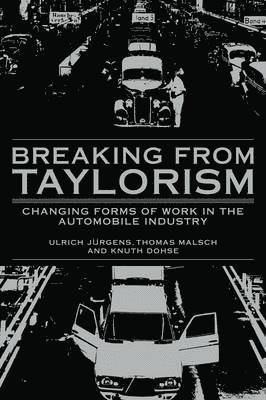
    Breaking from Taylorism

    Changing Forms of Work in the Automobile Industry

    AvUlrich Jürgens,Thomas Malsch

    Inbunden, Engelska, 1994

    1 900 kr

    Beställningsvara. Skickas inom 10-15 vardagar. Fri frakt över 249 kr.

    Fler format och utgåvor

    Häftad

    643 kr

    Beskrivning

    In this book, the future of one of the world's most important industries is examined from the perspective of work structures and labour relations policies. The authors examine the restructuring of the world automobile industry in the 1980s, and draw data from an in-depth empirical study of three leading car companies in three different countries: the United States, the United Kingdom and Germany. They demonstrate that the different strategies employed by firms and trades unions in industrial relations, and different national characteristics, have had a major impact on the dismantling of Taylorism and Fordism and the introduction of new structures of work. This book is an important contribution to the study of change in mass production industries throughout the world. It will be of interest to students of industrial relations and industrial sociology, as well as specialists in government and business.

    Produktinformation

    • Utgivningsdatum:1994-01-06
    • Mått:155 x 235 x 31 mm
    • Vikt:753 g
    • Format:Inbunden
    • Språk:Engelska
    • Antal sidor:464
    • Förlag:Cambridge University Press
    • ISBN:9780521405447

    Utforska kategorier

    • Företagsekonomi inom Ekonomi och Ledarskap

    Recensioner i media

    "There are extensive sections on levels of productivity, quality indices, and ratios of direct and indirect labour which speak to the goals and interests of management. It deserves the attention of those concerned with the future of work. It points to the need for studies which focus on workers' assessment of change." Labour

    Innehållsförteckning

    • 1. The restructuring of the world automobile industry: opportunities for new forms of work; 2. Changing markets and the rise of Toyotism: the development of the national car industries since the 1970s; 3. Company strategies for answering the challenges; 4. Industrial relations in the process of change; 5. Reorganising quality control - between pressure for efficiency and a job enrichment orientation; 6. Coping with new technology: skilled workers between specialisation and flexibilisation; 7. Regulating work performance and plant efficiency: changes in control and structures of work; 8. Comparative achievements in labour productivity and changes in personnel structures: trends and development patterns; 9. Tapping new resources: skill levels and worker participation; 10. Is the assembly line obsolete?; 11. Modern times in the automobile factory: trends toward new forms of work