• Fri frakt över 249 kr
  • •
  • Snabba leveranser
  • •
  • Billiga böcker
Kundservice

Du är på sajten för privatpersoner.

Företag, bibliotek eller offentlig verksamhet?

Du handlar på classic.bokus.com, där alla dina funktioner finns intakta.
Till classic.bokus.com
Bokus logotyp. Gå till startsidan.
  • Erbjudanden
  • Student
  • Topplistor
  • Barn & ungdom
  • Bokus Play
  • E-böcker
  • Ljudböcker
  • Pocketböcker
  • Spel & pussel

10% rabatt på allt med kod NYSTART10 →

Sidfot

Mina sidor

    Hjälp

    • Kundservice
    • Vanliga frågor och svar
    • Frakt och leverans
    • Retur vid ångerrätt
    • Reklamera vara
    • Betalning
    • Köpvillkor
    • Allmänna villkor
    • Information om webbplatsens tillgänglighet

    Om Bokus

    • Om oss
    • Pressrum
    • För studenter
    • För företag
    • För bibliotek och offentlig verksamhet
    • För leverantörer
    • Hållbarhet

    Populärt

    • Aktuella erbjudanden
    • Presentkort
    • Studentlitteratur
    • Nya böcker
    • Topplistor
    • Signerade böcker
    • Engelska böcker

    Inspiration

    • Boktips
    • BookTok
    • Populära bokserier
    • Barnbokskaraktärer
    • Populära författare
    Logotyp för Bokus
    Följ oss på Facebook (extern länk)Följ oss på Instagram (extern länk)Följ oss på YouTube (extern länk)Följ oss på TikTok (extern länk)
    bokus @ CookiesAnpassa cookiesIntegritetspolicyKöpvillkor
    Till Citymail hemsida (extern länk)Till Budbee hemsida (extern länk)Till Postnord hemsida (extern länk)Till Schenker hemsida (extern länk)Till Early Bird hemsida (extern länk)Till Walleys hemsida (extern länk)
    1. Psykologi och pedagogik
    2. Psykologi
    3. Socialpsykologi och gruppsykologi

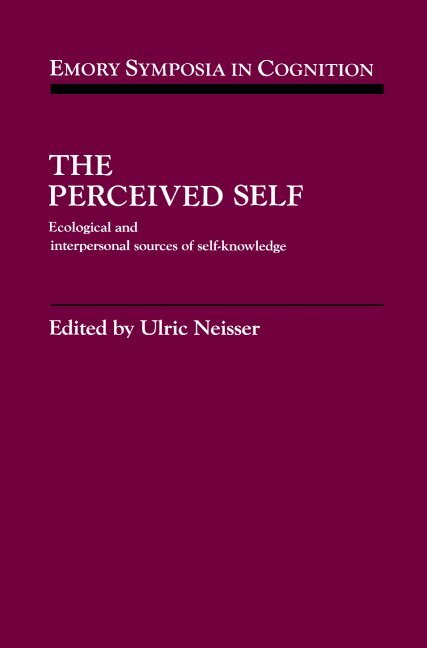
    The Perceived Self

    Ecological and Interpersonal Sources of Self Knowledge

    AvUlric Neisser

    Inbunden, Engelska, 1994

    Del 5 i serien Emory Symposia in Cognition

    1 649 kr

    Beställningsvara. Skickas inom 7-10 vardagar. Fri frakt över 249 kr.

    Beskrivning

    This book brings different ideas to bear on the classical problem of the self. Self-perception, both ecological and social, is the earliest and most fundamental form of self-knowledge. In his introduction, Ulric Neisser describes the 'ecological self' as based on direct and realistic perception of one's situation in the environment; the 'interpersonal self' as established by social interaction with other people. He argues that both of these 'selves' appear in early infancy, long before anything like a self-concept or a self-narrative is possible. In subsequent chapters, fifteen contributors - psychologists, philosophers and others - elaborate on these notions and introduce related ideas of their own. Their topics range from the perceptual and social development of infants to autism and blindness; from mechanisms of motor control to dance and non-verbal communication. The combined contributions of these leading individuals creates an unusual synthesis of perceptual, social and developmental theory.

    Produktinformation

    • Utgivningsdatum:1994-05-27
    • Mått:159 x 228 x 24 mm
    • Vikt:630 g
    • Format:Inbunden
    • Språk:Engelska
    • Serie:Emory Symposia in Cognition
    • Antal sidor:336
    • Förlag:Cambridge University Press
    • ISBN:9780521415095

    Utforska kategorier

    • Socialpsykologi och gruppsykologi inom Psykologi och pedagogik

    Innehållsförteckning

    • Preface; List of contributors; Part I. Introduction: 1. The self perceived Ulric Neisser; Part II. The Concept of an Ecological Self: 2. Ontogenesis of the perceived self Eleanor J. Gibson; 3. Body-environment coupling David N. Lee; 4. A theory of representation-driven actions Marc Jeannerod; 5. The ecological self in historical context Franklin C. Shontz; 6. Good intentions and dancing moments: Agency, freedom and self-knowledge in dance Sondra Horton Fraleigh; 7. The primacy of the ecological self Marjorie Grene; Part III. The Interpersonal Self and Its Implications: 8. The self born in intersubjectivity: the psychology of an infant communicating Colwyn Trevarthen; 9. On the interpersonal origins of self-concept Michael Tomasello; 10. Infant's knowledge of self, other, and relationship Sandra Pipp; 11. The role of feelings for an interpersonal self Daniel N. Stern; 12. Spontaneous communication and foundation of the interpersonal self Ross Buck; 13. Autism, affordances and the self Katherine A. Loveland; 14. Through feeling and sight to self and symbol R. Peter Hobson; 15. G. H. Mead and Martin Buber on the interpersonal self James M. Gustafson; 16. Cognitive science, other minds, and the philosophy of dialogue and the egocentric predicament David Jopling; Author index; Subject index.