• Fri frakt över 249 kr
  • •
  • Snabba leveranser
  • •
  • Billiga böcker
Kundservice

Du är på sajten för privatpersoner.

Företag, bibliotek eller offentlig verksamhet?

Du handlar på classic.bokus.com, där alla dina funktioner finns intakta.
Till classic.bokus.com
Bokus logotyp. Gå till startsidan.
  • Erbjudanden
  • Nyheter
  • Student
  • Topplistor
  • Barn & ungdom
  • Bokus Play
  • E-böcker
  • Pocketböcker
  • Spel & pussel

10% rabatt på allt med kod: NYSTART10 →

Sidfot

Mina sidor

    Hjälp

    • Kundservice
    • Vanliga frågor och svar
    • Frakt och leverans
    • Retur vid ångerrätt
    • Reklamera vara
    • Betalning
    • Köpvillkor
    • Allmänna villkor
    • Information om webbplatsens tillgänglighet

    Om Bokus

    • Om oss
    • Pressrum
    • För studenter
    • För företag
    • För bibliotek och offentlig verksamhet
    • För leverantörer
    • Hållbarhet

    Populärt

    • Aktuella erbjudanden
    • Presentkort
    • Studentlitteratur
    • Nya böcker
    • Topplistor
    • Signerade böcker
    • Engelska böcker

    Inspiration

    • Boktips
    • BookTok
    • Populära bokserier
    • Barnbokskaraktärer
    • Populära författare
    Logotyp för Bokus
    Följ oss på Facebook (extern länk)Följ oss på Instagram (extern länk)Följ oss på YouTube (extern länk)Följ oss på TikTok (extern länk)
    bokus @ CookiesAnpassa cookiesIntegritetspolicyKöpvillkor
    Till Citymail hemsida (extern länk)Till Budbee hemsida (extern länk)Till Postnord hemsida (extern länk)Till Schenker hemsida (extern länk)Till Early Bird hemsida (extern länk)Till Walleys hemsida (extern länk)
    1. Ekonomi och Ledarskap
    2. Nationalekonomi

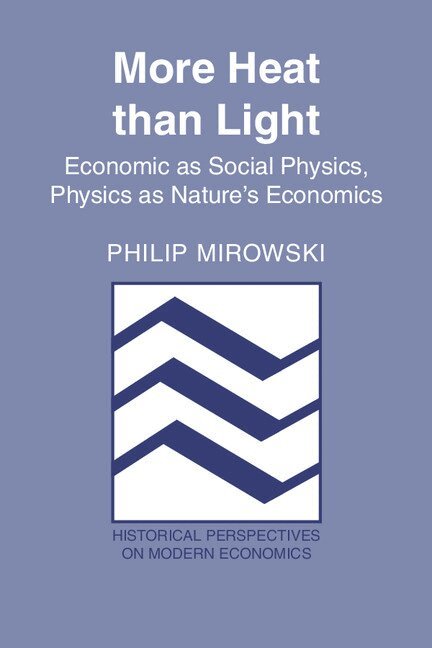
    More Heat than Light

    Economics as Social Physics, Physics as Nature's Economics

    AvPhilip Mirowski

    Häftad, Engelska, 1991

    Del i serien Historical Perspectives on Modern Economics

    684 kr

    Beställningsvara. Skickas inom 10-15 vardagar. Fri frakt över 249 kr.

    Beskrivning

    More Heat Than Light is a history of how physics has drawn some inspiration from economics and also how economics has sought to emulate physics, especially with regard to the theory of value. It traces the development of the energy concept in Western physics and its subsequent effect upon the invention and promulgation of neoclassical economics. Any discussion of the standing of economics as a science must include the historical symbiosis between the two disciplines. Starting with the philosopher Emile Meyerson's discussion of the relationship between notions of invariance and causality in the history of science, the book surveys the history of conservation principles in the Western discussion of motion. Recourse to the metaphors of the economy are frequent in physics, and the concepts of value, motion, and body reinforced each other throughout the development of both disciplines, especially with regard to practices of mathematical formalisation. However, in economics subsequent misuse of conservation principles led to serious blunders in the mathematical formalisation of economic theory. The book attempts to provide the reader with sufficient background in the history of physics in order to appreciate its theses. The discussion is technically detailed and complex, and familiarity with calculus is required.

    Produktinformation

    • Utgivningsdatum:1991-11-29
    • Mått:150 x 228 x 30 mm
    • Vikt:746 g
    • Format:Häftad
    • Språk:Engelska
    • Serie:Historical Perspectives on Modern Economics
    • Antal sidor:464
    • Förlag:Cambridge University Press
    • ISBN:9780521426893

    Utforska kategorier

    • Nationalekonomi inom Ekonomi och Ledarskap

    Recensioner i media

    "Intellectual stars of his magnitude (as opposed to scientific stars) don't come along very often....in More Heat Than Light...he states a challenge that is going to haunt economists for years....Mirowski and his ideas are about to move out of the history of economics into the wider stream." David Warsh, The Boston Globe

    Innehållsförteckning

    • List of figures; List of tables; Epigraph; Acknowledgments; Dedication; 1. The fearful spheres of Pascal and Parmenides; 2. Everything an economist needs to know about physics but was probably afraid to ask: the history of the energy concept; 3. Body, motions and value; 4. Science and substance theories of value in political economy to 1870; 5. Neoclassical economics: an irresistible field of force meets an immovable object; 6. The corruption of the field theory of value, and the retrogression to substance theories of value: neoclassical production theory; 7. The ironies of physics envy; 8. Universal history is the story of different intonations given to a handful of metaphors.