• Fri frakt över 249 kr
  • •
  • Snabba leveranser
  • •
  • Billiga böcker
Kundservice

Du är på sajten för privatpersoner.

Företag, bibliotek eller offentlig verksamhet?

Du handlar på classic.bokus.com, där alla dina funktioner finns intakta.
Till classic.bokus.com
Bokus logotyp. Gå till startsidan.
  • Erbjudanden
  • Nyheter
  • Student
  • Topplistor
  • Barn & ungdom
  • Bokus Play
  • E-böcker
  • Pocketböcker
  • Spel & pussel

10% rabatt på allt med kod: NYSTART10 →

Sidfot

Mina sidor

    Hjälp

    • Kundservice
    • Vanliga frågor och svar
    • Frakt och leverans
    • Retur vid ångerrätt
    • Reklamera vara
    • Betalning
    • Köpvillkor
    • Allmänna villkor
    • Information om webbplatsens tillgänglighet

    Om Bokus

    • Om oss
    • Pressrum
    • För studenter
    • För företag
    • För bibliotek och offentlig verksamhet
    • För leverantörer
    • Hållbarhet

    Populärt

    • Aktuella erbjudanden
    • Presentkort
    • Studentlitteratur
    • Nya böcker
    • Topplistor
    • Signerade böcker
    • Engelska böcker

    Inspiration

    • Boktips
    • BookTok
    • Populära bokserier
    • Barnbokskaraktärer
    • Populära författare
    Logotyp för Bokus
    Följ oss på Facebook (extern länk)Följ oss på Instagram (extern länk)Följ oss på YouTube (extern länk)Följ oss på TikTok (extern länk)
    bokus @ CookiesAnpassa cookiesIntegritetspolicyKöpvillkor
    Till Citymail hemsida (extern länk)Till Budbee hemsida (extern länk)Till Postnord hemsida (extern länk)Till Schenker hemsida (extern länk)Till Early Bird hemsida (extern länk)Till Walleys hemsida (extern länk)
    1. Språk och ordböcker
    2. Språkvetenskap och lingvistik

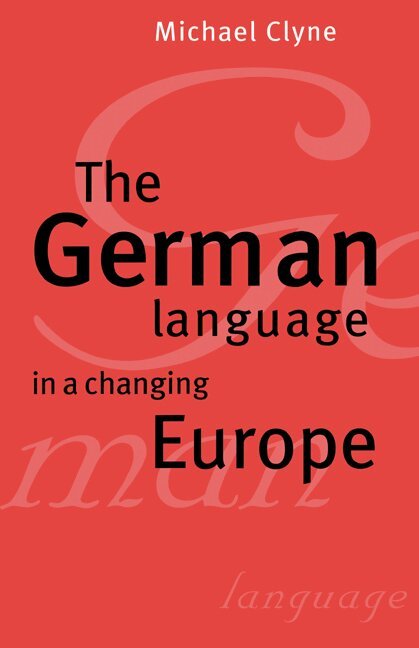
    The German Language in a Changing Europe

    AvMichael Clyne

    Inbunden, Engelska, 1995

    1 319 kr

    Beställningsvara. Skickas inom 10-15 vardagar. Fri frakt över 249 kr.

    Fler format och utgåvor

    Häftad

    707 kr

    Beskrivning

    Recent sociopolitical events have profoundly changed the status and functions of German and influenced its usage. In this study (published by Cambridge in 1984) Michael Clyne revises and expands his original analysis of the German language in Language and Society in the German-speaking Countries in the light of such changes as the end of the Cold War, German unification, the redrawing of the map of Europe, increasing European integration, and the changing self-images of Austria, Switzerland and Luxembourg. His discussion includes the differences in the form, function and status of the various national varieties of German; the relation between standard and non-standard varieties; gender, generational and political variation; Anglo-American influence on German; and the convergence of east and west. The result is a wide-ranging exploration of language and society in the German-speaking countries, all of which have problems or dilemmas concerning nationhood or ethnicity which are language-related and/or language-marked.

    Produktinformation

    • Utgivningsdatum:1995-11-16
    • Mått:140 x 216 x 21 mm
    • Vikt:520 g
    • Format:Inbunden
    • Språk:Engelska
    • Antal sidor:288
    • Förlag:Cambridge University Press
    • ISBN:9780521462693

    Utforska kategorier

    • Språkvetenskap och lingvistik inom Språk och ordböcker

    Recensioner i media

    "With The German Language in a changing Europe, Michael Clyne has once again produced a most insightful, readable, and, above all, usseful text. ...Clyne's approach...gives the book as a whole its uniqueness and its broad appeal to students and scholars of German language and culture, and renders it a first-rate addition to teaching and research resources in German studies." American Journal of Germanic Linguistics & Literatures

    Innehållsförteckning

    • 1. The status of German in contemporary Europe; 2. German as a pluricentric language; 3. German in divided and unified Germany; 4. Language and regionalism in Germany and Austria; 5. Communication patterns; 6. Gender, generation and politics: variation and change in language and discourse; 7. Communication norms and communication barriers; 8. Recent Anglo-American influence.