• Fri frakt över 249 kr
  • •
  • Snabba leveranser
  • •
  • Billiga böcker
Kundservice

Du är på sajten för privatpersoner.

Företag, bibliotek eller offentlig verksamhet?

Du handlar på classic.bokus.com, där alla dina funktioner finns intakta.
Till classic.bokus.com
Bokus logotyp. Gå till startsidan.
  • Erbjudanden
  • Student
  • Topplistor
  • Barn & ungdom
  • Bokus Play
  • E-böcker
  • Ljudböcker
  • Pocketböcker
  • Spel och pussel

5% studentrabatt – använd koden KURSBOK27 →

Sidfot

Mina sidor

    Hjälp

    • Kundservice
    • Vanliga frågor och svar
    • Frakt och leverans
    • Retur vid ångerrätt
    • Reklamera vara
    • Betalning
    • Köpvillkor
    • Allmänna villkor
    • Information om webbplatsens tillgänglighet

    Om Bokus

    • Om oss
    • Pressrum
    • För studenter
    • För företag
    • För bibliotek och offentlig verksamhet
    • För leverantörer
    • Hållbarhet

    Populärt

    • Aktuella erbjudanden
    • Presentkort
    • Studentlitteratur
    • Nya böcker
    • Topplistor
    • Signerade böcker
    • Engelska böcker

    Inspiration

    • Boktips
    • BookTok
    • Barnbokskaraktärer
    • Populära författare
    Logotyp för Bokus
    Följ oss på Facebook (extern länk)Följ oss på Instagram (extern länk)Följ oss på YouTube (extern länk)Följ oss på TikTok (extern länk)
    bokus @ CookiesAnpassa cookiesIntegritetspolicyKöpvillkor
    Till Citymail hemsida (extern länk)Till Budbee hemsida (extern länk)Till Postnord hemsida (extern länk)Till Schenker hemsida (extern länk)Till Early Bird hemsida (extern länk)Till Walleys hemsida (extern länk)
    1. Språk och ordböcker
    2. Språkvetenskap och lingvistik

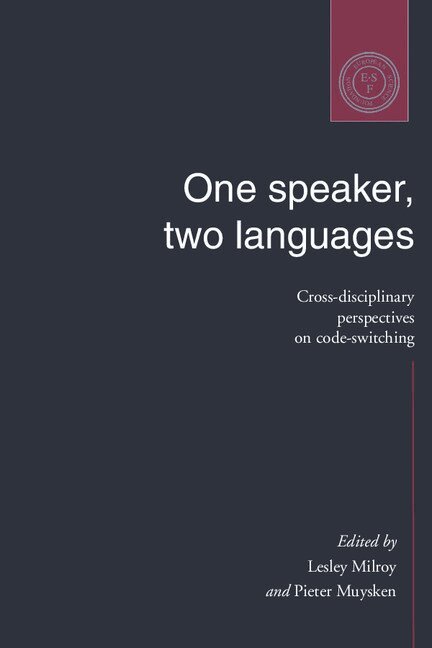
    One Speaker, Two Languages

    Cross-Disciplinary Perspectives on Code-Switching

    AvLesley Milroy,Pieter Muysken

    Häftad, Engelska, 1995

    747 kr

    Beställningsvara. Skickas inom 7-10 vardagar. Fri frakt över 249 kr.

    Beskrivning

    Code-switching - the alternating use of several languages by bilingual speakers - does not usually indicate lack of competence on the part of the speaker in any of the languages concerned, but results from complex bilingual skills. The reasons why people switch their codes are as varied as the directions from which linguists approach this issue, and raise many sociological, psychological, and grammatical questions. This volume of essays by leading scholars brings together the main strands of current research in four major areas: the policy implications of code-switching in specific institutional and community settings; the perspective of social theory on code-switching as a form of speech behaviour in particular social contexts; the grammatical analysis of code-switching, including the factors that constrain switching even within a sentence; and the implications of code-switching in bilingual processing and development.

    Produktinformation

    • Utgivningsdatum:1995-08-17
    • Mått:153 x 230 x 30 mm
    • Vikt:620 g
    • Format:Häftad
    • Språk:Engelska
    • Antal sidor:380
    • Förlag:Cambridge University Press
    • ISBN:9780521479127

    Utforska kategorier

    • Språkvetenskap och lingvistik inom Språk och ordböcker

    Mer om författaren

    Pieter Muysken is Professor of Linguistics at Radboud University Nijmegen, after previously teaching at the universities of Amsterdam and Leiden. His specialism is language contact and he does research in the Andes, the Caribbean and the Netherlands.

    Recensioner i media

    "...brings together an excellent representative collection of theoretical essays on bilingual code-switching....the breadth of the research areas...makes this volume worthwhile reading....a valuable collection." Rocky Mountain Review

    Innehållsförteckning

    • 1. Introduction Lesley Milroy and Pieter Muysken; Part I. Code-Switching in Institutional and Community Settings: 2. Bilingual speech of migrant people Louise Dabène and Danièle Moore; 3. Code-switching in the context of dialect/standard language relations Anna Giacolone-Ramat; 4. Code-switching in community, regional and national repertoires Penelope Gardner-Chloros; 5. Code-switching in the classroom Marilyn Martin-Jones; Part II. Code-Switching and Social Life: 6. The pragmatics of code-switching Peter Auer; 7. A social network approach to code-switching Lesley Milroy and Li Wei; 8. Code-switching and the politics of language Monica Heller; Part III. Grammatical Constraints on Code-Switching: 9. Code-switching and grammatical theory Pieter Muysken; 10. Patterns of language mixture Shana Poplack and Marjory Meechan; 11. A lexically based production model of code-switching Carol Myers-Scotton; Part IV. Code-Switching in Bilingual Development and Processing: 12. A psycholinguistic approach to code-switching François Grosjean; 13. Code-switching in bilingual first language acquisition Regina Köppe and Jürgen M. Meisel; 14. The code-switching behaviour of adults with language disorders Kenneth Hyltenstam; Conclusion; 15. Code-switching research as a theoretical challenge Andrée Tabouret-Keller.