• Fri frakt över 249 kr
  • •
  • Snabba leveranser
  • •
  • Billiga böcker
Kundservice

Du är på sajten för privatpersoner.

Företag, bibliotek eller offentlig verksamhet?

Du handlar på classic.bokus.com, där alla dina funktioner finns intakta.
Till classic.bokus.com
Bokus logotyp. Gå till startsidan.
  • Erbjudanden
  • Nyheter
  • Student
  • Topplistor
  • Barn & ungdom
  • Bokus Play
  • E-böcker
  • Pocketböcker
  • Spel & pussel

10% rabatt på allt med kod NYSTART10 →

Sidfot

Mina sidor

    Hjälp

    • Kundservice
    • Vanliga frågor och svar
    • Frakt och leverans
    • Retur vid ångerrätt
    • Reklamera vara
    • Betalning
    • Köpvillkor
    • Allmänna villkor
    • Information om webbplatsens tillgänglighet

    Om Bokus

    • Om oss
    • Pressrum
    • För studenter
    • För företag
    • För bibliotek och offentlig verksamhet
    • För leverantörer
    • Hållbarhet

    Populärt

    • Aktuella erbjudanden
    • Presentkort
    • Studentlitteratur
    • Nya böcker
    • Topplistor
    • Signerade böcker
    • Engelska böcker

    Inspiration

    • Boktips
    • BookTok
    • Populära bokserier
    • Barnbokskaraktärer
    • Populära författare
    Logotyp för Bokus
    Följ oss på Facebook (extern länk)Följ oss på Instagram (extern länk)Följ oss på YouTube (extern länk)Följ oss på TikTok (extern länk)
    bokus @ CookiesAnpassa cookiesIntegritetspolicyKöpvillkor
    Till Citymail hemsida (extern länk)Till Budbee hemsida (extern länk)Till Postnord hemsida (extern länk)Till Schenker hemsida (extern länk)Till Early Bird hemsida (extern länk)Till Walleys hemsida (extern länk)
    1. Data och IT
    2. Programmeringsböcker

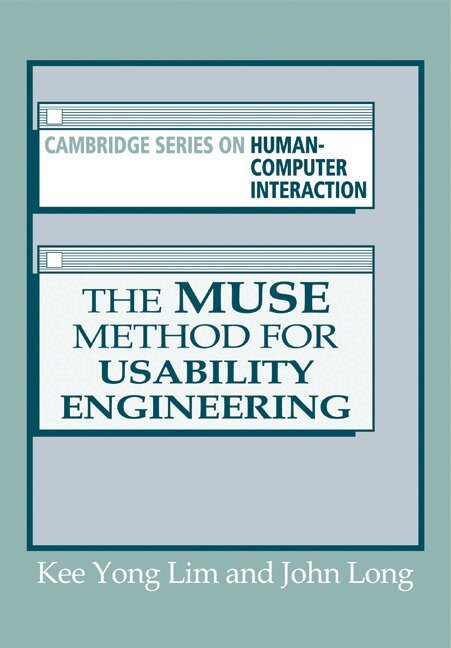
    The Muse Method for Usability Engineering

    AvKee Yong Lim,John B. Long

    Häftad, Engelska, 2009

    800 kr

    Beställningsvara. Skickas inom 10-15 vardagar. Fri frakt över 249 kr.

    Fler format och utgåvor

    Inbunden

    1 844 kr

    Beskrivning

    When this book was first published, recent aspects of human factors research had led to methodologies that integrated usability into the development of interactive systems. MUSE was one of the pioneering methods for Usability Engineering. It provides an environment in which human factors contributions can realise their full potential. MUSE supports active human factors involvement in both design specification and evaluation, and takes system development from user requirements to user interface design. Its methods describe how design errors can be avoided or rectified throughout system development, as well as showing how errors can be identified and providing support for inter-disciplinary design planning and coordination. It therefore ranks as one of the best developed and most completely structured human factors methods. This book reviews the motivation for developing MUSE, and provides readers with a manual for method application. It will be essential reading for all involved with systems development, whether from the HCI or software engineering communities, and can be used as well for course accompaniment.

    Produktinformation

    • Utgivningsdatum:2009-07-02
    • Mått:170 x 244 x 19 mm
    • Vikt:560 g
    • Format:Häftad
    • Språk:Engelska
    • Antal sidor:352
    • Förlag:Cambridge University Press
    • ISBN:9780521479998

    Utforska kategorier

    • Programmeringsböcker inom Data och IT
    • Människa – datorinteraktion inom Data och IT

    Recensioner i media

    "This extrapolation of a structured human factors method may mark a watershed in usability engineering approaches to design." John F. Meech and Raymond Devlin, Ergonomics

    Innehållsförteckning

    • Preface; Part I. The Need for a Structured Human Factors Method to Support System Development: 1. On human factors contributions to the development of interactive systems; Part II. Development and Overview of MUSE - A Structured Human Factors Method: 2. The development of MUSE; 3. An overview of MUSE; Part III. Detailed Account of MUSE - A Structured Human Factors Method: 4. The elicitation and analysis phase of MUSE; 5. The synthesis phase of MUSE; 6. The design specification phase of MUSE; Part IV. The Integration of Human Factors with Structured Software Engineering Methods: 7. Prerequisites and examples of the integration of human factors with structured software engineering methods; Part V. Synopsis: 8. Assessment and future development of MUSE and MUSE*/JSD; References; Glossary; Annexes; Bibliography; Index.