• Fri frakt över 249 kr
  • •
  • Snabba leveranser
  • •
  • Billiga böcker
Kundservice

Du är på sajten för privatpersoner.

Företag, bibliotek eller offentlig verksamhet?

Du handlar på classic.bokus.com, där alla dina funktioner finns intakta.
Till classic.bokus.com
Bokus logotyp. Gå till startsidan.
  • Erbjudanden
  • Nyheter
  • Student
  • Topplistor
  • Barn & ungdom
  • Bokus Play
  • E-böcker
  • Pocketböcker
  • Spel & pussel

10% rabatt på allt med kod NYSTART10 →

Sidfot

Mina sidor

    Hjälp

    • Kundservice
    • Vanliga frågor och svar
    • Frakt och leverans
    • Retur vid ångerrätt
    • Reklamera vara
    • Betalning
    • Köpvillkor
    • Allmänna villkor
    • Information om webbplatsens tillgänglighet

    Om Bokus

    • Om oss
    • Pressrum
    • För studenter
    • För företag
    • För bibliotek och offentlig verksamhet
    • För leverantörer
    • Hållbarhet

    Populärt

    • Aktuella erbjudanden
    • Presentkort
    • Studentlitteratur
    • Nya böcker
    • Topplistor
    • Signerade böcker
    • Engelska böcker

    Inspiration

    • Boktips
    • BookTok
    • Populära bokserier
    • Barnbokskaraktärer
    • Populära författare
    Logotyp för Bokus
    Följ oss på Facebook (extern länk)Följ oss på Instagram (extern länk)Följ oss på YouTube (extern länk)Följ oss på TikTok (extern länk)
    bokus @ CookiesAnpassa cookiesIntegritetspolicyKöpvillkor
    Till Citymail hemsida (extern länk)Till Budbee hemsida (extern länk)Till Postnord hemsida (extern länk)Till Schenker hemsida (extern länk)Till Early Bird hemsida (extern länk)Till Walleys hemsida (extern länk)
    1. Samhälle och politik
    2. Politik och statsskick

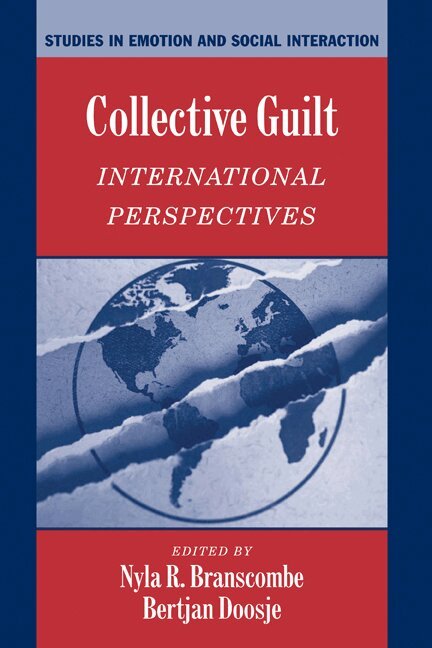
    Collective Guilt

    International Perspectives

    AvNyla R. Branscombe,Bertjan Doosje

    Häftad, Engelska, 2004

    Del i serien Studies in Emotion and Social Interaction

    584 kr

    Beställningsvara. Skickas inom 10-15 vardagar. Fri frakt över 249 kr.

    Beskrivning

    Emotion can result from interpreting group actions as reflecting on the self due to an association between the two. This volume considers the nature of collective guilt, the antecedent conditions necessary for it to be experienced, how it can be measured, as well as how collective guilt differs from other group based emotions. Research from Australia, Canada, Germany, Israel, the Netherlands, Northern Ireland, and the USA addresses critical questions concerning the who, when, and why of the experience of collective guilt. The political implications of collective guilt and forgiveness for the past are considered, and how those might depend on the national context. How collective guilt can be harnessed and used to create a more peaceful future for groups with a history of violence between then is emphasized.

    Produktinformation

    • Utgivningsdatum:2004-09-06
    • Mått:153 x 229 x 21 mm
    • Vikt:500 g
    • Format:Häftad
    • Språk:Engelska
    • Serie:Studies in Emotion and Social Interaction
    • Antal sidor:356
    • Förlag:Cambridge University Press
    • ISBN:9780521520836

    Utforska kategorier

    • Politik och statsskick inom Samhälle och politik

    Mer om författaren

    Nyla R. Branscombe is Professor of Psychology at University of Kansas. She is well known in the field of Intergroup Relations, with more than 75 articles and chapters published. She has been co-recipient of several major research awards from the Society of Personality and Social Psychology and the Society for the Psychological Study of Social Issues. Bertjan Doosje is Senior Lecturer at University of Amsterdam. His research has focused on group identification and its consequences for intergroup judgements. He currently serves on two journal editorial boards. He was co-recipient (with Branscombe) of the Society for the Psychological Study of Social Issues Otto Kleinberg award for Intercultural and Int. Relations prize in 1999.

    Recensioner i media

    "A decade or more ago, as researchers first recognized the key role of emotions in the ways groups deal with eaach other, the focus was naturally on emotions most obviously related to intergroup conflict, such as anger or fear. Now the conceptual focus has broadened to include a wider range of group-based emotions. Collective guilt is particularly interesting, because it can lead to prosocial behaviors (such as apologies or restitution to injured groups), but also can motivate people to turn a blind eye to their own groups's past misdeeds. This volume preseents research taking a variety of perspectives on collective guilt, addressing important issues in multiple national and historical contexts." Elliot R. Smith, Indiana University

    Innehållsförteckning

    • Part I. Defining the Nature of Collective Guilt: 1. International perspectives on the experience of collective guilt Nyla R. Branscombe and Bertjan Doosje; 2. The measurement of collective guilt: what it is and what it is not Nyla R. Branscombe, Ben Slugoski and Diane M. Kappen; 3. The evocation of moral emotions in intergroup contexts: the distinction between collective guilt and collective shame Brian Lickel, Toni Schmader and Marchelle Barquissau; 4. Collective guilt in the United States: predicting support for social policies that alleviate social injustice Robyn Mallet and Janet Swim; 5. Gender inequality and the intensity of men's collective guilt Michael T. Schmitt, Nyla R. Branscombe and Jack W. Brehm; Part II. The Relationship between Group Identification and Collective Guilt: 6. Consequences of national in-group identification for responses to immoral historical events Bertjan Doosje, Nyla R. Branscombe, Russell Spears and Antony S. R. Manstead; 7. Refining the meaning of the 'collective' in collective guilt: harm, guilt, and apology in Australia Craig McGarty and Ana-Maria Bliuc; 8. Who feels guilty? Collective guilt, moral outrage, exonerating cognitions, group identification and personal values among Jewish-Israelis Sonia Roccas, Yechiel Klar and Ido Liviatan; 9. It depends on your point of view: implications of perspective taking and national identification for Dutch collective guilt Sven Zebel, Bertjan Doosje and Russel Spears; 10. Collective guilt, national identity, and political processes in Germany Lars Rensmann; Part III. Consequences for Intergroup Relations: 11. Intergroup forgiveness and guilt in Northern Ireland: social psychological dimensions of 'The Troubles' Miles Hewstone, Ed Cairns, Alverto Voci, Frances McLernon, Ulrike Niens and Masi Noor; 12. Intergroup reconciliation processes in Israel: theoretical analysis and empirical findings Arie Nadler and Ido Liviatan; 13. On whether to apologise to indigenous Australians: the denial of white guilt Martha Augoustinos and Amanda LeCouteur; 14. Racial wrongs and restitutions: the role of guilt and other group based emotions Aarti Iyer, Colin W. Leach and Anne Pedersen; 15. Importance of social categorization for forgiveness and collective guilt assignment for the Holocaust Michael J. A. Wohl and Nyla R. Branscombe; 16. Individual versus group rights in Western philosophy and the law Elazar Barkan; 17. A social psychological process perspective on collective guilt Nyla R. Branscombe.