• Fri frakt över 249 kr
  • •
  • Snabba leveranser
  • •
  • Billiga böcker
Kundservice

Du är på sajten för privatpersoner.

Företag, bibliotek eller offentlig verksamhet?

Du handlar på classic.bokus.com, där alla dina funktioner finns intakta.
Till classic.bokus.com
Bokus logotyp. Gå till startsidan.
  • Erbjudanden
  • Nyheter
  • Student
  • Topplistor
  • Barn & ungdom
  • Bokus Play
  • E-böcker
  • Pocketböcker
  • Spel & pussel

Må bättre, för mindre! Upp till 50% rabatt på hälsoböcker

Sidfot

Mina sidor

    Hjälp

    • Kundservice
    • Vanliga frågor och svar
    • Frakt och leverans
    • Retur vid ångerrätt
    • Reklamera vara
    • Betalning
    • Köpvillkor
    • Allmänna villkor
    • Information om webbplatsens tillgänglighet

    Om Bokus

    • Om oss
    • Pressrum
    • För studenter
    • För företag
    • För bibliotek och offentlig verksamhet
    • För leverantörer
    • Hållbarhet

    Populärt

    • Aktuella erbjudanden
    • Presentkort
    • Studentlitteratur
    • Nya böcker
    • Topplistor
    • Signerade böcker
    • Engelska böcker

    Inspiration

    • Boktips
    • BookTok
    • Populära bokserier
    • Barnbokskaraktärer
    • Populära författare
    Logotyp för Bokus
    Följ oss på Facebook (extern länk)Följ oss på Instagram (extern länk)Följ oss på YouTube (extern länk)Följ oss på TikTok (extern länk)
    bokus @ CookiesAnpassa cookiesIntegritetspolicyKöpvillkor
    Till Citymail hemsida (extern länk)Till Budbee hemsida (extern länk)Till Postnord hemsida (extern länk)Till Schenker hemsida (extern länk)Till Early Bird hemsida (extern länk)Till Walleys hemsida (extern länk)
    1. Filosofi och religion
    2. Religion och tro
    3. Kristendom

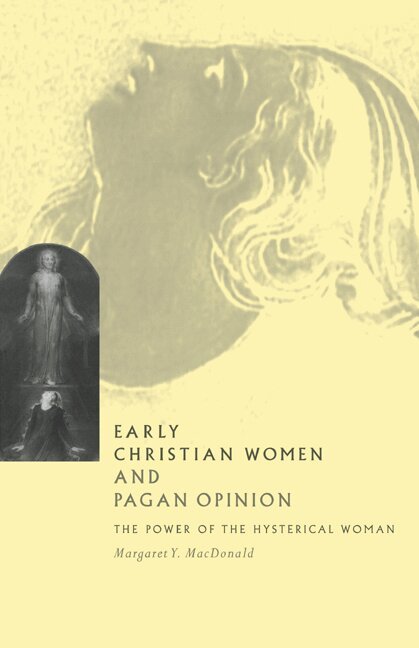
    Early Christian Women and Pagan Opinion

    The Power of the Hysterical Woman

    AvMargaret Y. MacDonald

    Inbunden, Engelska, 1996

    1 335 kr

    Beställningsvara. Skickas inom 10-15 vardagar. Fri frakt över 249 kr.

    Fler format och utgåvor

    Häftad

    463 kr

    Beskrivning

    This is a study of how women figured in public reaction to the church from New Testament times to Christianity's encounter with the pagan critics of the second century CE. The reference to a hysterical woman was made by the most prolific critic of Christianity, Celsus. He was referring to a follower of Jesus - probably Mary Magdalene - who was at the centre of efforts to create and promote belief in the resurrection. MacDonald draws attention to the conviction, emerging from the works of several pagan authors, that female initiative was central to Christianity's development; she sets out to explore the relationship between this and the common Greco-Roman belief that women were inclined towards excesses in religion. The findings of cultural anthropologists of Mediterranean societies are examined in an effort to probe the societal values that shaped public opinion and early church teaching. Concerns expressed in New Testament and early Christian texts about the respectability of women, and even generally about their behaviour, are seen in a new light when one appreciates that outsiders focused on early church women and understood their activities as a reflection of the group as a whole.

    Produktinformation

    • Utgivningsdatum:1996-10-03
    • Mått:142 x 223 x 20 mm
    • Vikt:520 g
    • Format:Inbunden
    • Språk:Engelska
    • Antal sidor:292
    • Förlag:Cambridge University Press
    • ISBN:9780521561747

    Utforska kategorier

    • Kristendom inom Filosofi och religion

    Recensioner i media

    "This sensitively written and subtly argues book sheds new light on the position of women in early Christianity by investigating the stereotypes of Christian women purveyed in pagan and early Christian texts through the lens of social-scientific models of gender relations." University of Toronto Quarterly

    Innehållsförteckning

    • Introduction: 1. Defining the task; 2. Women's studies in early Christianity and cultural anthropology; 3. Honour and shame; 4. Public, male/ private, female; 5. A social-scientific concept of power; Part I. Pagan Reaction to Early Christian Women in the Second Century CE: 1. Pliny; 2. Marcus Cornelius Fronto; 3. Lucius Apuleius; 4. Lucian of Samosata; 5. Galen of Pergamum; 6. Celsus; 7. Conclusion; Part II. Celibacy, Women, and Early Church Responses to Public Opinion: 1. Paul's teaching on marriage as a 'conversionist' response to the world; 2. Paul's focus on women holy in body and spirit in 1 Corinthians 7; 3. A focus on women in light of the values of honor and shame; 4. 1 Timothy 5.3-16 - second-century celibate women under public scrutiny; 5. When the private becomes public - contacts between 1 Timothy 5.3-16 and the Acts of Paul and Thecla; Part III. Marriage, Women, and Early Church Responses to Public Opinion: 1.1 Corinthians 7.12-16 - the evangelising potential of household relations; 2. 1 Peter 3.1-16 - recovering the lives of the quiet evangelists; 3. Justin's woman married to an unchaste husband - religious sensiblities and life with a pagan husband; 4. Married life and the social reality of women in the communities of Ignatius of Antioch; 5. From Ephesians 5.21-33 to Ignatius, Letter to Polycarp 5.1-2 - the evolution of authority structures governing the lives of married women; 6. The church-bride and married women as mediators between the church and the world; 7. Conclusion; General conclusion.