• Fri frakt över 249 kr
  • •
  • Snabba leveranser
  • •
  • Billiga böcker
Kundservice

Du är på sajten för privatpersoner.

Företag, bibliotek eller offentlig verksamhet?

Du handlar på classic.bokus.com, där alla dina funktioner finns intakta.
Till classic.bokus.com
Bokus logotyp. Gå till startsidan.
  • Erbjudanden
  • Nyheter
  • Student
  • Topplistor
  • Barn & ungdom
  • Bokus Play
  • E-böcker
  • Pocketböcker
  • Spel & pussel

10% rabatt på allt med kod: NYSTART10 →

Sidfot

Mina sidor

    Hjälp

    • Kundservice
    • Vanliga frågor och svar
    • Frakt och leverans
    • Retur vid ångerrätt
    • Reklamera vara
    • Betalning
    • Köpvillkor
    • Allmänna villkor
    • Information om webbplatsens tillgänglighet

    Om Bokus

    • Om oss
    • Pressrum
    • För studenter
    • För företag
    • För bibliotek och offentlig verksamhet
    • För leverantörer
    • Hållbarhet

    Populärt

    • Aktuella erbjudanden
    • Presentkort
    • Studentlitteratur
    • Nya böcker
    • Topplistor
    • Signerade böcker
    • Engelska böcker

    Inspiration

    • Boktips
    • BookTok
    • Populära bokserier
    • Barnbokskaraktärer
    • Populära författare
    Logotyp för Bokus
    Följ oss på Facebook (extern länk)Följ oss på Instagram (extern länk)Följ oss på YouTube (extern länk)Följ oss på TikTok (extern länk)
    bokus @ CookiesAnpassa cookiesIntegritetspolicyKöpvillkor
    Till Citymail hemsida (extern länk)Till Budbee hemsida (extern länk)Till Postnord hemsida (extern länk)Till Schenker hemsida (extern länk)Till Early Bird hemsida (extern länk)Till Walleys hemsida (extern länk)
    1. Språk och ordböcker
    2. Språkvetenskap och lingvistik

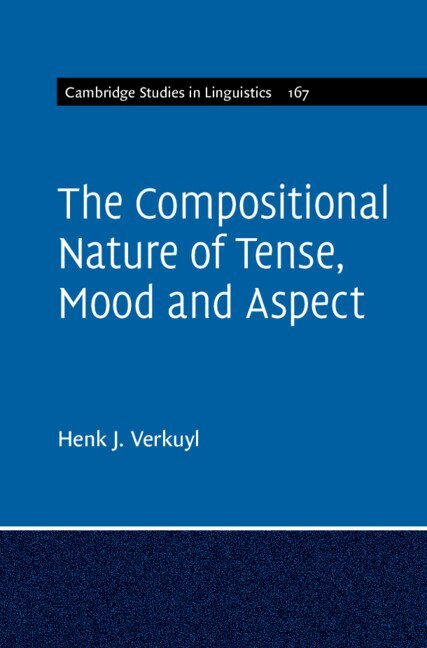
    A Theory of Aspectuality

    The Interaction between Temporal and Atemporal Structure

    AvHenk J. Verkuyl

    Häftad, Engelska, 1996

    Del 64 i serien Cambridge Studies in Linguistics

    767 kr

    Beställningsvara. Skickas inom 10-15 vardagar. Fri frakt över 249 kr.

    Beskrivning

    Sentences may pertain to states or processes or events. They may express duration, frequency, habituality, and many other forms of temporality. How do they do this? It is the aspectual properties of sentences in natural languages which allow the user to express a temporal structure, and Henk Verkuyl presents a unified formal system to account for them. He explains aspectuality in terms of the opposition between terminative aspect and durative aspect, and describes the way in which terminative aspect is compositionally formed on the basis of semantic information expressed by different syntactic elements, in particular the verb and its arguments. The aim is to determine which semantic conditions make a sentence terminative; but at least ten different forms of durative aspectuality are also treated. All are drawn into a theory which can account for both terminative and durative aspectuality together. A Theory of Aspectuality draws together into a coherent whole the author's thinking on the subject over the last twenty years, and will interest all those working on aspect and the semantics of noun phrases. It promises to be a major new contribution to our understanding of the subject.

    Produktinformation

    • Utgivningsdatum:1996-05-30
    • Mått:154 x 228 x 27 mm
    • Vikt:675 g
    • Format:Häftad
    • Språk:Engelska
    • Serie:Cambridge Studies in Linguistics
    • Antal sidor:412
    • Förlag:Cambridge University Press
    • ISBN:9780521564526

    Utforska kategorier

    • Språkvetenskap och lingvistik inom Språk och ordböcker

    Recensioner i media

    ' … thoroughly and convincingly argued … [it] deserves to be on the reading list of every semanticist.' Journal of Linguistics

    Innehållsförteckning

    • Part I. Issues of Compositionality: 1. The plus-principle; 2. Aspectual classes and aspectual composition; Part II. Noun Phrase Structure: 3. The tools of generalised quantification; 4. In search of SQA; 5. Numerals and quantifiers: one level up; 6. Some problems of prenominal NP structure; 7. Determiner structure; 8. Some explorative issues; Part III. Temporal Structure: 9. Homogeneity; 10. Localism and additive structure; 11. Event semantics and aspect construal; 12. Aspect and perspective; 13. Event construal; 14. Testing the plus-principle; Conclusion; Notes; References; Index.