• Fri frakt över 249 kr
  • •
  • Snabba leveranser
  • •
  • Billiga böcker
Kundservice

Du är på sajten för privatpersoner.

Företag, bibliotek eller offentlig verksamhet?

Du handlar på classic.bokus.com, där alla dina funktioner finns intakta.
Till classic.bokus.com
Bokus logotyp. Gå till startsidan.
  • Erbjudanden
  • Student
  • Topplistor
  • Barn & ungdom
  • Bokus Play
  • E-böcker
  • Ljudböcker
  • Pocketböcker
  • Spel & pussel

10% rabatt på allt med kod NYSTART10 →

Sidfot

Mina sidor

    Hjälp

    • Kundservice
    • Vanliga frågor och svar
    • Frakt och leverans
    • Retur vid ångerrätt
    • Reklamera vara
    • Betalning
    • Köpvillkor
    • Allmänna villkor
    • Information om webbplatsens tillgänglighet

    Om Bokus

    • Om oss
    • Pressrum
    • För studenter
    • För företag
    • För bibliotek och offentlig verksamhet
    • För leverantörer
    • Hållbarhet

    Populärt

    • Aktuella erbjudanden
    • Presentkort
    • Studentlitteratur
    • Nya böcker
    • Topplistor
    • Signerade böcker
    • Engelska böcker

    Inspiration

    • Boktips
    • BookTok
    • Populära bokserier
    • Barnbokskaraktärer
    • Populära författare
    Logotyp för Bokus
    Följ oss på Facebook (extern länk)Följ oss på Instagram (extern länk)Följ oss på YouTube (extern länk)Följ oss på TikTok (extern länk)
    bokus @ CookiesAnpassa cookiesIntegritetspolicyKöpvillkor
    Till Citymail hemsida (extern länk)Till Budbee hemsida (extern länk)Till Postnord hemsida (extern länk)Till Schenker hemsida (extern länk)Till Early Bird hemsida (extern länk)Till Walleys hemsida (extern länk)
    1. Samhälle och politik
    2. Politik och statsskick
    3. Internationella relationer

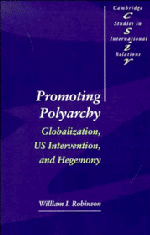
    Promoting Polyarchy

    Globalization, US Intervention, and Hegemony

    AvWilliam I. Robinson

    Häftad, Engelska, 1996

    Del 48 i serien Cambridge Studies in International Relations

    624 kr

    Beställningsvara. Skickas inom 7-10 vardagar. Fri frakt över 249 kr.

    Beskrivning

    Promoting Polyarchy is an exciting, detailed, and controversial work on the apparent change in US foreign policy from supporting dictatorships to an 'open' promotion of 'democratic' regimes. William I. Robinson argues that behind the façade of 'democracy promotion', the policy is designed more to retain the elite-based and undemocratic status quo of Third World countries than to encourage mass aspirations for democratization. He supports this challenging argument with a wealth of information garnered from field work and hitherto unpublished government documents, and assembled in case studies of the Philippines, Chile, Nicaragua, Haiti, South Africa, and the former Soviet Bloc. With its combination of theoretical and historical analysis, empirical argument, and bold claims, Promoting Polyarchy is an essential book for anyone concerned with democracy, globalization and international affairs.

    Produktinformation

    • Utgivningsdatum:1996-08-22
    • Mått:153 x 227 x 32 mm
    • Vikt:790 g
    • Format:Häftad
    • Språk:Engelska
    • Serie:Cambridge Studies in International Relations
    • Antal sidor:488
    • Förlag:Cambridge University Press
    • ISBN:9780521566919

    Utforska kategorier

    • Internationella relationer inom Samhälle och politik

    Recensioner i media

    'In Promoting Polyarchy William Robinson, building on a formidable array of local knowledge and theoretical reflection, makes the bold argument that democracy promotion in US foreign policy is best explained in terms of the pluralist idea of polyarchy and that this restricted conception of democracy serves the interests of an increasingly transnational elite. ... The logic of the analysis and the power of his case studies represent a challenge that complacent pluralists and those sceptical of globalization should not ignore.' Leslie Sklair, The London School of Economics and Political Science

    Innehållsförteckning

    • Introduction: from East-West to North-South: US intervention in the 'new world order'; 1. From 'straight power concepts' to 'persuasion' in US foreign policy; 2. Political operations in US foreign policy; 3. The Philippines: 'molded in the image of American democracy'; 4. Chile: ironing out a 'Fluke' of the political system; 5. Nicaragua: from low-intensity warfare to low-intensity democracy; 6. Haiti: the 'practically insolvable problem' of establishing consensual domination; 7. Conclusions: the future of polyarchy and global society.