• Fri frakt över 249 kr
  • •
  • Snabba leveranser
  • •
  • Billiga böcker
Kundservice

Du är på sajten för privatpersoner.

Företag, bibliotek eller offentlig verksamhet?

Du handlar på classic.bokus.com, där alla dina funktioner finns intakta.
Till classic.bokus.com
Bokus logotyp. Gå till startsidan.
  • Erbjudanden
  • Nyheter
  • Student
  • Topplistor
  • Barn & ungdom
  • Bokus Play
  • E-böcker
  • Pocketböcker
  • Spel & pussel

Må bättre, för mindre! Upp till 50% rabatt på hälsoböcker

Sidfot

Mina sidor

    Hjälp

    • Kundservice
    • Vanliga frågor och svar
    • Frakt och leverans
    • Retur vid ångerrätt
    • Reklamera vara
    • Betalning
    • Köpvillkor
    • Allmänna villkor
    • Information om webbplatsens tillgänglighet

    Om Bokus

    • Om oss
    • Pressrum
    • För studenter
    • För företag
    • För bibliotek och offentlig verksamhet
    • För leverantörer
    • Hållbarhet

    Populärt

    • Aktuella erbjudanden
    • Presentkort
    • Studentlitteratur
    • Nya böcker
    • Topplistor
    • Signerade böcker
    • Engelska böcker

    Inspiration

    • Boktips
    • BookTok
    • Populära bokserier
    • Barnbokskaraktärer
    • Populära författare
    Logotyp för Bokus
    Följ oss på Facebook (extern länk)Följ oss på Instagram (extern länk)Följ oss på YouTube (extern länk)Följ oss på TikTok (extern länk)
    bokus @ CookiesAnpassa cookiesIntegritetspolicyKöpvillkor
    Till Citymail hemsida (extern länk)Till Budbee hemsida (extern länk)Till Postnord hemsida (extern länk)Till Schenker hemsida (extern länk)Till Early Bird hemsida (extern länk)Till Walleys hemsida (extern länk)
    1. Filosofi och religion
    2. Filosofi

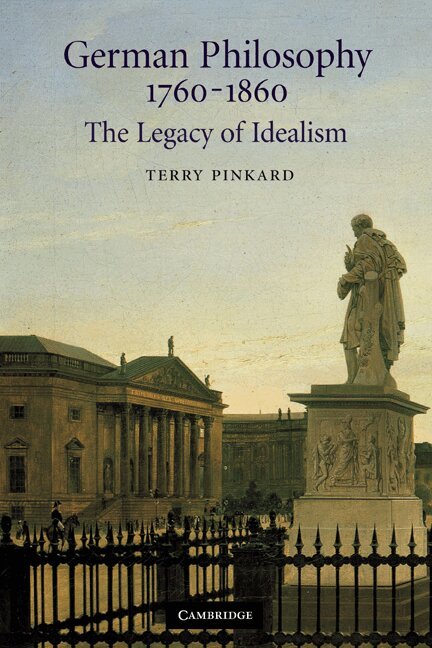
    German Philosophy 1760-1860

    The Legacy of Idealism

    AvTerry Pinkard

    Inbunden, Engelska, 2002

    1 315 kr

    Beställningsvara. Skickas inom 10-15 vardagar. Fri frakt över 249 kr.

    Fler format och utgåvor

    Häftad

    561 kr

    Beskrivning

    In the second half of the eighteenth century, German philosophy came for a while to dominate European philosophy. It changed the way in which not only Europeans, but people all over the world, conceived of themselves and thought about nature, religion, human history, politics, and the structure of the human mind. In this rich and wide-ranging book, Terry Pinkard interweaves the story of 'Germany' - changing during this period from a loose collection of principalities into a newly-emerged nation with a distinctive culture - with an examination of the currents and complexities of its developing philosophical thought. He examines the dominant influence of Kant, with his revolutionary emphasis on 'self-determination', and traces this influence through the development of romanticism and idealism to the critiques of post-Kantian thinkers such as Schopenhauer and Kierkegaard. His book will interest a range of readers in the history of philosophy, cultural history and the history of ideas.

    Produktinformation

    • Utgivningsdatum:2002-08-29
    • Mått:159 x 236 x 30 mm
    • Vikt:740 g
    • Format:Inbunden
    • Språk:Engelska
    • Antal sidor:396
    • Förlag:Cambridge University Press
    • ISBN:9780521663267

    Utforska kategorier

    • Filosofi inom Filosofi och religion

    Mer om författaren

    Terry Pinkard is Professor of Philosophy at Northwestern University. His most recent book is Hegel: A Biography (Cambridge, 2001).

    Recensioner i media

    "Pinkard does an incredible job of explaining Hegel's strictly philosophical ideas and largely overcomes the barrier of Hegel's notoriously obscure style." The New York Times Book Review

    Innehållsförteckning

    • Introduction: 'Germany' and German philosophy; Part I. Kant and the Revolution in Philosophy: 1. The revolution in philosophy I: Human spontaneity and the natural order; 2. The revolution in philosophy II: Autonomy and the moral order; 3. The revolution in philosophy III: Aesthetic taste, teleology, and the world order; Part II. The Revolution Continued: Post-Kantians: 4. The 1780s: the immediate post-Kantian reaction: Jacobi and Reinhold; 5. The 1790s: Fichte; 6. The 1790s after Fichte: The romantic appropriation of Kant I: Hölderlin, Novalis, Schleiermacher, Schlegel; 7. 1795–1809: The romantic appropriation of Kant II: Schelling; 8. 1801–7: The other post-Kantian: Jacob Friedrich Fries and non-romantic sentimentalism; Part III. The Revolution Completed? Hegel: 9. Hegel's Phenomenology of Spirit: post-Kantianism in a new vein; 10. Hegel's analysis of mind and world: the Science of Logic; 11. Nature and spirit: Hegel's system; Part IV. The Revolution in Question: 12. Schelling's attempt at restoration: idealism under review; 13. Kantian paradoxes and modern despair: Schopenhauer and Kierkegaard; Conclusion. The legacy of idealism.