• Fri frakt över 249 kr
  • •
  • Snabba leveranser
  • •
  • Billiga böcker
Kundservice

Du är på sajten för privatpersoner.

Företag, bibliotek eller offentlig verksamhet?

Du handlar på classic.bokus.com, där alla dina funktioner finns intakta.
Till classic.bokus.com
Bokus logotyp. Gå till startsidan.
  • Erbjudanden
  • Nyheter
  • Student
  • Topplistor
  • Barn & ungdom
  • Bokus Play
  • E-böcker
  • Pocketböcker
  • Spel & pussel

10% rabatt på allt med kod NYSTART10 →

Sidfot

Mina sidor

    Hjälp

    • Kundservice
    • Vanliga frågor och svar
    • Frakt och leverans
    • Retur vid ångerrätt
    • Reklamera vara
    • Betalning
    • Köpvillkor
    • Allmänna villkor
    • Information om webbplatsens tillgänglighet

    Om Bokus

    • Om oss
    • Pressrum
    • För studenter
    • För företag
    • För bibliotek och offentlig verksamhet
    • För leverantörer
    • Hållbarhet

    Populärt

    • Aktuella erbjudanden
    • Presentkort
    • Studentlitteratur
    • Nya böcker
    • Topplistor
    • Signerade böcker
    • Engelska böcker

    Inspiration

    • Boktips
    • BookTok
    • Populära bokserier
    • Barnbokskaraktärer
    • Populära författare
    Logotyp för Bokus
    Följ oss på Facebook (extern länk)Följ oss på Instagram (extern länk)Följ oss på YouTube (extern länk)Följ oss på TikTok (extern länk)
    bokus @ CookiesAnpassa cookiesIntegritetspolicyKöpvillkor
    Till Citymail hemsida (extern länk)Till Budbee hemsida (extern länk)Till Postnord hemsida (extern länk)Till Schenker hemsida (extern länk)Till Early Bird hemsida (extern länk)Till Walleys hemsida (extern länk)
    1. Ekonomi och Ledarskap
    2. Nationalekonomi

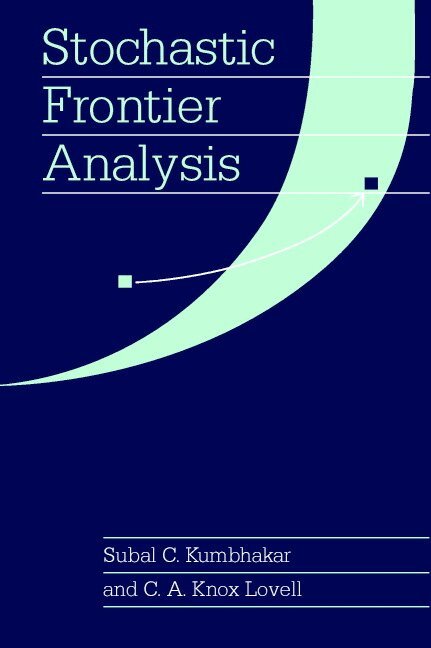
    Stochastic Frontier Analysis

    AvSubal C. Kumbhakar,C. A. Knox Lovell

    Häftad, Engelska, 2003

    588 kr

    Beställningsvara. Skickas inom 10-15 vardagar. Fri frakt över 249 kr.

    Beskrivning

    Modern textbook presentations of production economics typically treat producers as successful optimizers. Conventional econometric practice has generally followed this paradigm, and least squares based regression techniques have been used to estimate production, cost, profit and other functions. In such a framework deviations from maximum output, from minimum cost and cost minimizing input demands, and from maximum profit and profit maximizing output supplies and input demands, are attributed exclusively to random statistical noise. However casual empiricism and the business press both make persuasive cases for the argument that, although producers may indeed attempt to optimize, they do not always succeed. This book develops econometric techniques for the estimation of production, cost and profit frontiers, and for the estimation of the technical and economic efficiency with which producers approach these frontiers. Since these frontiers envelop rather than intersect the data, and since the authors continue to maintain the traditional econometric belief in the presence of external forces contributing to random statistical noise, the work is titled Stochastic Frontier Analysis.

    Produktinformation

    • Utgivningsdatum:2003-03-10
    • Mått:153 x 228 x 21 mm
    • Vikt:455 g
    • Format:Häftad
    • Språk:Engelska
    • Antal sidor:344
    • Förlag:Cambridge University Press
    • ISBN:9780521666633

    Utforska kategorier

    • Nationalekonomi inom Ekonomi och Ledarskap

    Recensioner i media

    'Stochastic Frontier Analysis is an excellent, up-to-date and complete summary of both the theory and techniques used in frontier production, cost and profit analysis. The authors are two of the leading researchers in the field. Students and practitioners in this area will find this book to be the only reference source they need.' William H. Greene, Stern School of Business, New York University

    Innehållsförteckning

    • 1. Introduction; 2. Analytical foundations; 3. The estimation of technical efficiency; 4. The estimation and decomposition of cost efficiency; 5. The estimation and decomposition of profit efficiency; 6. The shadow price approach to the estimation and decomposition of economic efficiency; 7. Incorporating exogenous influences on efficiency; 8. The estimation of efficiency change and productivity change.