• Fri frakt över 249 kr
  • •
  • Snabba leveranser
  • •
  • Billiga böcker
Kundservice

Du är på sajten för privatpersoner.

Företag, bibliotek eller offentlig verksamhet?

Du handlar på classic.bokus.com, där alla dina funktioner finns intakta.
Till classic.bokus.com
Bokus logotyp. Gå till startsidan.
  • Erbjudanden
  • Nyheter
  • Student
  • Topplistor
  • Barn & ungdom
  • Bokus Play
  • E-böcker
  • Pocketböcker
  • Spel & pussel

10% rabatt på allt med kod NYSTART10 →

Sidfot

Mina sidor

    Hjälp

    • Kundservice
    • Vanliga frågor och svar
    • Frakt och leverans
    • Retur vid ångerrätt
    • Reklamera vara
    • Betalning
    • Köpvillkor
    • Allmänna villkor
    • Information om webbplatsens tillgänglighet

    Om Bokus

    • Om oss
    • Pressrum
    • För studenter
    • För företag
    • För bibliotek och offentlig verksamhet
    • För leverantörer
    • Hållbarhet

    Populärt

    • Aktuella erbjudanden
    • Presentkort
    • Studentlitteratur
    • Nya böcker
    • Topplistor
    • Signerade böcker
    • Engelska böcker

    Inspiration

    • Boktips
    • BookTok
    • Populära bokserier
    • Barnbokskaraktärer
    • Populära författare
    Logotyp för Bokus
    Följ oss på Facebook (extern länk)Följ oss på Instagram (extern länk)Följ oss på YouTube (extern länk)Följ oss på TikTok (extern länk)
    bokus @ CookiesAnpassa cookiesIntegritetspolicyKöpvillkor
    Till Citymail hemsida (extern länk)Till Budbee hemsida (extern länk)Till Postnord hemsida (extern länk)Till Schenker hemsida (extern länk)Till Early Bird hemsida (extern länk)Till Walleys hemsida (extern länk)
    1. Data och IT
    2. Programmeringsböcker
    3. Programvaruutveckling

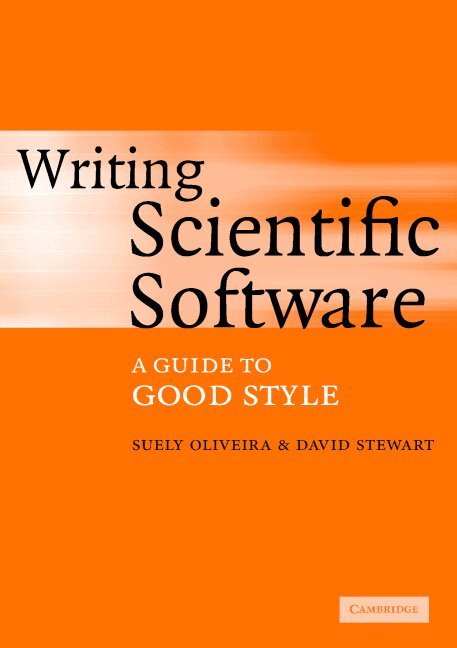
    Writing Scientific Software

    A Guide to Good Style

    AvSuely Oliveira,David E. Stewart

    Häftad, Engelska, 2006

    707 kr

    Beställningsvara. Skickas inom 10-15 vardagar. Fri frakt över 249 kr.

    Beskrivning

    The core of scientific computing is designing, writing, testing, debugging and modifying numerical software for application to a vast range of areas: from graphics, meteorology and chemistry to engineering, biology and finance. Scientists, engineers and computer scientists need to write good code, for speed, clarity, flexibility and ease of re-use. Oliveira and Stewart's style guide for numerical software points out good practices to follow, and pitfalls to avoid. By following their advice, readers will learn how to write efficient software, and how to test it for bugs, accuracy and performance. Techniques are explained with a variety of programming languages, and illustrated with two extensive design examples, one in Fortran 90 and one in C++: other examples in C, C++, Fortran 90 and Java are scattered throughout the book. This manual of scientific computing style will be an essential addition to the bookshelf and lab of everyone who writes numerical software.

    Produktinformation

    • Utgivningsdatum:2006-09-07
    • Mått:246 x 174 x 16 mm
    • Vikt:549 g
    • Format:Häftad
    • Språk:Engelska
    • Antal sidor:316
    • Förlag:Cambridge University Press
    • ISBN:9780521675956

    Utforska kategorier

    • Programvaruutveckling inom Data och IT

    Mer om författaren

    Suely Oliveira is Associate Professor of Computer Science at the University of Iowa. David Stewart is an Associate Professor in the Department of Mathematics at the University of Iowa.

    Recensioner i media

    'Writing Scientific Software bridges the chasm that too often separates numerical analysis from real scientific computing. It is full of tips, tricks, and just plain interesting information. The reader will learn how to write code that takes advantage of many hidden features in modern computer architectures, programming languages, and compilers. This is a book that is full of good sense.' William H. Press, author of Numerical Recipes

    Innehållsförteckning

    • Part I. Numerical Software: 1. Why numerical software?; 2. Scientific computation and numerical analysis; 3. Priorities; 4. Famous disasters; 5. Exercises; Part II. Developing Software: 6. Basics of computer organization; 7. Software design; 8. Modularity and all that; 9. Data structures; 10. Design for testing and debugging; 11. Exercises; Part III. Efficiency in Time, Efficiency in Memory: 12. Be algorithm aware; 13. Computer architecture and efficiency; 14. Global vs. local optimization; 15. Grabbing memory when you need it; 16. Memory bugs and leaks; Part IV. Tools: 17. Sources of scientific software; 18. Unix tools; 19. Cubic spline function library; 20. Multigrid algorithms; Appendix A: review of vectors and matrices; Appendix B: trademarks; Bibliography; Index.