• Fri frakt över 249 kr
  • •
  • Snabba leveranser
  • •
  • Billiga böcker
Kundservice

Du är på sajten för privatpersoner.

Företag, bibliotek eller offentlig verksamhet?

Du handlar på classic.bokus.com, där alla dina funktioner finns intakta.
Till classic.bokus.com
Bokus logotyp. Gå till startsidan.
  • Erbjudanden
  • Student
  • Topplistor
  • Barn & ungdom
  • Bokus Play
  • E-böcker
  • Ljudböcker
  • Pocketböcker
  • Spel och pussel

Pocketfynda! Hundratals böcker för 49 kr/st →

Sidfot

Mina sidor

    Hjälp

    • Kundservice
    • Vanliga frågor och svar
    • Frakt och leverans
    • Retur vid ångerrätt
    • Reklamera vara
    • Betalning
    • Köpvillkor
    • Allmänna villkor
    • Information om webbplatsens tillgänglighet

    Om Bokus

    • Om oss
    • Pressrum
    • För studenter
    • För företag
    • För bibliotek och offentlig verksamhet
    • För leverantörer
    • Hållbarhet

    Populärt

    • Aktuella erbjudanden
    • Presentkort
    • Studentlitteratur
    • Nya böcker
    • Topplistor
    • Signerade böcker
    • Engelska böcker

    Inspiration

    • Boktips
    • BookTok
    • Barnbokskaraktärer
    • Populära författare
    Logotyp för Bokus
    Följ oss på Facebook (extern länk)Följ oss på Instagram (extern länk)Följ oss på YouTube (extern länk)Följ oss på TikTok (extern länk)
    bokus @ CookiesAnpassa cookiesIntegritetspolicyKöpvillkor
    Till Citymail hemsida (extern länk)Till Budbee hemsida (extern länk)Till Postnord hemsida (extern länk)Till Schenker hemsida (extern länk)Till Early Bird hemsida (extern länk)Till Walleys hemsida (extern länk)
    1. Språk och ordböcker
    2. Språkvetenskap och lingvistik

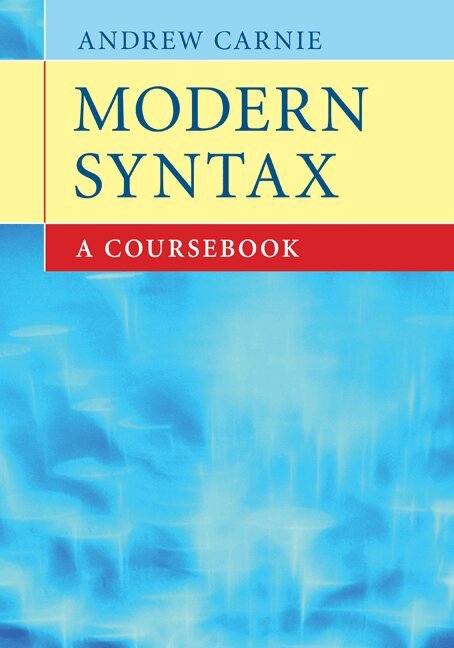
    Modern Syntax

    A Coursebook

    AvAndrew Carnie

    Häftad, Engelska, 2011

    470 kr

    Beställningsvara. Skickas inom 7-10 vardagar. Fri frakt över 249 kr.

    Fler format och utgåvor

    Inbunden

    1 042 kr

    Beskrivning

    This practical coursebook introduces all the basics of modern syntactic analysis in a simple step-by-step fashion. Each unit is constructed so that the reader discovers new ideas, formulates hypotheses and practises fundamentals. The reader is presented with short sections of explanation with examples, followed by practice exercises. Feedback and comment sections follow to enable students to monitor their progress. No previous background in syntax is assumed. Students move through all the key topics in the field including features, rules of combination and displacement, empty categories, and subcategorization. The theoretical perspective in this work is unique, drawing together the best ideas from three major syntactic frameworks (minimalism, HPSG and LFG). Students using this book will learn fundamentals in such a way that they can easily go on to pursue further study in any of these frameworks.

    Produktinformation

    • Utgivningsdatum:2011-01-13
    • Mått:174 x 247 x 18 mm
    • Vikt:740 g
    • Format:Häftad
    • Språk:Engelska
    • Antal sidor:370
    • Förlag:Cambridge University Press
    • ISBN:9780521682046

    Utforska kategorier

    • Språkvetenskap och lingvistik inom Språk och ordböcker

    Mer om författaren

    Andrew Carnie is Professor of Linguistics at the University of Arizona, where he teaches syntactic theory and Celtic linguistics. His previous publications include Constituent Structure, Second Edition (2010), Irish Nouns (2008) and Syntax: A Generative Introduction, Second Edition (2006).

    Recensioner i media

    'An ideal point of entry into the complex and challenging science of natural language syntax. Highly recommended.' Cedric Boeckx, ICREA and Universitat Autònoma de Barcelona

    Innehållsförteckning

    • Part I. Basic Ideas in Syntax: 1. Defining syntax; 2. Syntactic data; 3. Hypotheses: rules; Part II. Categories and Subcategories: 4. Words and lexical categories; 5. Functional categories; 6. Pronouns; 7. Other subcategories of nouns; 8. Subcategories of verbs; 9. Tangent: tense, aspect and mood; 10. Auxiliaries; Part III. Constituents, Merge and Trees: 11. Constituency; 12. Complements; 13. Complements: a case study; 14. Specifiers of VP and TP; 15. Specifiers of NP and DP; 16. Tagging; 17. Adjuncts; 18. Drawing trees; Part IV. Movement and Control: 19. Passives; 20. Non-finite clauses 1: control constructions; 21. Non-finite clauses 1: raising constructions; 22. Head movement 1: auxiliaries; 23. Head movement 2: main verbs; 24. Wh-movement; Part V. Conclusions and Appendices: 25. Evaluating our progress; 26. The next steps; Appendix 1. Glossary, symbols and abbreviations; Appendix 2. Features and their values; Appendix 3. Rules, constraints and principles.