• Fri frakt över 249 kr
  • •
  • Snabba leveranser
  • •
  • Billiga böcker
Kundservice

Du är på sajten för privatpersoner.

Företag, bibliotek eller offentlig verksamhet?

Du handlar på classic.bokus.com, där alla dina funktioner finns intakta.
Till classic.bokus.com
Bokus logotyp. Gå till startsidan.
  • Erbjudanden
  • Nyheter
  • Student
  • Topplistor
  • Barn & ungdom
  • Bokus Play
  • E-böcker
  • Pocketböcker
  • Spel & pussel

10% rabatt på allt med kod: NYSTART10 →

Sidfot

Mina sidor

    Hjälp

    • Kundservice
    • Vanliga frågor och svar
    • Frakt och leverans
    • Retur vid ångerrätt
    • Reklamera vara
    • Betalning
    • Köpvillkor
    • Allmänna villkor
    • Information om webbplatsens tillgänglighet

    Om Bokus

    • Om oss
    • Pressrum
    • För studenter
    • För företag
    • För bibliotek och offentlig verksamhet
    • För leverantörer
    • Hållbarhet

    Populärt

    • Aktuella erbjudanden
    • Presentkort
    • Studentlitteratur
    • Nya böcker
    • Topplistor
    • Signerade böcker
    • Engelska böcker

    Inspiration

    • Boktips
    • BookTok
    • Populära bokserier
    • Barnbokskaraktärer
    • Populära författare
    Logotyp för Bokus
    Följ oss på Facebook (extern länk)Följ oss på Instagram (extern länk)Följ oss på YouTube (extern länk)Följ oss på TikTok (extern länk)
    bokus @ CookiesAnpassa cookiesIntegritetspolicyKöpvillkor
    Till Citymail hemsida (extern länk)Till Budbee hemsida (extern länk)Till Postnord hemsida (extern länk)Till Schenker hemsida (extern länk)Till Early Bird hemsida (extern länk)Till Walleys hemsida (extern länk)
    1. Ekonomi och Ledarskap
    2. Nationalekonomi

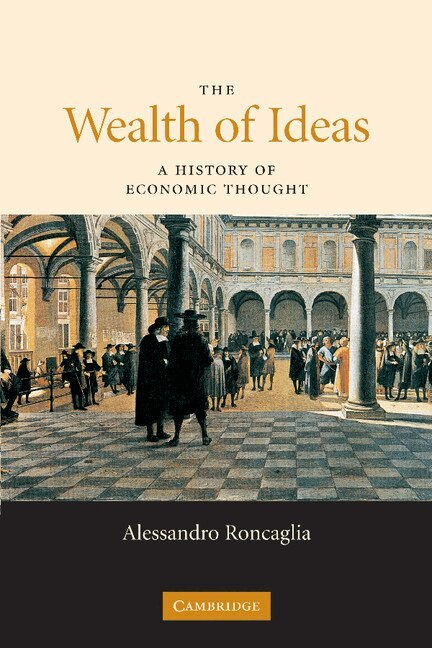
    The Wealth of Ideas

    A History of Economic Thought

    AvAlessandro Roncaglia

    Häftad, Engelska, 2006

    463 kr

    Beställningsvara. Skickas inom 10-15 vardagar. Fri frakt över 249 kr.

    Beskrivning

    The Wealth of Ideas, first published in 2005, traces the history of economic thought, from its prehistory (the Bible, Classical antiquity) to the present day. In this eloquently written, scientifically rigorous and well documented book, chapters on William Petty, Adam Smith, David Ricardo, Karl Marx, William Stanley Jevons, Carl Menger, Léon Walras, Alfred Marshall, John Maynard Keynes, Joseph Schumpeter and Piero Sraffa alternate with chapters on other important figures and on debates of the period. Economic thought is seen as developing between two opposite poles: a subjective one, based on the ideas of scarcity and utility, and an objective one based on the notions of physical costs and surplus. Professor Roncaglia focuses on the different views of the economy and society and on their evolution over time and critically evaluates the foundations of the scarcity-utility approach in comparison with the Classical/Keynesian approach.

    Produktinformation

    • Utgivningsdatum:2006-11-30
    • Mått:153 x 226 x 32 mm
    • Vikt:968 g
    • Format:Häftad
    • Språk:Engelska
    • Antal sidor:598
    • Förlag:Cambridge University Press
    • ISBN:9780521691871

    Utforska kategorier

    • Nationalekonomi inom Ekonomi och Ledarskap

    Mer om författaren

    Alessandro Roncaglia is Professor of Economics in the Department of Economic Sciences, University of Rome 'La Sapienza'. He is a member of the Accademia Nazionale dei Lincei and editor of BNL Quarterly Review and Moneta e Credito. His numerous publications include Piero Sraffa: His life, thought and cultural heritage (2000) and the Italian edition of this book, La ricchezza delle idee (2001) which received the 2003 Jérome Adolphe Blanqui Award from the European Society for the History of Economic Thought.

    Recensioner i media

    "This is an impressive, wide-ranging and useful volume." Business History Review Geoffrey M. Hodgson, University of Hertfordshire

    Innehållsförteckning

    • Preface; 1. The history of economic thought and its role; 2. The prehistory of political economy; 3. William Petty and the origins of political economy; 4. From body politic to economic tables; 5. Adam Smith; 6. Economic science at the time of the French revolution; 7. David Ricardo; 8. The 'Ricardians' and the decline of Ricardianism; 9. Karl Marx; 10. The marginalist revolution: the subjective theory of value; 11. The Austrian school and its neighbourhood; 12. General economic equilibrium; 13. Alfred Marshall; 14. John Maynard Keynes; 15. Joseph Schumpeter; 16. Piero Sraffa; 17. The age of fragmentation; 18. Where are we going? Some (very tentative) considerations; References; Index.