• Fri frakt över 249 kr
  • •
  • Snabba leveranser
  • •
  • Billiga böcker
Kundservice

Du är på sajten för privatpersoner.

Företag, bibliotek eller offentlig verksamhet?

Du handlar på classic.bokus.com, där alla dina funktioner finns intakta.
Till classic.bokus.com
Bokus logotyp. Gå till startsidan.
  • Erbjudanden
  • Nyheter
  • Student
  • Topplistor
  • Barn & ungdom
  • Bokus Play
  • E-böcker
  • Pocketböcker
  • Spel & pussel

10% rabatt på allt med kod: NYSTART10 →

Sidfot

Mina sidor

    Hjälp

    • Kundservice
    • Vanliga frågor och svar
    • Frakt och leverans
    • Retur vid ångerrätt
    • Reklamera vara
    • Betalning
    • Köpvillkor
    • Allmänna villkor
    • Information om webbplatsens tillgänglighet

    Om Bokus

    • Om oss
    • Pressrum
    • För studenter
    • För företag
    • För bibliotek och offentlig verksamhet
    • För leverantörer
    • Hållbarhet

    Populärt

    • Aktuella erbjudanden
    • Presentkort
    • Studentlitteratur
    • Nya böcker
    • Topplistor
    • Signerade böcker
    • Engelska böcker

    Inspiration

    • Boktips
    • BookTok
    • Populära bokserier
    • Barnbokskaraktärer
    • Populära författare
    Logotyp för Bokus
    Följ oss på Facebook (extern länk)Följ oss på Instagram (extern länk)Följ oss på YouTube (extern länk)Följ oss på TikTok (extern länk)
    bokus @ CookiesAnpassa cookiesIntegritetspolicyKöpvillkor
    Till Citymail hemsida (extern länk)Till Budbee hemsida (extern länk)Till Postnord hemsida (extern länk)Till Schenker hemsida (extern länk)Till Early Bird hemsida (extern länk)Till Walleys hemsida (extern länk)
    1. Historia och arkeologi
    2. Historia
    3. Amerikas historia

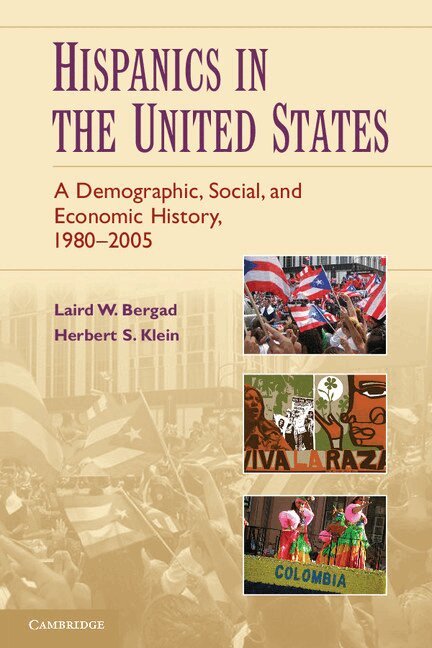
    Hispanics in the United States

    A Demographic, Social, and Economic History, 1980-2005

    AvLaird W. Bergad,Herbert S. Klein

    Häftad, Engelska, 2010

    456 kr

    Beställningsvara. Skickas inom 10-15 vardagar. Fri frakt över 249 kr.

    Fler format och utgåvor

    Inbunden

    643 kr

    Beskrivning

    In 1980 the US government began to systematically collect data on Hispanics. By 2005 the Latino population of the United States had become the nation's largest minority and is projected to comprise about one-third of the total US population in 2050. Utilizing census data and other statistical source materials, this book examines the transformations in the demographic, social, and economic structures of Latino-Americans in the United States between 1980 and 2005. Unlike most other studies, this book presents data on transformations over time, rather than a static portrait of specific topics at particular moments. Latino-Americans are examined over this twenty-five year period in terms of their demographic structures, changing patterns of wealth and poverty, educational attainment, citizenship and voter participation, occupational structures, employment, and unemployment. The result is a detailed socioeconomic portrait by region and over time that indicates the basic patterns that have lead to the formation of a complex national minority group that has become central to US society.

    Produktinformation

    • Utgivningsdatum:2010-08-09
    • Mått:152 x 228 x 26 mm
    • Vikt:640 g
    • Format:Häftad
    • Språk:Engelska
    • Antal sidor:468
    • Förlag:Cambridge University Press
    • ISBN:9780521718103

    Utforska kategorier

    • Amerikas historia inom Historia och arkeologi

    Mer om författaren

    Laird W. Bergad is Distinguished Professor of Latin American and Caribbean history in the Department of Latin American and Puerto Rican Studies at Lehman College and the Ph.D. Program in History at the Graduate Center of the City University of New York. He was the founding director of Lehman College's interdisciplinary program in Latin American and Caribbean studies and Chair of the Department of Latin American and Puerto Rican Studies, and he served on the executive committees of the CUNY/Cuba (and later Caribbean) Scholarly Exchange Program and the CUNY-University of Puerto Rico Exchange. Bergad is the founding and current director of the CUNY Center for Latin American, Caribbean, and Latino Studies at the Graduate Center. His previously published books include Coffee and the Growth of Agrarian Capitalism in Nineteenth-Century Puerto Rico; Cuban Rural Society in the Nineteenth Century: The Social and Economic History of Monoculture in Matanzas; The Cuban Slave Market, 1790–1880 (co-author); The Demographic and Economic History of Slavery in Minas Gerais, Brazil, 1720–1888; and The Comparative Histories of Slavery in Brazil, Cuba, and the United States. Herbert S. Klein is the author of some twenty books and 155 articles in several languages on Latin America and on comparative themes in social and economic history. Among these books are four comparative studies of slavery, the most recent of which are African Slavery in Latin America and the Caribbean (co-author), The Atlantic Slave Trade, and Slavery and the Economy of São Paulo, 1750–1850 (co-author). He has also published books on such diverse themes as The American Finances of the Spanish Empire, 1680–1809 and A Population History of the United States and is co-author of Brazil Since 1980 and Mexico Since 1980.

    Recensioner i media

    "The central, unifying theme of this book is that Hispanics in the United States are an incredibly diverse group about which no easy generalizations can be made. This may sound like a non-finding, but in fact Bergad and Klein elaborate with an impressive wealth of empirical detail just what such diversity means. They explore the diversity of the Latino population along four axes, fundamentally: class (as expressed by income and human capital indicators such as education), geographic location, immigrant status, and gender. The authors have produced, from the raw material provided by U.S. Census databases, an impressive collection of tables, graphs, and maps that illustrate in great detail the demographic history of U.S. Latinos since 1980. This is a remarkable achievement in that it required assembling, processing, and analyzing data from what is sometimes an unfriendly source (the census IPUMS files). The great advantage of this book is that the authors assume no specialized statistical knowledge on the part of the reader. Although, the work which went into generating the knowledge presented in the book evidently required the use of advanced statistical methods, the authors were able to present the data with remarkable clarity and accessibility. Thus, readers from all kinds of fields will benefit from this analysis, not only those with advanced statistical knowledge." – César J. Ayala, University of California, Los Angeles

    Innehållsförteckning

    • Introduction; 1. Immigration to the United States to 1980; 2. The Hispanic population to 1980; 3. Population growth and dispersion, 1980–2005; 4. The demography of the Hispanic population; 5. Wealth and poverty; 6. Educational attainment; 7. Citizenship, the Latino electorate, and voter participation; 8. Occupational structures, employment, and unemployment; 9. English language abilities and domestic usage; 10. Hispanic business ownership; 11. Race; 12. Endogamous and exogamous marriage patterns among Latino household heads; 13. Conclusion.