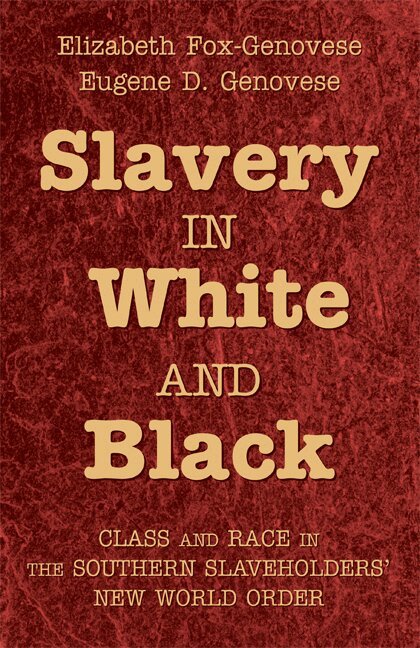
Häftad, Engelska, 2008
Slavery in White and Black
Class and Race in the Southern Slaveholders' New World Order
Av Elizabeth Fox-Genovese, Eugene D. Genovese
502 kr
Beställningsvara. Skickas inom 5-8 vardagar. Fri frakt över 249 kr.
Beskrivning
Produktinformation
- Utgivningsdatum: 2008-10-27
- Mått: 156 x 235 x 21 mm
- Vikt: 560 g
- Format: Häftad
- Språk: Engelska
- Antal sidor: 332
- Förlag: Cambridge University Press
- ISBN: 9780521721813
Utforska kategorier
Mer om författaren
Elizabeth Fox-Genovese (1941–2007) was Eleonore Raoul Professor of the Humanities at Emory University, where she was founding director of Women's Studies. She served on the Governing Council of the National Endowment for the Humanities (2002-2008). In 2003, President George Bush awarded her with a National Humanities Medal; the Georgia State senate honored her with a special resolution of appreciation for her contributions as a scholar, teacher, and citizen of Georgia; and the fellowship of Catholic Scholars bestowed on her its Cardinal Wright Award. Among her books and published lectures are: The Origins of Pysiocracy: Economic Revolution and Social Order in Eighteenth-Century France; Within the Plantation Household: Black and White Women of the Old South; and Feminism without Illusions: A Critique of Individualism. Eugene D. Genovese is a retired professor of history. Among his books are Roll, Jordan Roll: The World the Slaves Made; The Slaveholders' Dilemma: southern Conservative Thought 1820–1860; and A Consuming Fire: The Fall of the Confederacy in the Mind of the White Christian South. Fox-Genovese and Genovese co-authored Fruits of Merchant capital: Slavery and Bourgeois Property in the Rise and Expansion of Capitalism, and The Mind of the Master Class: History and Faith in the Southern Slaveholders' Worldview. In 2004 the Intercollegiate Studies Institute presented them jointly with its Gerhard Niemeyer Award for Distinguished Contributions to Scholarship in the Liberal Arts.
Recensioner i media
'By forcing us to confront the historical ubiquity of slavery and the revolutionary novelty of wage labour, the Genoveses invite us to see the Civil War as a struggle over capitalism at least as much as a struggle over slavery.' London Review of Books
Betyg & recensioner
0 recensioner
Inga recensioner tillgängliga.