• Fri frakt över 249 kr
  • •
  • Snabba leveranser
  • •
  • Billiga böcker
Kundservice

Du är på sajten för privatpersoner.

Företag, bibliotek eller offentlig verksamhet?

Du handlar på classic.bokus.com, där alla dina funktioner finns intakta.
Till classic.bokus.com
Bokus logotyp. Gå till startsidan.
  • Erbjudanden
  • Student
  • Topplistor
  • Barn & ungdom
  • Bokus Play
  • E-böcker
  • Ljudböcker
  • Pocketböcker
  • Spel och pussel

Upp till 25% på utvalda nyheter →

Sidfot

Mina sidor

    Hjälp

    • Kundservice
    • Vanliga frågor och svar
    • Frakt och leverans
    • Retur vid ångerrätt
    • Reklamera vara
    • Betalning
    • Köpvillkor
    • Allmänna villkor
    • Information om webbplatsens tillgänglighet

    Om Bokus

    • Om oss
    • Pressrum
    • För studenter
    • För företag
    • För bibliotek och offentlig verksamhet
    • För leverantörer
    • Hållbarhet

    Populärt

    • Aktuella erbjudanden
    • Presentkort
    • Studentlitteratur
    • Nya böcker
    • Topplistor
    • Signerade böcker
    • Engelska böcker

    Inspiration

    • Boktips
    • BookTok
    • Barnbokskaraktärer
    • Populära författare
    Logotyp för Bokus
    Följ oss på Facebook (extern länk)Följ oss på Instagram (extern länk)Följ oss på YouTube (extern länk)Följ oss på TikTok (extern länk)
    bokus @ CookiesAnpassa cookiesIntegritetspolicyKöpvillkor
    Till Citymail hemsida (extern länk)Till Budbee hemsida (extern länk)Till Postnord hemsida (extern länk)Till Schenker hemsida (extern länk)Till Early Bird hemsida (extern länk)Till Walleys hemsida (extern länk)
    1. Språk och ordböcker
    2. Språkvetenskap och lingvistik

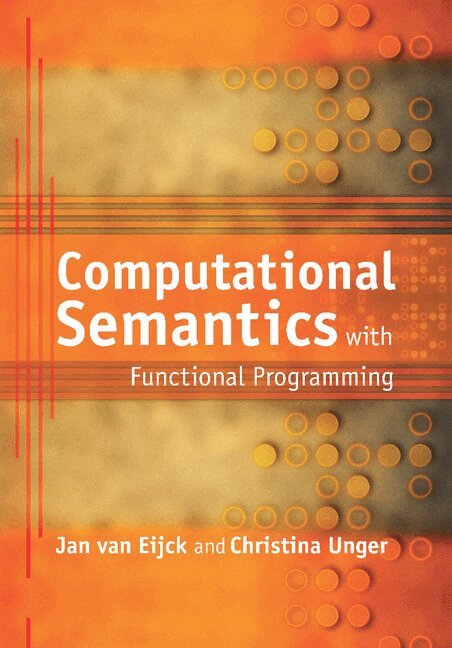
    Computational Semantics with Functional Programming

    AvJan van Eijck,Christina Unger

    Häftad, Engelska, 2010

    593 kr

    Beställningsvara. Skickas inom 7-10 vardagar. Fri frakt över 249 kr.

    Fler format och utgåvor

    Inbunden

    1 423 kr

    Beskrivning

    Computational semantics is the art and science of computing meaning in natural language. The meaning of a sentence is derived from the meanings of the individual words in it, and this process can be made so precise that it can be implemented on a computer. Designed for students of linguistics, computer science, logic and philosophy, this comprehensive text shows how to compute meaning using the functional programming language Haskell. It deals with both denotational meaning (where meaning comes from knowing the conditions of truth in situations), and operational meaning (where meaning is an instruction for performing cognitive action). Including a discussion of recent developments in logic, it will be invaluable to linguistics students wanting to apply logic to their studies, logic students wishing to learn how their subject can be applied to linguistics, and functional programmers interested in natural language processing as a new application area.

    Produktinformation

    • Utgivningsdatum:2010-09-23
    • Mått:170 x 244 x 22 mm
    • Vikt:820 g
    • Format:Häftad
    • Språk:Engelska
    • Antal sidor:422
    • Förlag:Cambridge University Press
    • ISBN:9780521757607

    Utforska kategorier

    • Språkvetenskap och lingvistik inom Språk och ordböcker

    Mer om författaren

    Jan van Eijck is a Senior Researcher at the Centre for Mathematics and Computer Science in Amsterdam, and Professor of Computational Linguistics at the Research Institute for Language and Speech, Utrecht University. Christina Unger is based in the Semantic Computing Group in the Cognitive Interaction Technology Center of Excellence at the University of Bielefeld.

    Recensioner i media

    'This remarkable textbook teaches you the know-how to become an active participant in this rapidly evolving interdisciplinary field.' Johan van Benthem, University of Amsterdam and Stanford University

    Innehållsförteckning

    • 1. Formal study of natural language; 2. Lambda calculus, types and functional programming; 3. Functional programming with Haskell; 4. Formal syntax for fragments; 5. Formal semantics for fragments; 6. Model checking with predicate logic; 7. The composition of meaning in natural language; 8. Extension and intension; 9. Parsing; 10. Handling relations and scoping; 11. Continuation passing style semantics; 12. Discourse representation and context; 13. Communication as informative action.