• Fri frakt över 249 kr
  • •
  • Snabba leveranser
  • •
  • Billiga böcker
Kundservice

Du är på sajten för privatpersoner.

Företag, bibliotek eller offentlig verksamhet?

Du handlar på classic.bokus.com, där alla dina funktioner finns intakta.
Till classic.bokus.com
Bokus logotyp. Gå till startsidan.
  • Erbjudanden
  • Nyheter
  • Student
  • Topplistor
  • Barn & ungdom
  • Bokus Play
  • E-böcker
  • Pocketböcker
  • Spel & pussel

10% rabatt på allt med kod NYSTART10 →

Sidfot

Mina sidor

    Hjälp

    • Kundservice
    • Vanliga frågor och svar
    • Frakt och leverans
    • Retur vid ångerrätt
    • Reklamera vara
    • Betalning
    • Köpvillkor
    • Allmänna villkor
    • Information om webbplatsens tillgänglighet

    Om Bokus

    • Om oss
    • Pressrum
    • För studenter
    • För företag
    • För bibliotek och offentlig verksamhet
    • För leverantörer
    • Hållbarhet

    Populärt

    • Aktuella erbjudanden
    • Presentkort
    • Studentlitteratur
    • Nya böcker
    • Topplistor
    • Signerade böcker
    • Engelska böcker

    Inspiration

    • Boktips
    • BookTok
    • Populära bokserier
    • Barnbokskaraktärer
    • Populära författare
    Logotyp för Bokus
    Följ oss på Facebook (extern länk)Följ oss på Instagram (extern länk)Följ oss på YouTube (extern länk)Följ oss på TikTok (extern länk)
    bokus @ CookiesAnpassa cookiesIntegritetspolicyKöpvillkor
    Till Citymail hemsida (extern länk)Till Budbee hemsida (extern länk)Till Postnord hemsida (extern länk)Till Schenker hemsida (extern länk)Till Early Bird hemsida (extern länk)Till Walleys hemsida (extern länk)
    1. Ekonomi och Ledarskap
    2. Nationalekonomi
    3. Miljöekonomi

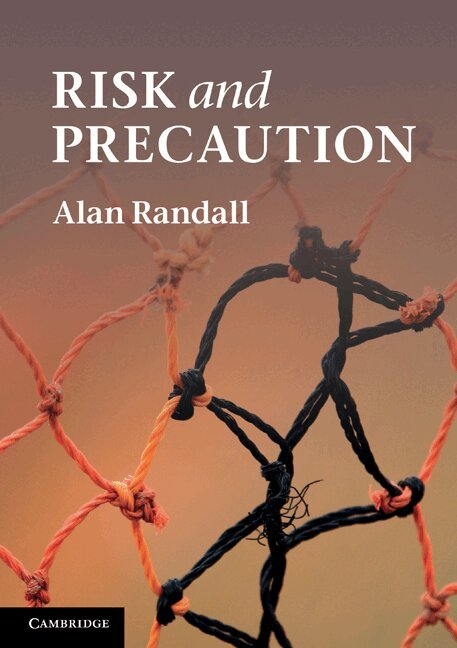
    Risk and Precaution

    AvAlan Randall

    Häftad, Engelska, 2011

    379 kr

    Beställningsvara. Skickas inom 10-15 vardagar. Fri frakt över 249 kr.

    Fler format och utgåvor

    Inbunden

    1 444 kr

    Beskrivning

    The precautionary principle has been labeled simplistic and the rational approach to decision-making under risk was modeled on well-specified games of chance. How then are we to manage the risks, uncertainties, and 'unknown unknowns' of the real world? In this book, Alan Randall unravels the key controversies surrounding the precautionary principle and develops a new framework that can be taken seriously in policy and management circles. Respecting the complexity of the real world, he defines a justifiable role for the precautionary principle in a risk management framework that integrates precaution with elements of the standard risk management model. This is explained using examples from medicine, pharmacy, synthetic chemicals, nanotechnology, the environment and natural resources conservation. This carefully reasoned but highly accessible book will appeal to readers from a broad range of disciplines, including environmental policy, risk management and cost-benefit analysis.

    Produktinformation

    • Utgivningsdatum:2011-02-03
    • Mått:174 x 246 x 12 mm
    • Vikt:550 g
    • Format:Häftad
    • Språk:Engelska
    • Antal sidor:278
    • Förlag:Cambridge University Press
    • ISBN:9780521759199

    Utforska kategorier

    • Miljöekonomi inom Ekonomi och Ledarskap

    Mer om författaren

    Alan Randall is Professor of Agricultural and Resource Economics at the University of Sydney, having served previously at Ohio State University for 25 years, 12 of them as department chair. He specializes in environmental economics and policy, with particular interests in environmental risk; biodiversity, habitat and environmental sustainability; environmental regulation, monitoring, and enforcement; and the benefits and costs of environmental projects and programs. His writings include Making the Environment Count: Selected Essays (Edward Elgar, 1999), Resource Economics: An Economic Approach to Natural Resource and Environmental Policy (Wiley, 1981, 1987; and Elgar, 2010 with John C. Bergstrom), and numerous journal articles. He is active in professional associations and on editorial boards, and has served on the National Research Council standing committee on human dimensions of global change and several NRC panels dealing with environmental policy issues. Professor Randall is a Fellow of three scholarly societies (the American Agricultural Economics Association, the Australian Agricultural and Resource Economics Society, and the Association of Environmental and Resource Economists), has received Ohio State University Awards for Distinguished Scholarship and Distinguished Faculty Service, and holds honorary doctorates from the University of Sydney and the Norwegian University of Environment and Life Sciences.

    Recensioner i media

    'This book is indeed an extraordinary accomplishment. It is a sophisticated, in-depth treatment of risk management in all of its complexities and complications. Numerous intellectual disciplines and subject matter fields are integrated to examine risk management in public policy. Randall's quest is to explore whether there is need in public policy for precautions, or safety margins, above and beyond that provided by ordinary risk management. The book demonstrates that for many situations ordinary risk management serves society well. Yet there are damaging events of infrequent occurrence but of major consequence, where ordinary risk management fails. His solution is to advance what he labels 'integrated risk management' which includes precautions not provided by ordinary risk management. His distinction between 'principles' and 'rules' in public policy formation alone makes reading the book worthwhile.' Emery N. Castle, Professor Emeritus, Oregon State University and Senior Fellow Emeritus and President Emeritus, Resources for the Future

    Innehållsförteckning

    • List of figures; List of boxes; Acknowledgements; Part I. The Precautionary Principle – Why So Much Fuss about Such a Simple Idea?: 1. Precaution as common sense: 'look before you leap'; 2. Commonsense precaution or paralysis of fear?; Part II. Harm and Chance – Managing Risk: 3. Harm, risk, and threat; 4. ORM – risk management as we know it; 5. Problems with ordinary risk management; Part III. Defining and Justifying a Coherent Precautionary Principle: 6. A defensible precautionary principle must withstand these challenges; 7. Toward a PP framework – evidence, threat, and remedy; 8. Threat and evidence; 9. Remedy; 10. Precaution for utilitarians?; 11. A robust and defensible precautionary principle; Part IV. Precaution in Action: 12. Precaution: from principle to policy; 13. Integrated risk management; Part V. Conclusion: 14. A role for precaution in an integrated risk management framework; References; Index.