• Fri frakt över 249 kr
  • •
  • Snabba leveranser
  • •
  • Billiga böcker
Kundservice

Du är på sajten för privatpersoner.

Företag, bibliotek eller offentlig verksamhet?

Du handlar på classic.bokus.com, där alla dina funktioner finns intakta.
Till classic.bokus.com
Bokus logotyp. Gå till startsidan.
  • Erbjudanden
  • Nyheter
  • Student
  • Topplistor
  • Barn & ungdom
  • Bokus Play
  • E-böcker
  • Pocketböcker
  • Spel & pussel

10% rabatt på allt med kod NYSTART10 →

Sidfot

Mina sidor

    Hjälp

    • Kundservice
    • Vanliga frågor och svar
    • Frakt och leverans
    • Retur vid ångerrätt
    • Reklamera vara
    • Betalning
    • Köpvillkor
    • Allmänna villkor
    • Information om webbplatsens tillgänglighet

    Om Bokus

    • Om oss
    • Pressrum
    • För studenter
    • För företag
    • För bibliotek och offentlig verksamhet
    • För leverantörer
    • Hållbarhet

    Populärt

    • Aktuella erbjudanden
    • Presentkort
    • Studentlitteratur
    • Nya böcker
    • Topplistor
    • Signerade böcker
    • Engelska böcker

    Inspiration

    • Boktips
    • BookTok
    • Populära bokserier
    • Barnbokskaraktärer
    • Populära författare
    Logotyp för Bokus
    Följ oss på Facebook (extern länk)Följ oss på Instagram (extern länk)Följ oss på YouTube (extern länk)Följ oss på TikTok (extern länk)
    bokus @ CookiesAnpassa cookiesIntegritetspolicyKöpvillkor
    Till Citymail hemsida (extern länk)Till Budbee hemsida (extern länk)Till Postnord hemsida (extern länk)Till Schenker hemsida (extern länk)Till Early Bird hemsida (extern länk)Till Walleys hemsida (extern länk)
    1. Psykologi och pedagogik
    2. Psykologi

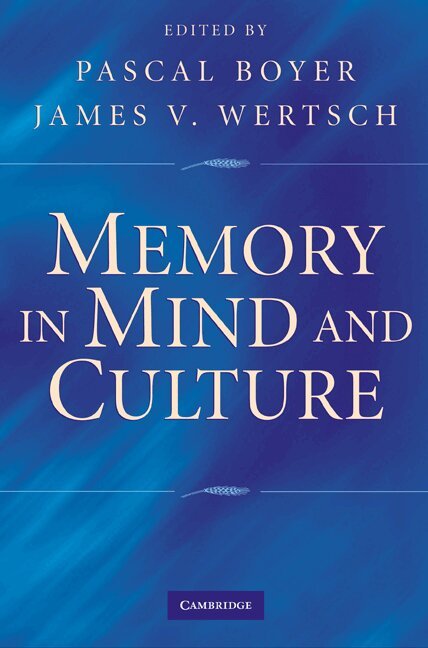
    Memory in Mind and Culture

    AvPascal Boyer,James V. Wertsch

    Inbunden, Engelska, 2009

    1 362 kr

    Beställningsvara. Skickas inom 10-15 vardagar. Fri frakt över 249 kr.

    Beskrivning

    This text introduces students, scholars, and interested educated readers to the issues of human memory broadly considered, encompassing both individual memory, collective remembering by societies, and the construction of history. The book is organised around several major questions: How do memories construct our past? How do we build shared collective memories? How does memory shape history? This volume presents a special perspective, emphasising the role of memory processes in the construction of self-identity, of shared cultural norms and concepts, and of historical awareness. Although the results are fairly new and the techniques suitably modern, the vision itself is of course related to the work of such precursors as Frederic Bartlett and Aleksandr Luria, who in very different ways represent the starting point of a serious psychology of human culture.
    Produktinformation

    • Utgivningsdatum:2009-06-08
    • Mått:158 x 235 x 22 mm
    • Vikt:560 g
    • Format:Inbunden
    • Språk:Engelska
    • Antal sidor:332
    • Förlag:Cambridge University Press
    • ISBN:9780521760782

    Utforska kategorier

    • Psykologi inom Psykologi och pedagogik

    Mer om författaren

    Pascal Boyer studied philosophy and anthropology at the Universities of Paris and Cambridge, where he did his graduate work with Professor Jack Goody, on memory constraints on the transmission of oral literature. He has done anthropological fieldwork in Cameroon on the transmission of the Fang oral epics and on Fang traditional religion. Since then he has worked mostly on the experimental study of cognitive capacities underlying cultural transmission. After teaching in Cambridge, San Diego, Lyon, and Santa Barbara, Boyer moved to his present position at the departments of anthropology and psychology at Washington University, St. Louis. James V. Wertsch is Professor in Arts and Sciences at Washington University in St. Louis. After finishing his Ph.D. at the University of Chicago in 1975, Wertsch was a postdoctoral Fellow in Moscow at the USSR Academy of Sciences and Moscow State University. His research is concerned with language, thought, and culture, with a special focus on collective memory and national identity. Wertsch is the author of more than 200 publications appearing in a dozen languages. These include the volumes Voices of the Mind (1991), Mind as Action (1998), and Voices of Collective Remembering (2002).

    Recensioner i media

    “Memory isn't just for psychologists, or neuroscientists, anymore. Psychologists learned a lot about memory in the 100 years after Ebbinghaus. Then cognitive neuropsychology and cognitive neuroscience began to connect the psychology of memory "down" to its neural substrates. The remaining task is to connect the psychology of memory "up" to the other social sciences, viewing individual memory processes, and individual memories, in the context of social and cultural structures and processes lying outside the individual. Boyer and Wertsch have done just that. In this book, their authors summarize what we already know, and initiate a new line of research that will – it is to be hoped – remind psychologists that they are social as well as biological scientists, and foster the development of a cognitive perspective within the social sciences more generally.” —John F. Kihlstrom, University of California, Berkeley

    Innehållsförteckning

    • Part I. In Mind, Culture and History: A Special Perspective: 1. What are memories for? Functions of recall in cognition and culture Pascal Boyer; Part II. How Do Memories Construct Our Past?: 2. Networks of autobiographical memories Helen L. Williams and Martin A. Conway; 3. Cultural life scripts and individual life stories Dorthe Berntsen and Annette Bohn; 4. Specificity of memory: implications for individual and collective remembering Daniel L. Schacter, Angela H. Gutchess, and Elizabeth A. Kensinger; Part III. How Do We Build Shared Collective Memories?: 5. Collective memory James V. Wertsch; 6. The role of repeated retrieval in shaping collective memory Henry L. Roediger III, Franklin M. Zaromb, and Andrew C. Butler; 7. Making history: social and psychological processes underlying collective memory James W. Pennebaker and Amy Gonzales; 8. How does collective memory create a sense of the collective? Alan Lambert, Laura Nesse, Chad Rogers, and Larry Jacoby; Part IV. How Does Memory Shape History?: 9. Historical memories Craig W. Blatz and Michael Ross; 10. The memory boom: why and why now? David W. Blight; 11. Historians and sites of memory Jay Winter; Part V. How Does Memory Shape Culture?: 12. Oral traditions as collective memories: implications for a general theory of individual and collective memory David C. Rubin; 13. Cognitive predispositions and cultural transmission Pascal Boyer.