• Fri frakt över 249 kr
  • •
  • Snabba leveranser
  • •
  • Billiga böcker
Kundservice

Du är på sajten för privatpersoner.

Företag, bibliotek eller offentlig verksamhet?

Du handlar på classic.bokus.com, där alla dina funktioner finns intakta.
Till classic.bokus.com
Bokus logotyp. Gå till startsidan.
  • Erbjudanden
  • Nyheter
  • Student
  • Topplistor
  • Barn & ungdom
  • Bokus Play
  • E-böcker
  • Pocketböcker
  • Spel & pussel

10% rabatt på allt med kod NYSTART10 →

Sidfot

Mina sidor

    Hjälp

    • Kundservice
    • Vanliga frågor och svar
    • Frakt och leverans
    • Retur vid ångerrätt
    • Reklamera vara
    • Betalning
    • Köpvillkor
    • Allmänna villkor
    • Information om webbplatsens tillgänglighet

    Om Bokus

    • Om oss
    • Pressrum
    • För studenter
    • För företag
    • För bibliotek och offentlig verksamhet
    • För leverantörer
    • Hållbarhet

    Populärt

    • Aktuella erbjudanden
    • Presentkort
    • Studentlitteratur
    • Nya böcker
    • Topplistor
    • Signerade böcker
    • Engelska böcker

    Inspiration

    • Boktips
    • BookTok
    • Populära bokserier
    • Barnbokskaraktärer
    • Populära författare
    Logotyp för Bokus
    Följ oss på Facebook (extern länk)Följ oss på Instagram (extern länk)Följ oss på YouTube (extern länk)Följ oss på TikTok (extern länk)
    bokus @ CookiesAnpassa cookiesIntegritetspolicyKöpvillkor
    Till Citymail hemsida (extern länk)Till Budbee hemsida (extern länk)Till Postnord hemsida (extern länk)Till Schenker hemsida (extern länk)Till Early Bird hemsida (extern länk)Till Walleys hemsida (extern länk)
    1. Naturvetenskap och teknik
    2. Geovetenskap
    3. Geovetenskap
    4. Meteorologi och klimatologi

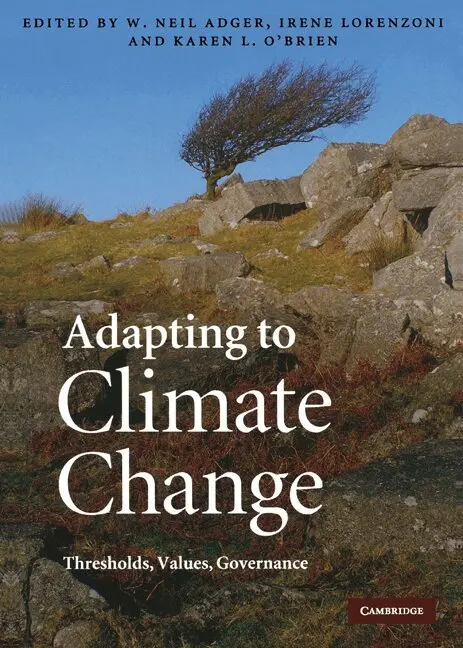
    Adapting to Climate Change

    Thresholds, Values, Governance

    AvW. Neil Adger,Irene Lorenzoni

    Inbunden, Engelska, 2009

    1 456 kr

    Beställningsvara. Skickas inom 10-15 vardagar. Fri frakt över 249 kr.

    Beskrivning

    Adapting to climate change is a critical problem facing humanity. This involves reconsidering our lifestyles, and is linked to our actions as individuals, societies and governments. This book presents top science and social science research on whether the world can adapt to climate change. Written by experts, both academics and practitioners, it examines the risks to ecosystems, demonstrating how values, culture and the constraining forces of governance act as barriers to action. As a review of science and a holistic assessment of adaptation options, it is essential reading for those concerned with responses to climate change, especially researchers, policymakers, practitioners, and graduate students. Significant features include historical, contemporary, and future insights into adaptation to climate change; coverage of adaptation issues from different perspectives: climate science, hydrology, engineering, ecology, economics, human geography, anthropology and political science; and contributions from leading researchers and practitioners from around the world.

    Produktinformation

    • Utgivningsdatum:2009-06-25
    • Mått:178 x 254 x 29 mm
    • Vikt:1 130 g
    • Format:Inbunden
    • Språk:Engelska
    • Antal sidor:532
    • Förlag:Cambridge University Press
    • ISBN:9780521764858

    Utforska kategorier

    • Meteorologi och klimatologi inom Naturvetenskap och teknik
    • Miljöekonomi inom Ekonomi och Ledarskap

    Mer om författaren

    W. Neil Adger is Professor of Environmental Economics in the School of Environmental Sciences at the University of East Anglia, Norwich, UK. He has led the programme on adaptation in the Tyndall Centre for Climate Change Research at the University of East Anglia since its inception in 2000. He served as a Lead Author in the Millennium Ecosystem Assessment and as a Convening Lead Author for the Fourth Assessment Report of the Intergovernmental Panel of Climate Change. He is a co-recipient as a member of the IPCC of the Nobel Peace Prize 2007. He was awarded a Philip Leverhulme Prize from the Leverhulme Trust in 2001 for his research achievements. Irene Lorenzoni is Lecturer in Environmental Politics and Governance at the School of Environmental Sciences at the University of East Anglia, Norwich, UK. Her interest is in the understanding of, and engagement with, climate change and energy. She is deputy leader of the adaptation programme of the Tyndall Centre for Climate Change Research, and a contributing author for the Fourth Assessment Report of the IPCC on barriers to adaptation, which was co-awarded the Nobel Peace Prize in 2007. Karen L. O'Brien is a Professor in the Department of Sociology and Human Geography at the University of Oslo, Norway and Scientific Chair of the Global Environmental Change and Human Security (GECHS) project of the International Human Dimensions Programme on Global Environmental Change (IHDP). Her current research focuses on climate change adaptation as a social process, and on the role that values and worldviews play in responding to environmental change. She was a lead author on the Fourth Assessment Report of the IPCC.

    Recensioner i media

    Review of the hardback: 'This book is a major contribution to a subject that has hitherto been far too little studied and commented on. 'Adaptation' to climate change sounds a simple idea, but turns out to be a complex and problematic one. Everyone involved in the debate about how to cope with global warming will profit by studying the diverse contributions this volume contains.' Lord Tony Giddens, London School of Economics and Political Science

    Innehållsförteckning

    • Introduction; 1. Adaptation now; Part I. Adapting to Thresholds in Physical and Ecological Systems: 2. Ecological limits of adaptation to climate change; 3. Adapting to the effects of climate change on water supply reliability; 4. Protecting London from tidal flooding: limits to engineering adaptation; 5. Climate prediction: a limit to adaptation?; 6. Learning to crawl: how to use seasonal climate forecasts to build adaptive capacity; 7. Norse Greenland settlement and limits to adaptation; 8. Sea ice change in Arctic Canada: are there limits to Inuit adaptation?; Part II. The Role of Value and Culture in Adaptation: 9. The past, present and some possible futures of adaptation; 10. Do values subjectively define the limits to climate change adaptation?; 11. Conceptual and practical barriers to adaptation: vulnerability and responses to heat waves in the UK; 12. Values and cost-benefit analysis: economic efficiency criteria in adaptation; 13. Hidden costs and disparate uncertainties: trade-offs in approaches to climate policy; 14. Community based adaptation and culture in theory and practice; 15. Exploring the invisibility of local knowledge in decision-making: the Boscastle harbour flood disaster; 16. Adaptation and conflict within fisheries: insights for living with climate change; 17. Exploring cultural dimensions of adaptation to climate change; 18. Adapting to an uncertain climate on the great plains: testing hypotheses on historical populations; 19. Climate change and adaptive human migration: lessons from rural North America; Part III. Governance, Knowledge and Technologies for Adaptation: 20. Are our levers long and our fulcra strong enough? Exploring the soft underbelly of adaptation decisions and actions; 21. Decentralized planning and climate adaptation: toward transparent governance; 22. Climate adaptation, local institutions and rural livelihoods; 23. Adaptive governance for a changing coastline: science, policy and publics in search of a sustainable future; 24. Climate change, international cooperation and adaptation in transboundary water management; 25. Decentralization: a window of opportunity for successful adaptation to climate change?; 26. Adapting to climate change: the nation-state as problem and solution; 27. Limits to adaptation: analysing institutional constraints; 28. Accessing diversification, networks and traditional resource management as adaptations to climate extremes; 29. Governance limits to effective global financial support for adaptation; 30. Organizational learning and governance in adaptation in urban development; 31. Conclusions: transforming the world; Index.