• Fri frakt över 249 kr
  • •
  • Snabba leveranser
  • •
  • Billiga böcker
Kundservice

Du är på sajten för privatpersoner.

Företag, bibliotek eller offentlig verksamhet?

Du handlar på classic.bokus.com, där alla dina funktioner finns intakta.
Till classic.bokus.com
Bokus logotyp. Gå till startsidan.
  • Erbjudanden
  • Nyheter
  • Student
  • Topplistor
  • Barn & ungdom
  • Bokus Play
  • E-böcker
  • Pocketböcker
  • Spel & pussel

10% rabatt på allt med kod: NYSTART10 →

Sidfot

Mina sidor

    Hjälp

    • Kundservice
    • Vanliga frågor och svar
    • Frakt och leverans
    • Retur vid ångerrätt
    • Reklamera vara
    • Betalning
    • Köpvillkor
    • Allmänna villkor
    • Information om webbplatsens tillgänglighet

    Om Bokus

    • Om oss
    • Pressrum
    • För studenter
    • För företag
    • För bibliotek och offentlig verksamhet
    • För leverantörer
    • Hållbarhet

    Populärt

    • Aktuella erbjudanden
    • Presentkort
    • Studentlitteratur
    • Nya böcker
    • Topplistor
    • Signerade böcker
    • Engelska böcker

    Inspiration

    • Boktips
    • BookTok
    • Populära bokserier
    • Barnbokskaraktärer
    • Populära författare
    Logotyp för Bokus
    Följ oss på Facebook (extern länk)Följ oss på Instagram (extern länk)Följ oss på YouTube (extern länk)Följ oss på TikTok (extern länk)
    bokus @ CookiesAnpassa cookiesIntegritetspolicyKöpvillkor
    Till Citymail hemsida (extern länk)Till Budbee hemsida (extern länk)Till Postnord hemsida (extern länk)Till Schenker hemsida (extern länk)Till Early Bird hemsida (extern länk)Till Walleys hemsida (extern länk)
    1. Naturvetenskap och teknik
    2. Teknik och industri
    3. Elektronik och kommunikationer

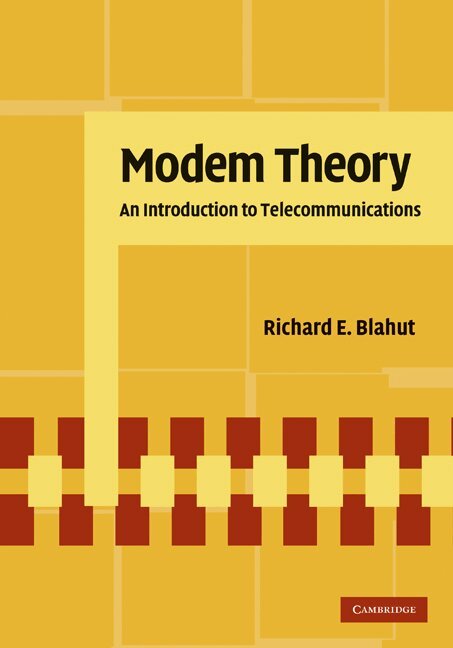
    Modem Theory

    An Introduction to Telecommunications

    AvRichard E. Blahut

    Inbunden, Engelska, 2009

    1 201 kr

    Beställningsvara. Skickas inom 10-15 vardagar. Fri frakt över 249 kr.

    Beskrivning

    At the heart of any modern communication system is the modem, connecting the data source to the communication channel. This first course in the mathematical theory of modem design introduces the theory of digital modulation and coding that underpins the design of digital telecommunications systems. A detailed treatment of core subjects is provided, including baseband and passband modulation and demodulation, equalization, and sequence estimation. The modulation waveforms for communication channels and digital recording channels are treated in a common setting and with unified terminology. A variety of more advanced topics is also covered, such as trellis codes, turbo codes, the Viterbi algorithm, block codes, maximum likelihood and maximum posterior probability, iterative demodulation, and jamming. Numerous end-of-chapter exercises are also included to test the reader's understanding throughout. This insightful book is ideal for senior undergraduate students studying digital communications and is also a useful reference for practising engineers.

    Produktinformation

    • Utgivningsdatum:2009-11-26
    • Mått:178 x 255 x 30 mm
    • Vikt:1 160 g
    • Format:Inbunden
    • Språk:Engelska
    • Antal sidor:514
    • Förlag:Cambridge University Press
    • ISBN:9780521780148

    Utforska kategorier

    • Elektronik och kommunikationer inom Naturvetenskap och teknik

    Mer om författaren

    Richard E. Blahut is a Professor of Electrical and Computer Engineering at the University of Illinois, Urbana-Champaign. He is Life Fellow of the IEEE and the recipient of many awards including the IEEE Alexander Graham Bell Medal (1998) and Claude E. Shannon Award (2005), the Tau Beta Pi Daniel C. Drucker Eminent Faculty Award, and the IEEE Millennium Medal. He was named a Fellow of the IBM Corporation in 1980, where he worked for over 30 years, and was elected to the National Academy of Engineering in 1990.

    Innehållsförteckning

    • 1. Introduction; 2. Baseband modulation; 3. Baseband demodulation; 4. Sequences at baseband; 5. Passband modulation; 6. Passband demodulation; 7. Principles of optimal demodulation; 8. Synchronization; 9. Codes for digital modulation; 10. Codes for data transmission; 11. Performance of practical demodulators; 12. Secure communications.