• Fri frakt över 249 kr
  • •
  • Snabba leveranser
  • •
  • Billiga böcker
Kundservice

Du är på sajten för privatpersoner.

Företag, bibliotek eller offentlig verksamhet?

Du handlar på classic.bokus.com, där alla dina funktioner finns intakta.
Till classic.bokus.com
Bokus logotyp. Gå till startsidan.
  • Erbjudanden
  • Nyheter
  • Student
  • Topplistor
  • Barn & ungdom
  • Bokus Play
  • E-böcker
  • Pocketböcker
  • Spel & pussel

10% rabatt på allt med kod NYSTART10 →

Sidfot

Mina sidor

    Hjälp

    • Kundservice
    • Vanliga frågor och svar
    • Frakt och leverans
    • Retur vid ångerrätt
    • Reklamera vara
    • Betalning
    • Köpvillkor
    • Allmänna villkor
    • Information om webbplatsens tillgänglighet

    Om Bokus

    • Om oss
    • Pressrum
    • För studenter
    • För företag
    • För bibliotek och offentlig verksamhet
    • För leverantörer
    • Hållbarhet

    Populärt

    • Aktuella erbjudanden
    • Presentkort
    • Studentlitteratur
    • Nya böcker
    • Topplistor
    • Signerade böcker
    • Engelska böcker

    Inspiration

    • Boktips
    • BookTok
    • Populära bokserier
    • Barnbokskaraktärer
    • Populära författare
    Logotyp för Bokus
    Följ oss på Facebook (extern länk)Följ oss på Instagram (extern länk)Följ oss på YouTube (extern länk)Följ oss på TikTok (extern länk)
    bokus @ CookiesAnpassa cookiesIntegritetspolicyKöpvillkor
    Till Citymail hemsida (extern länk)Till Budbee hemsida (extern länk)Till Postnord hemsida (extern länk)Till Schenker hemsida (extern länk)Till Early Bird hemsida (extern länk)Till Walleys hemsida (extern länk)
    1. Psykologi och pedagogik
    2. Psykologi
    3. Socialpsykologi och gruppsykologi

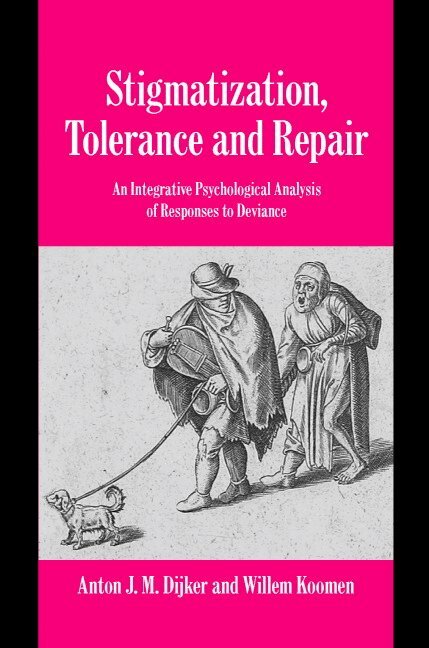
    Stigmatization, Tolerance and Repair

    An Integrative Psychological Analysis of Responses to Deviance

    AvAnton J. M. Dijker,Willem Koomen

    Inbunden, Engelska, 2007

    Del i serien Studies in Emotion and Social Interaction

    1 519 kr

    Beställningsvara. Skickas inom 10-15 vardagar. Fri frakt över 249 kr.

    Fler format och utgåvor

    Häftad

    528 kr

    Beskrivning

    Society is faced with a variety of undesirable behaviours and conditions such as crime, mental and physical illnesses and disabilities, that usually provoke different responses in people such as emotions of anger, fear or pity. In our evolutionary past, these emotions adaptively motivated the repair of interpersonal relationships, whereas more recently they may also result in other types of social control such as stigmatization or tolerance. Dijker and Koomen show, on the basis of elementary psychological processes, how peoples' responses are not only dependent on type of deviance but also on personality, situation, historical period and culture. They also examine the implications of these responses for the well-being and coping of people with deviant conditions or stigmas. This book provides conceptual tools for developing interventions to reduce stigmatization and offers a deeper understanding of the psychological basis of social control as well as opportunities to influence its potentially harmful consequences.

    Produktinformation

    • Utgivningsdatum:2007-11-22
    • Mått:159 x 239 x 28 mm
    • Vikt:794 g
    • Format:Inbunden
    • Språk:Engelska
    • Serie:Studies in Emotion and Social Interaction
    • Antal sidor:428
    • Förlag:Cambridge University Press
    • ISBN:9780521790192

    Utforska kategorier

    • Socialpsykologi och gruppsykologi inom Psykologi och pedagogik

    Mer om författaren

    Anton J. M. Dijker is a social psychologist and works for the Faculty of Health, Medicine and Life Sciences in the Department of Health Education and Promotion at the University of Maastricht. Willem Koomen is a social psychologist and works for the Faculty of Social and Behavioural Sciences in the Department of Social Psychology at the University of Amsterdam.

    Innehållsförteckning

    • 1. Introduction; 2. Evolutionary origins of social responses to deviance; 3. Mental representations of deviance and their emotional and judgmental implications; 4. Meeting individuals with deviant conditions: understanding the role of automatic and controlled psychological processes; 5. Individual differences in responding to deviance; 6. Variations in social control across societies, cultures, and historical periods; 7. A focus on persons with a deviant condition I: their social world, coping and behavior; 8. A focus on persons with a deviant condition II: socio-economic status, self-esteem and well-being; 9. Theorizing about interventions to prevent or reduce stigmatization.