• Fri frakt över 249 kr
  • •
  • Snabba leveranser
  • •
  • Billiga böcker
Kundservice

Du är på sajten för privatpersoner.

Företag, bibliotek eller offentlig verksamhet?

Du handlar på classic.bokus.com, där alla dina funktioner finns intakta.
Till classic.bokus.com
Bokus logotyp. Gå till startsidan.
  • Erbjudanden
  • Student
  • Topplistor
  • Barn & ungdom
  • Bokus Play
  • E-böcker
  • Ljudböcker
  • Pocketböcker
  • Spel och pussel

Pocketfynda! Hundratals böcker för 49 kr/st →

Sidfot

Mina sidor

    Hjälp

    • Kundservice
    • Vanliga frågor och svar
    • Frakt och leverans
    • Retur vid ångerrätt
    • Reklamera vara
    • Betalning
    • Köpvillkor
    • Allmänna villkor
    • Information om webbplatsens tillgänglighet

    Om Bokus

    • Om oss
    • Pressrum
    • För studenter
    • För företag
    • För bibliotek och offentlig verksamhet
    • För leverantörer
    • Hållbarhet

    Populärt

    • Aktuella erbjudanden
    • Presentkort
    • Studentlitteratur
    • Nya böcker
    • Topplistor
    • Signerade böcker
    • Engelska böcker

    Inspiration

    • Boktips
    • BookTok
    • Barnbokskaraktärer
    • Populära författare
    Logotyp för Bokus
    Följ oss på Facebook (extern länk)Följ oss på Instagram (extern länk)Följ oss på YouTube (extern länk)Följ oss på TikTok (extern länk)
    bokus @ CookiesAnpassa cookiesIntegritetspolicyKöpvillkor
    Till Citymail hemsida (extern länk)Till Budbee hemsida (extern länk)Till Postnord hemsida (extern länk)Till Schenker hemsida (extern länk)Till Early Bird hemsida (extern länk)Till Walleys hemsida (extern länk)
    1. Psykologi och pedagogik
    2. Psykologi
    3. Kognitiv psykologi

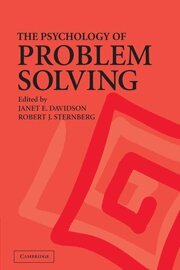
    The Psychology of Problem Solving

    AvJanet E. Davidson,Robert J. Sternberg

    Inbunden, Engelska, 2003

    1 102 kr

    Beställningsvara. Skickas inom 7-10 vardagar. Fri frakt över 249 kr.

    Beskrivning

    Problems are a central part of human life. The Psychology of Problem Solving organizes in one volume much of what psychologists know about problem solving and the factors that contribute to its success or failure. There are chapters by leading experts in this field, including Miriam Bassok, Randall Engle, Anders Ericsson, Arthur Graesser, Keith Stanovich, Norbert Schwarz, and Barry Zimmerman, among others. The Psychology of Problem Solving is divided into four parts. Following an introduction that reviews the nature of problems and the history and methods of the field, Part II focuses on individual differences in, and the influence of, the abilities and skills that humans bring to problem situations. Part III examines motivational and emotional states and cognitive strategies that influence problem solving performance, while Part IV summarizes and integrates the various views of problem solving proposed in the preceding chapters.

    Produktinformation

    • Utgivningsdatum:2003-06-09
    • Mått:158 x 237 x 28 mm
    • Vikt:650 g
    • Format:Inbunden
    • Språk:Engelska
    • Antal sidor:408
    • Förlag:Cambridge University Press
    • ISBN:9780521793339

    Utforska kategorier

    • Kognitiv psykologi inom Psykologi och pedagogik

    Recensioner i media

    'A good book on any subject should summarise the current state of knowledge, and point to the important areas where further work is needed, and this book does both. Overall, this is a very stimulating collection, which all researchers in problem solving will wish to consult.' Trends in Cognitive Sciences

    Innehållsförteckning

    • Part I. Introduction: 1. Recognizing, defining, and representing problems; 2. The acquisition of expert performance as problem solving: construction and modification of mediating mechanisms through deliberate practice; Part II. Relevant Abilities and Skills: 3. Is success or failure at problem solving complex problems related to intellectual ability?; 4. Creativity: a source of difficulty in problem solving; 5. Insights about insightful problem solving; 6. The role of working memory in problem solving; 7. Comprehension of text in problem solving; Part III. States and Strategies: 8. Motivating self-regulated problem solvers; 9. Feeling and thinking: implications for problem solving; 10. The fundamental computational biases of human cognition: heuristics that (sometimes) impair decision making and problem solving; 11. Analogical transfer in problem solving; Part IV. Conclusions and Integration: 12. Problem-solving, large/small, hard/easy problem-space/problem-solver: the issue of dichotomization.