• Fri frakt över 249 kr
  • •
  • Snabba leveranser
  • •
  • Billiga böcker
Kundservice

Du är på sajten för privatpersoner.

Företag, bibliotek eller offentlig verksamhet?

Du handlar på classic.bokus.com, där alla dina funktioner finns intakta.
Till classic.bokus.com
Bokus logotyp. Gå till startsidan.
  • Erbjudanden
  • Nyheter
  • Student
  • Topplistor
  • Barn & ungdom
  • Bokus Play
  • E-böcker
  • Pocketböcker
  • Spel & pussel

10% studentrabatt med kod TERM26

Sidfot

Mina sidor

    Hjälp

    • Kundservice
    • Vanliga frågor och svar
    • Frakt och leverans
    • Retur vid ångerrätt
    • Reklamera vara
    • Betalning
    • Köpvillkor
    • Allmänna villkor
    • Information om webbplatsens tillgänglighet

    Om Bokus

    • Om oss
    • Pressrum
    • För studenter
    • För företag
    • För bibliotek och offentlig verksamhet
    • För leverantörer
    • Hållbarhet

    Populärt

    • Aktuella erbjudanden
    • Presentkort
    • Studentlitteratur
    • Nya böcker
    • Topplistor
    • Signerade böcker
    • Engelska böcker

    Inspiration

    • Boktips
    • BookTok
    • Populära bokserier
    • Barnbokskaraktärer
    • Populära författare
    Logotyp för Bokus
    Följ oss på Facebook (extern länk)Följ oss på Instagram (extern länk)Följ oss på YouTube (extern länk)Följ oss på TikTok (extern länk)
    bokus @ CookiesAnpassa cookiesIntegritetspolicyKöpvillkor
    Till Citymail hemsida (extern länk)Till Budbee hemsida (extern länk)Till Postnord hemsida (extern länk)Till Schenker hemsida (extern länk)Till Early Bird hemsida (extern länk)Till Walleys hemsida (extern länk)
    1. Juridik
    2. Internationell rätt

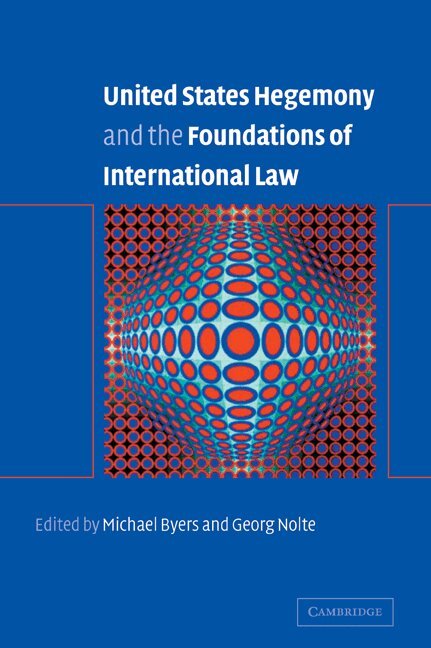
    United States Hegemony and the Foundations of International Law

    AvMichael Byers,Georg Nolte

    Inbunden, Engelska, 2003

    1 672 kr

    Beställningsvara. Skickas inom 10-15 vardagar. Fri frakt över 249 kr.

    Beskrivning

    Successive hegemonic powers have shaped the foundations of international law. This book examines whether the predominance of the United States is leading to foundational change in the international legal system. A range of leading scholars in international law and international relations consider six foundational areas that could be undergoing change, including international community, sovereign equality, the law governing the use of force, and compliance. The authors demonstrate that the effects of US predominance on the foundations of international law are real, but also intensely complex. This complexity is due, in part, to a multitude of actors exercising influential roles. And it is also due to the continued vitality and remaining functionality of the international legal system itself. This system limits the influence of individual states, while stretching and bending in response to the changing geopolitics of our time.

    Produktinformation

    • Utgivningsdatum:2003-05-29
    • Mått:161 x 236 x 40 mm
    • Vikt:996 g
    • Format:Inbunden
    • Språk:Engelska
    • Antal sidor:552
    • Förlag:Cambridge University Press
    • ISBN:9780521819497

    Utforska kategorier

    • Internationell rätt inom Juridik
    • Internationella relationer inom Samhälle och politik

    Mer om författaren

    Michael Byers is Associate Professor of Law at Duke University. Georg Nolte is Professor of Law at the University of Göttingen.

    Recensioner i media

    'The range of topics is impressive and the collection will prove invaluable to students of international law and relations.' Contemporary Review

    Innehållsförteckning

    • List of contributors; Preface; Introduction: the complexities of foundational change Michael Byers; Part I. International Community: 1. The international community, international law and the United States: three in one, two against one, or one and the same? Edward Kwakwa; 2. The influence of the United States on the concept of the 'International Community' Andreas Paulus; 3. Comments on chapters 1 and 2 Martti Koskenniemi, Steven Ratner and Volker Rittberger; Part II. Sovereign Equality: 4. Sovereign equality: 'the Wimbledon sails on' Michel Cosnard; 5. More equal than the rest? Hierarchy, equality and US predominance in international law Nico Krisch; 6. Comments on chapters 4 and 5 Pierre-Marie Dupuy, Matthias Herdegen and Gregory H. Fox; Part III. Use of Force: 7. The use of force by the United States after the end of the Cold War, and its impact on international law Marcelo G. Kohen; 8. Bending the law, breaking it, or developing it? The United States and the humanitarian use of force in the post-Cold War era Brad R. Roth; 9. Comments on chapters 7 and 8 Thomas Franck, Jochen Abr. Frowein and Daniel Thürer; Part IV. Customary International Law: 10. Powerful but unpersuasive? The role of the United States in the evolution of customary international law Stephen Toope; 11. Hegemonic custom? Achilles Skordas; 12. Comments on chapters 10 and 11 Rainer Hofmann, Andrew Hurrell and Rüdiger Wolfrum; Part V. Law of Treaties: 13. The effects of US predominance on the elaboration of treaty regimes and on the evolution of the law of treaties Pierre Klein; 14. US reservations to human rights treaties: all for one and none for all? Catherine Redgwell; 15. Comments on chapters 13 and 14 Jost Delbrück, Alain Pellet and Bruno Simma; Part VI. Compliance: 16. The impact on international law of US noncompliance Shirley V. Scott; 17. Compliance: multilateral achievements and predominant powers Peter-Tobias Stoll; 18. Comments on chapters 16 and 17 Vaughan Lowe, David M. Malone and Christian Tomuschat; Conclusion Georg Nolte; Index.