• Fri frakt över 249 kr
  • •
  • Snabba leveranser
  • •
  • Billiga böcker
Kundservice

Du är på sajten för privatpersoner.

Företag, bibliotek eller offentlig verksamhet?

Du handlar på classic.bokus.com, där alla dina funktioner finns intakta.
Till classic.bokus.com
Bokus logotyp. Gå till startsidan.
  • Erbjudanden
  • Student
  • Topplistor
  • Barn & ungdom
  • Bokus Play
  • E-böcker
  • Ljudböcker
  • Pocketböcker
  • Spel och pussel

Pocketfynda! Hundratals böcker för 49 kr/st →

Sidfot

Mina sidor

    Hjälp

    • Kundservice
    • Vanliga frågor och svar
    • Frakt och leverans
    • Retur vid ångerrätt
    • Reklamera vara
    • Betalning
    • Köpvillkor
    • Allmänna villkor
    • Information om webbplatsens tillgänglighet

    Om Bokus

    • Om oss
    • Pressrum
    • För studenter
    • För företag
    • För bibliotek och offentlig verksamhet
    • För leverantörer
    • Hållbarhet

    Populärt

    • Aktuella erbjudanden
    • Presentkort
    • Studentlitteratur
    • Nya böcker
    • Topplistor
    • Signerade böcker
    • Engelska böcker

    Inspiration

    • Boktips
    • BookTok
    • Barnbokskaraktärer
    • Populära författare
    Logotyp för Bokus
    Följ oss på Facebook (extern länk)Följ oss på Instagram (extern länk)Följ oss på YouTube (extern länk)Följ oss på TikTok (extern länk)
    bokus @ CookiesAnpassa cookiesIntegritetspolicyKöpvillkor
    Till Citymail hemsida (extern länk)Till Budbee hemsida (extern länk)Till Postnord hemsida (extern länk)Till Schenker hemsida (extern länk)Till Early Bird hemsida (extern länk)Till Walleys hemsida (extern länk)
    1. Samhälle och politik
    2. Politik och statsskick

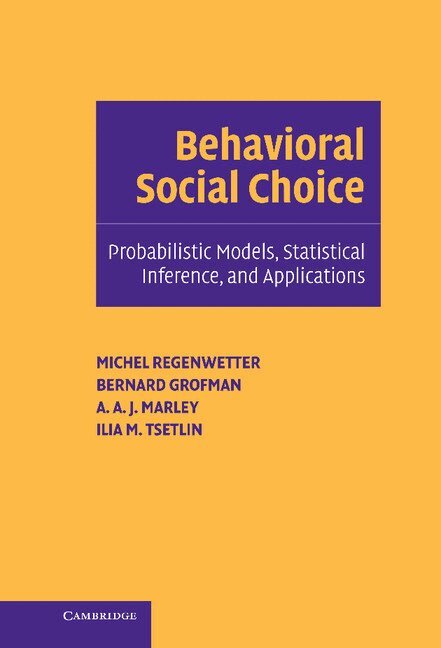
    Behavioral Social Choice

    Probabilistic Models, Statistical Inference, and Applications

    AvMichel Regenwetter,Bernard Grofman

    Inbunden, Engelska, 2006

    1 107 kr

    Beställningsvara. Skickas inom 7-10 vardagar. Fri frakt över 249 kr.

    Fler format och utgåvor

    Häftad

    546 kr

    Beskrivning

    Behavioral Social Choice looks at the probabilistic foundations of collective decision-making rules. The authors challenge much of the existing theoretical wisdom about social choice processes, and seek to restore faith in the possibility of democratic decision-making. In particular, they argue that worries about the supposed prevalence of majority rule cycles that would preclude groups from reaching a final decision about what alternative they prefer have been greatly overstated. In practice, majority rule can be expected to work well in most real-world settings. Furthermore, if there is a problem, they show that the problem is more likely to be one of sample estimates missing the majority winner in a close contest (e.g., Bush-Gore) than a problem about cycling. The authors also provide new mathematical tools to estimate the prevalence of cycles as a function of sample size and insights into how alternative model specifications can change our estimates of social orderings.

    Produktinformation

    • Utgivningsdatum:2006-05-15
    • Mått:156 x 235 x 18 mm
    • Vikt:465 g
    • Format:Inbunden
    • Språk:Engelska
    • Antal sidor:258
    • Förlag:Cambridge University Press
    • ISBN:9780521829687

    Utforska kategorier

    • Politik och statsskick inom Samhälle och politik

    Mer om författaren

    Michel Regenwetter is Associate Professor of Psychology and Political Science at the University of Illinois, Urbana-Champaign. In 1999, Dr Regenwetter was awarded the Young Investigator Award of the Society for Mathematical Psychology. He has been principal investigator on multiple grants from the National Science Foundation and the Research Board of the University of Illinois. Dr Regenwetter has published over 20 scholarly articles in leading academic journals in his field, including in the Journal of Experimental Psychology: Learning, Memory and Cognition, the Journal of Mathematical Psychology, Management Science, Mathematical Social Sciences, Psychological Review, Psychometrika, Social Choice and Welfare, and Theory and Decision. Dr Regenwetter has served as guest associate editor for Management Science, and since 2003, he has been a permanent member of the editorial board of the Journal of Mathematical Psychology. Bernard Grofman is a Professor of Political Science at the University of California, Irvine, where he has been teaching since 1980. He received his B.S. in Mathematics at the University of Chicago in 1966 and his Ph.D. in Political Science at the University of Chicago in 1972. He is co-author of 3 previous books published by Cambridge University Press, and co-editor of 16 other books. He has also published over 200 research articles and book chapters, including work in leading journals such as the American Political Science Review, the American Journal of Political Science, the Journal of Politics, the British Journal of Political Science, Electoral Studies, Social Choice and Welfare, and Public Choice. A. A. J. Marley, a Fellow of the American Psychological Society, was Chair of the Department of Psychology at McGill University, Montréal from 1992 to 2001 (with a one-year sabbatical break in 1997), and is now Adjunct Professor at the University of Victoria and Professor Emeritus of McGill University. He has been editor of the Journal of Mathematical Psychology and President of the Society for Mathematical Psychology. Ilia M. Tsetlin is an Assistant Professor of Decision Sciences at INSEAD. His teaching and research interests are in modeling decisions under uncertainty, with particular focus on competitive decision making and social choice. His research has appeared in academic journals such as Operations Research, the Journal of Risk and Uncertainty, and Social Choice and Welfare.

    Recensioner i media

    "The juxtaposition of 'behavioral' and 'social choice' is unusual, to say the least, because the former suggests an empirical and the latter a theoretical orientation. In Behavioral Social Choice, the authors succeed remarkably in merging these different orientations and rigorously demonstrating how care and subtlety are required in aggregating individual preferences into the vaunted 'will of the majority'." Steven J. Brams, New York University

    Innehållsförteckning

    • Part I. Probabilistic Models of Social Choice Behavior: 1. The lack of theoretical and practical support for majority cycles; 2. A general concept of majority rule; Part II. Applications of Probabilistic Models to Empirical Data: 3. On the model dependence versus robustness of social choice results; 4. Constructing majority preferences from subset choice data; Part III. A General Statistical Sampling and Bayesian Inference Framework: 5. Majority rule in a statistical sampling and Bayesian inference framework; 6. Conclusions and directions for future behavioral social choice research.