• Fri frakt över 249 kr
  • •
  • Snabba leveranser
  • •
  • Billiga böcker
Kundservice

Du är på sajten för privatpersoner.

Företag, bibliotek eller offentlig verksamhet?

Du handlar på classic.bokus.com, där alla dina funktioner finns intakta.
Till classic.bokus.com
Bokus logotyp. Gå till startsidan.
  • Erbjudanden
  • Nyheter
  • Student
  • Topplistor
  • Barn & ungdom
  • Bokus Play
  • E-böcker
  • Pocketböcker
  • Spel & pussel

10% rabatt på allt med kod: NYSTART10 →

Sidfot

Mina sidor

    Hjälp

    • Kundservice
    • Vanliga frågor och svar
    • Frakt och leverans
    • Retur vid ångerrätt
    • Reklamera vara
    • Betalning
    • Köpvillkor
    • Allmänna villkor
    • Information om webbplatsens tillgänglighet

    Om Bokus

    • Om oss
    • Pressrum
    • För studenter
    • För företag
    • För bibliotek och offentlig verksamhet
    • För leverantörer
    • Hållbarhet

    Populärt

    • Aktuella erbjudanden
    • Presentkort
    • Studentlitteratur
    • Nya böcker
    • Topplistor
    • Signerade böcker
    • Engelska böcker

    Inspiration

    • Boktips
    • BookTok
    • Populära bokserier
    • Barnbokskaraktärer
    • Populära författare
    Logotyp för Bokus
    Följ oss på Facebook (extern länk)Följ oss på Instagram (extern länk)Följ oss på YouTube (extern länk)Följ oss på TikTok (extern länk)
    bokus @ CookiesAnpassa cookiesIntegritetspolicyKöpvillkor
    Till Citymail hemsida (extern länk)Till Budbee hemsida (extern länk)Till Postnord hemsida (extern länk)Till Schenker hemsida (extern länk)Till Early Bird hemsida (extern länk)Till Walleys hemsida (extern länk)
    1. Samhälle och politik
    2. Politik och statsskick

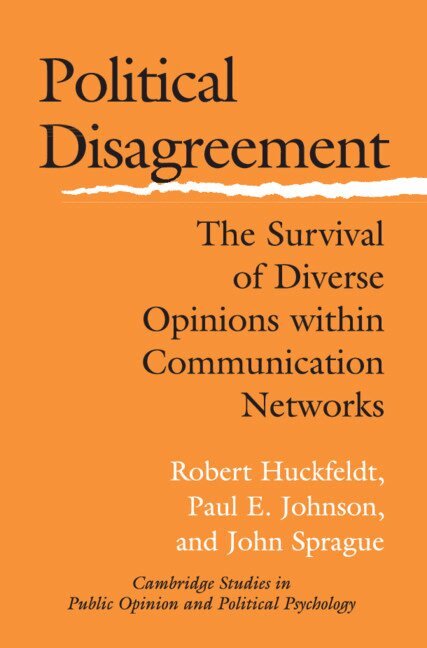
    Political Disagreement

    The Survival of Diverse Opinions within Communication Networks

    AvRobert Huckfeldt,Paul E. Johnson

    Inbunden, Engelska, 2004

    Del i serien Cambridge Studies in Public Opinion and Political Psychology

    1 107 kr

    Beställningsvara. Skickas inom 10-15 vardagar. Fri frakt över 249 kr.

    Fler format och utgåvor

    Häftad

    430 kr

    Beskrivning

    Political disagreement is widespread within the communication network of ordinary citizens; furthermore, political diversity within these networks is entirely consistent with a theory of democratic politics built on the importance of individual interdependence. The persistence of political diversity and disagreement does not imply that political interdependence is absent among citizens or that political influence is lacking. The book's analysis makes a number of contributions. The authors demonstrate the ubiquitous nature of political disagreement. They show that communication and influence within dyads is autoregressive - that the consequences of dyadic interactions depend on the distribution of opinions within larger networks of communication. They argue that the autoregressive nature of political influence serves to sustain disagreement within patterns of social interaction, as it restores the broader political relevance of social communication and influence. They eliminate the deterministic implications that have typically been connected to theories of democratic politics based on interdependent citizens.

    Produktinformation

    • Utgivningsdatum:2004-07-12
    • Mått:157 x 238 x 23 mm
    • Vikt:482 g
    • Format:Inbunden
    • Språk:Engelska
    • Serie:Cambridge Studies in Public Opinion and Political Psychology
    • Antal sidor:272
    • Förlag:Cambridge University Press
    • ISBN:9780521834308

    Utforska kategorier

    • Politik och statsskick inom Samhälle och politik

    Mer om författaren

    Robert Huckfeldt is Distinguished Professor of Political Science at the University of California, Davis. His interests lie in the areas of elections, public opinion, political communication, urban politics, and more generally in the relationships among groups and individuals in politics. He is the author of Dynamic Modeling (with Thomas Likens and Carol Weitzel Kohfeld, 1982), Politics in Context (2003), Race and the Decline of Class in American Politics (with Carol Weitzel Kohfeld, 1989) and Citizens, Politics, and Social Communication (with John Sprague, 1995). He has contributed articles to the American Political Science Review, The American Journal of Political Science, the Journal of Politics, the American Journal of Political Science, as well as other journals. Paul Johnson has published articles in the American Journal of Political Science, The Journal of Political Science, The Journal of Politics, The Journal of Theoretical Politics, Rationality and Society, The American Behavioral Scientist, and other journals. His articles include applications of game theory, social choice theory, and complexity theory. He currently has an avid interest in the development of tools for agent based modeling and computer simulation in the social sciences. He is the lead author of the Swarm User Guide, the manual that is distributed with the Swarm Simulation System. He is contributing to the development of Swarm and offers the Swarm FAQ as well as pre-packaged versions of Swarm for Linux users as well as several example programs. Professor Sprague has written on voting and elections, the history of socialist voting, voting patterns in the US Supreme Court, lawyers in politics, and crime including homicide. His academic career has been wholly at Washington University, St Louis, where he has been chair of the Department of Political Science. He is the author of Voting Patterns on the US Supreme Court (1969), Lawyers in Politics (with Heinz Eulau, 1984), The Dynamics of Riots (with Barbara Salert, 1980), Systems Analysis for Social Scientists (with Fernando Cortez and Adam Prseworski, 1974), Paper Stones: A History of Electoral Socialism (with Adam Przeworski, 1988) and Citizens, Politics, and Social Communication (with Robert Huckfeldt, Cambridge, 1995). He has contributed articles to the American Political Science Review, the Journal of Politics, the American Journal of Political Science, Political Methodology, Criminology, and other journals.

    Recensioner i media

    'Political Disagreement discovers, in the contingencies of personal acquaintanceship, a foundation for democratic dissent. It is a work of the first order of originality, intellectual power, and importance.' Paul M. Sniderman, Stanford University

    Innehållsförteckning

    • 1. Communication, influence, and the capacity of citizens to disagree; 2. New information, old information, and persistent disagreement; 3. Dyads, networks, and autoregressive influence; 4. Disagreement, heterogeneity, and the effectiveness of political communication; 5. Disagreement, heterogeneity, and persuasion: how does disagreement survive?; 6. Agent-based explanations, patterns of communication, and the inevitability of homogeneity; 7. Agent-based explanations, autoregressive influence, and the survival of disagreement; 8. Heterogeneous networks and citizen capacity: disagreement ambivalence, and engagement; 9. Summary, implications, and conclusion.