• Fri frakt över 249 kr
  • •
  • Snabba leveranser
  • •
  • Billiga böcker
Kundservice

Du är på sajten för privatpersoner.

Företag, bibliotek eller offentlig verksamhet?

Du handlar på classic.bokus.com, där alla dina funktioner finns intakta.
Till classic.bokus.com
Bokus logotyp. Gå till startsidan.
  • Erbjudanden
  • Nyheter
  • Student
  • Topplistor
  • Barn & ungdom
  • Bokus Play
  • E-böcker
  • Pocketböcker
  • Spel & pussel

10% rabatt på allt med kod NYSTART10 →

Sidfot

Mina sidor

    Hjälp

    • Kundservice
    • Vanliga frågor och svar
    • Frakt och leverans
    • Retur vid ångerrätt
    • Reklamera vara
    • Betalning
    • Köpvillkor
    • Allmänna villkor
    • Information om webbplatsens tillgänglighet

    Om Bokus

    • Om oss
    • Pressrum
    • För studenter
    • För företag
    • För bibliotek och offentlig verksamhet
    • För leverantörer
    • Hållbarhet

    Populärt

    • Aktuella erbjudanden
    • Presentkort
    • Studentlitteratur
    • Nya böcker
    • Topplistor
    • Signerade böcker
    • Engelska böcker

    Inspiration

    • Boktips
    • BookTok
    • Populära bokserier
    • Barnbokskaraktärer
    • Populära författare
    Logotyp för Bokus
    Följ oss på Facebook (extern länk)Följ oss på Instagram (extern länk)Följ oss på YouTube (extern länk)Följ oss på TikTok (extern länk)
    bokus @ CookiesAnpassa cookiesIntegritetspolicyKöpvillkor
    Till Citymail hemsida (extern länk)Till Budbee hemsida (extern länk)Till Postnord hemsida (extern länk)Till Schenker hemsida (extern länk)Till Early Bird hemsida (extern länk)Till Walleys hemsida (extern länk)
    1. Ekonomi och Ledarskap
    2. Nationalekonomi
    3. Mikroekonomi

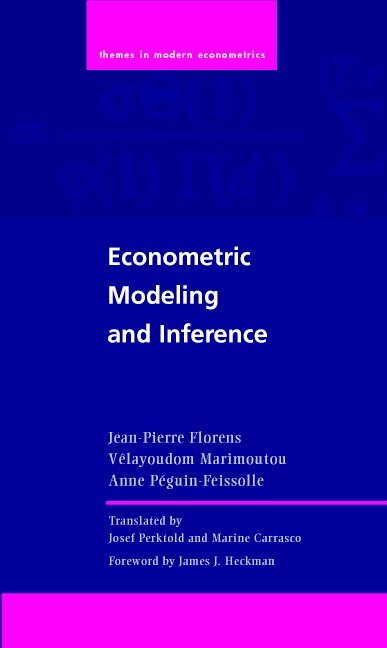
    Econometric Modeling and Inference

    AvJean-Pierre Florens,Velayoudom Marimoutou

    Inbunden, Engelska, 2007

    Del i serien Themes in Modern Econometrics

    1 082 kr

    Tillfälligt slut

    Fler format och utgåvor

    Häftad

    674 kr

    Beskrivning

    Presents the main statistical tools of econometrics, focusing specifically on modern econometric methodology. The authors unify the approach by using a small number of estimation techniques, mainly generalized method of moments (GMM) estimation and kernel smoothing. The choice of GMM is explained by its relevance in structural econometrics and its preeminent position in econometrics overall. Split into four parts, Part I explains general methods. Part II studies statistical models that are best suited for microeconomic data. Part III deals with dynamic models that are designed for macroeconomic and financial applications. In Part IV the authors synthesize a set of problems that are specific to statistical methods in structural econometrics, namely identification and over-identification, simultaneity, and unobservability. Many theoretical examples illustrate the discussion and can be treated as application exercises. Nobel Laureate James A. Heckman offers a foreword to the work.

    Produktinformation

    • Utgivningsdatum:2007-07-02
    • Mått:152 x 235 x 29 mm
    • Vikt:802 g
    • Format:Inbunden
    • Språk:Engelska
    • Serie:Themes in Modern Econometrics
    • Antal sidor:518
    • Förlag:Cambridge University Press
    • ISBN:9780521876407
    • Översättare:Josef Perktold, Marine Carrasco

    Utforska kategorier

    • Mikroekonomi inom Ekonomi och Ledarskap

    Mer om författaren

    Jean-Pierre Florens is Professor of Mathematics at the University of Toulouse I, where he holds the Chair in Statistics and Econometrics, and a senior member of the Institut Universitaire de France. He is also a member of the IDEI and GREMAQ research groups. Professor Florens' research interests include: statistics and econometrics methods, applied econometrics, and applied statistics. He is coauthor of Elements of Bayesian Statistics with Michel Mouchart and Jean-Marie Rolin (1990). The editor or co-editor of several econometrics and statistics books, he has also published numerous articles in the major econometric reviews, such as Econometrica, Journal of Econometrics, and Econometric Theory. Vêlayoudom Marimoutou is Professor of Economics at the University of Aix-Marseille 2 and a member of GREQAM. His research fields include: time series analysis, non-stationary processes, long range dependence, and applied econometrics of exchange rates, finance, macroeconometrics, convergence, and international trade. His articles have appeared in publications such as the Journal of International Money and Finance, Oxford Bulletin of Economics and Statistics, and the Journal of Applied Probability. Anne Peguin-Feissolle is Research Director of the National Center of Scientific Research (CNRS) and a member of the GREQAM. She conducts research on econometric modelling, especially nonlinear econometrics, applications to macroeconomics, finance, spatial economics, artificial neural network modelling, and long memory problems. Professor Peguin-Feissolle's published research has appeared in Economics Letters, Economic Modelling, European Economic Review, Applied Economics, and the Annales d'Economie et de Statistique, among other publications.

    Recensioner i media

    'This book is invaluable to researchers and all who are interested in the statistical analysis of time series, microeconomic data, financial and econometric models.' Journal of Applied Statistics

    Innehållsförteckning

    • Part I. Statistical Methods: 1. Statistical models; 2. Sequential models and asymptotics; 3. Estimation by maximization and by the method of moments; 4. Asymptotic tests; 5. Nonparametric methods; 6. Simulation methods; Part II. Regression Models: 7. Conditional expectation; 8. Univariate regression; 9. Generalized least squares method, heteroskedasticity, and multivariate regression; 10. Nonparametric estimation of the regression; 11. Discrete variables and partially observed models; Part III. Dynamic Models: 12. Stationary dynamic models; 13. Nonstationary processes and cointegration; 14. Models for conditional variance; 15. Nonlinear dynamic models; Part IV. Structural Modeling: 16. Identification and over identification in structural modeling; 17. Simultaneity; 18. Models with unobservable variables.