• Fri frakt över 249 kr
  • •
  • Snabba leveranser
  • •
  • Billiga böcker
Kundservice

Du är på sajten för privatpersoner.

Företag, bibliotek eller offentlig verksamhet?

Du handlar på classic.bokus.com, där alla dina funktioner finns intakta.
Till classic.bokus.com
Bokus logotyp. Gå till startsidan.
  • Erbjudanden
  • Nyheter
  • Student
  • Topplistor
  • Barn & ungdom
  • Bokus Play
  • E-böcker
  • Pocketböcker
  • Spel & pussel

10% rabatt på allt med kod: NYSTART10 →

Sidfot

Mina sidor

    Hjälp

    • Kundservice
    • Vanliga frågor och svar
    • Frakt och leverans
    • Retur vid ångerrätt
    • Reklamera vara
    • Betalning
    • Köpvillkor
    • Allmänna villkor
    • Information om webbplatsens tillgänglighet

    Om Bokus

    • Om oss
    • Pressrum
    • För studenter
    • För företag
    • För bibliotek och offentlig verksamhet
    • För leverantörer
    • Hållbarhet

    Populärt

    • Aktuella erbjudanden
    • Presentkort
    • Studentlitteratur
    • Nya böcker
    • Topplistor
    • Signerade böcker
    • Engelska böcker

    Inspiration

    • Boktips
    • BookTok
    • Populära bokserier
    • Barnbokskaraktärer
    • Populära författare
    Logotyp för Bokus
    Följ oss på Facebook (extern länk)Följ oss på Instagram (extern länk)Följ oss på YouTube (extern länk)Följ oss på TikTok (extern länk)
    bokus @ CookiesAnpassa cookiesIntegritetspolicyKöpvillkor
    Till Citymail hemsida (extern länk)Till Budbee hemsida (extern länk)Till Postnord hemsida (extern länk)Till Schenker hemsida (extern länk)Till Early Bird hemsida (extern länk)Till Walleys hemsida (extern länk)
    1. Kultur
    2. Musikböcker

    The Great Transformation of Musical Taste

    Concert Programming from Haydn to Brahms

    AvWilliam Weber

    Inbunden, Engelska, 2008

    1 582 kr

    Beställningsvara. Skickas inom 10-15 vardagar. Fri frakt över 249 kr.

    Fler format och utgåvor

    Häftad

    684 kr

    Beskrivning

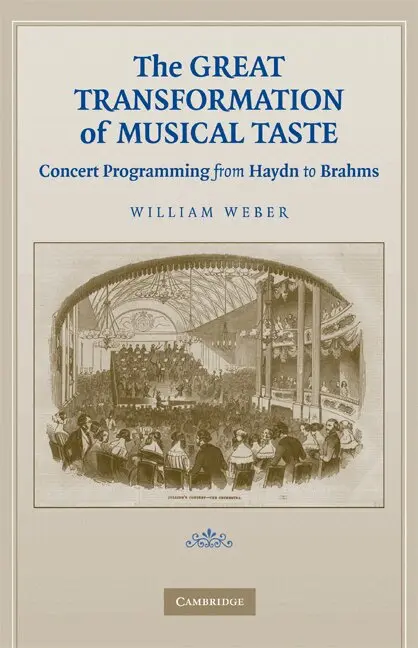
    Grounded in knowledge of thousands of programs, this book examines how musical life in London, Leipzig, Vienna, Boston, and other cities underwent a fundamental transformation in relationship with movements in European politics. William Weber traces how musical taste evolved in European concert programs from 1750 to 1870, as separate worlds arose around classical music and popular songs. In 1780 a typical program accommodated a variety of tastes through a patterned 'miscellany' of genres, held together by diplomatic musicians. This framework began weakening around 1800 as new kinds of music appeared, from string quartets to quadrilles to ballads, which could not easily coexist on the same programs. Utopian ideas and extravagant experiments influenced programming as ideological battles were fought over who should govern musical taste. More than a hundred illustrations or transcriptions of programs enable readers to follow Weber's analysis in detail.

    Produktinformation

    • Utgivningsdatum:2008-05-28
    • Mått:158 x 234 x 23 mm
    • Vikt:720 g
    • Format:Inbunden
    • Språk:Engelska
    • Antal sidor:378
    • Förlag:Cambridge University Press
    • ISBN:9780521882606

    Utforska kategorier

    • Musikböcker inom Kultur

    Mer om författaren

    William Weber is Professor of History at California State University, Long Beach.

    Recensioner i media

    Review of the hardback: 'Wonderful book for 'classical' music lovers … This book gets good reviews elsewhere and for good reason: it is fascinating and informative. A must-have.' E. Douglas Jensen, www.amazon.com

    Innehållsförteckning

    • Introduction; Part I. Miscellany and Collegiality, 1750–1800: 1. Concepts and contexts; 2. Variations on miscellany; Part II. Crisis and Experiment, 1800–48: 3. Musical idealism and the crisis of the old order; 4. The rise of the chamber-music concert; 5. Convention and experiment in benefit and virtuoso concerts; 6. Toward classical-music orchestral concerts; 7. Promenade concerts: rise of the 'pops'; Part III. Founding a New Order, 1848–75: 8. Classical music achieves hegemony; 9. Vocal music for the general public; 10. Epilogue: state of the musical community in 1914.