• Fri frakt över 249 kr
  • •
  • Snabba leveranser
  • •
  • Billiga böcker
Kundservice

Du är på sajten för privatpersoner.

Företag, bibliotek eller offentlig verksamhet?

Du handlar på classic.bokus.com, där alla dina funktioner finns intakta.
Till classic.bokus.com
Bokus logotyp. Gå till startsidan.
  • Erbjudanden
  • Nyheter
  • Student
  • Topplistor
  • Barn & ungdom
  • Bokus Play
  • E-böcker
  • Pocketböcker
  • Spel & pussel

10% rabatt på allt med kod NYSTART10 →

Sidfot

Mina sidor

    Hjälp

    • Kundservice
    • Vanliga frågor och svar
    • Frakt och leverans
    • Retur vid ångerrätt
    • Reklamera vara
    • Betalning
    • Köpvillkor
    • Allmänna villkor
    • Information om webbplatsens tillgänglighet

    Om Bokus

    • Om oss
    • Pressrum
    • För studenter
    • För företag
    • För bibliotek och offentlig verksamhet
    • För leverantörer
    • Hållbarhet

    Populärt

    • Aktuella erbjudanden
    • Presentkort
    • Studentlitteratur
    • Nya böcker
    • Topplistor
    • Signerade böcker
    • Engelska böcker

    Inspiration

    • Boktips
    • BookTok
    • Populära bokserier
    • Barnbokskaraktärer
    • Populära författare
    Logotyp för Bokus
    Följ oss på Facebook (extern länk)Följ oss på Instagram (extern länk)Följ oss på YouTube (extern länk)Följ oss på TikTok (extern länk)
    bokus @ CookiesAnpassa cookiesIntegritetspolicyKöpvillkor
    Till Citymail hemsida (extern länk)Till Budbee hemsida (extern länk)Till Postnord hemsida (extern länk)Till Schenker hemsida (extern länk)Till Early Bird hemsida (extern länk)Till Walleys hemsida (extern länk)
    1. Språk och ordböcker
    2. Språkvetenskap och lingvistik

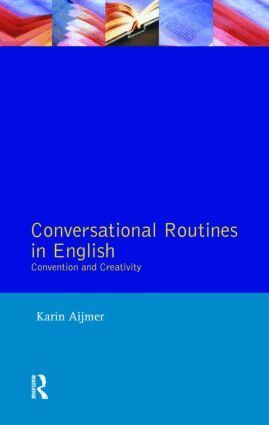
    Conversational Routines in English

    Convention and Creativity

    AvKarin Aijmer

    Häftad, Engelska, 1996

    Del i serien Studies in Language and Linguistics

    1 020 kr

    Beställningsvara. Skickas inom 10-15 vardagar. Fri frakt över 249 kr.

    Fler format och utgåvor

    Inbunden

    2 495 kr

    E-bok

    1 209 kr

    E-bok

    1 212 kr

    Beskrivning

    It is surprising how much of everyday conversation consists of repetitive expressions such as 'thank you', 'sorry', would you mind?' and their many variants. However commonplace they may be, they do have important functions in communication.This thorough study draws upon original data from the London-Lund Corpus of Spoken English to provide a discoursal and pragmatic account of the more common expressions found in conversational routines, such as apologising, thanking, requesting and offering.The routines studied in this book range from conventionalized or idiomatized phrases to those which can be generated by grammar. Examples have been taken from face-to-face conversations, radio discussions and telephone conversations, and transcription has been based upon the prosodic system of Crystal (1989).An extensive introduction provides the theory and methodology for the book and discusses the criteria for fixedness, grammatical analysis, and pragmatic functions of conversational routines which are later applied to the phrases. Following chapters deal specifically with phrases for thanking, apologising, indirect requests, and discourse-organising markers for conversational routines, on the basis of empirical investigation of the data from the London-Lund Corpus of Spoken English.

    Produktinformation

    • Utgivningsdatum:1996-10-29
    • Mått:138 x 216 x 13 mm
    • Vikt:500 g
    • Format:Häftad
    • Språk:Engelska
    • Serie:Studies in Language and Linguistics
    • Antal sidor:268
    • Förlag:Taylor & Francis Ltd
    • ISBN:9780582082113

    Utforska kategorier

    • Språkvetenskap och lingvistik inom Språk och ordböcker

    Recensioner i media

    "This book should benefit anyone interested in the area of communication and interaction and the social activity that it involves." ENGLISH LANGUAGE AND LINGUISTICS

    Innehållsförteckning

    • PrefaceAcknowledgementsCHAPTER ONE: Introduction1.1 Aim and scope of the present study1.2 Material and method1.3 Frequency of conversational routines in spoken language1.4 Psychological aspects of conversational routines1.5 Conversational routines and ritualisation1.6 Lexicalization, grammaticalisation an idiomatisation1.7 Conversational routines and meaning1.8 Criteria of fixdedness1.9. The processing of conversational routines1.10. Routines and discourse1.11 Conversational routines and grammatical analysis1.12. A model for describing the strucural flexibility of conversational routines1.13 The pragmatic function of conversational routines1.14 The pragmatics of conversational routines1.15 Conversational routines and language teachingCHAPTER TWO: Thanking2.1 Introduction2.2 Thank you/thanks as an illolcutionary force indicating device2.3 Thanking and politeness2.4 Strategies of thanking 2.5 Gratitude expressions2.6 Continuation patterns2.7 The grammatical analysis of gratitude expressions2.8 Prosody an fixedness 2.9 Distribution of thanking over different texts 2.10 Thank you/thanks as stems 2.11 The functions of gratitutude expressions 2.12 Thanking as a discourse marker 2.13 The pragmatics of thanking 2.14 Frames for thanking 2.15 ConclusionCHAPTER THREE: Apologies 3.1 Introduction 3.2 Defining apologies 3.3 Apologising strategies 3.4 The form of apologising3.5 Continuation patterns 3.6 The grammatical analysis of apology and expression 3.7 Apologies and prosody 3.8 Distribution of apologies over different texts 3.9 Collocational fixedness and flexibility 3.10 Apologies and function 3.11 Retrospective and anticipatory apologies 3.12 The structural function of apologies 3.13 The type of offence 3.14 Apologies and pragmatic frames 3.15 Conclusion CHAPTER FOUR: Requests and offers 4.1 Introduction 4.2 The speech act assignment mechanism and indirect speech acts 4.3 Indirect speech acts and pragmatic principles 4.4 Indirect speech acts and implicature 4.5 Pragmatic ambiguity 4.6 Defining requests 4.7 Requestive strategies 4.8 A taxonomy of requests 4.9 Requests and politeness 4.10 Continuation patterns 4.11 The grammatical analysis of requestive routines 4.12 Describing request expressions 4.13 Indirect requests and speech act stems 4.14 Types of stem4.15 Lexical mitigating devices 4.16 Internal and external modifiers 4.17 Referential strategies 4.18 Requests and pragmatic conventions 4.19 Imperatives 4.20 Patterns expressing offers 4.21 Conclusion CHAPTER FIVE: Discourse markers as conversational routines 5.1 Introduction 5.2 Coherence and discourse markers 5.3 Discourse markers characterized 5.4 The metalinguistic function 5.5 Relevance theory and communication 5.6 The approach to discourse markers in this work5.7 The linguistic properties of discourse markers 5.8 Contextual properties of discourse markers 5.9 Functional properties of discourse markers 5.10 Combinations in the discourse marker slot 5.11 Discourse markers and cognitive frames 5.12 Conclusion References Index