• Fri frakt över 249 kr
  • •
  • Snabba leveranser
  • •
  • Billiga böcker
Kundservice

Du är på sajten för privatpersoner.

Företag, bibliotek eller offentlig verksamhet?

Du handlar på classic.bokus.com, där alla dina funktioner finns intakta.
Till classic.bokus.com
Bokus logotyp. Gå till startsidan.
  • Erbjudanden
  • Student
  • Topplistor
  • Barn & ungdom
  • Bokus Play
  • E-böcker
  • Ljudböcker
  • Pocketböcker
  • Spel och pussel

Pocketfynda! Hundratals böcker för 49 kr/st →

Sidfot

Mina sidor

    Hjälp

    • Kundservice
    • Vanliga frågor och svar
    • Frakt och leverans
    • Retur vid ångerrätt
    • Reklamera vara
    • Betalning
    • Köpvillkor
    • Allmänna villkor
    • Information om webbplatsens tillgänglighet

    Om Bokus

    • Om oss
    • Pressrum
    • För studenter
    • För företag
    • För bibliotek och offentlig verksamhet
    • För leverantörer
    • Hållbarhet

    Populärt

    • Aktuella erbjudanden
    • Presentkort
    • Studentlitteratur
    • Nya böcker
    • Topplistor
    • Signerade böcker
    • Engelska böcker

    Inspiration

    • Boktips
    • BookTok
    • Barnbokskaraktärer
    • Populära författare
    Logotyp för Bokus
    Följ oss på Facebook (extern länk)Följ oss på Instagram (extern länk)Följ oss på YouTube (extern länk)Följ oss på TikTok (extern länk)
    bokus @ CookiesAnpassa cookiesIntegritetspolicyKöpvillkor
    Till Citymail hemsida (extern länk)Till Budbee hemsida (extern länk)Till Postnord hemsida (extern länk)Till Schenker hemsida (extern länk)Till Early Bird hemsida (extern länk)Till Walleys hemsida (extern länk)
    1. Data och IT
    2. Programmeringsböcker
    3. Webbprogrammering

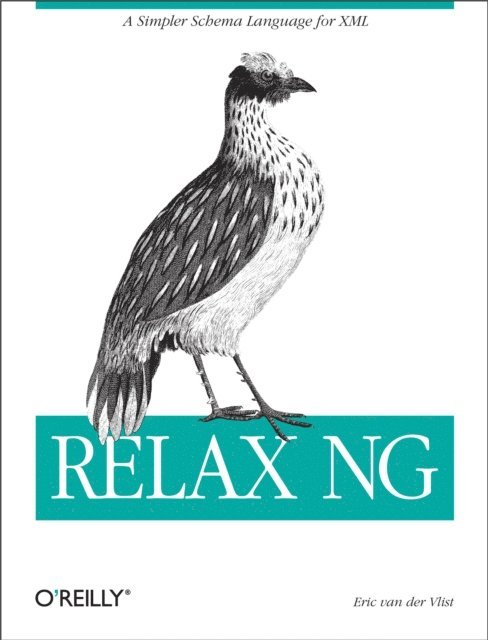
    Relax NG

    AvEric Van Der Vlist

    Häftad, Engelska, 2004

    Del i serien O'Reilly Ser.

    264 kr

    Beställningsvara. Skickas inom 5-8 vardagar. Fri frakt över 249 kr.

    Fler format och utgåvor

    E-bok

    328 kr

    E-bok

    328 kr

    Beskrivning

    As developers know, the beauty of XML is that it is extensible, even to the point that you can invent new elements and attributes as you write XML documents. Then, however, you need to define your changes so that applications will be able to make sense of them and this is where XML schema languages come into play. RELAX NG (pronounced relaxing), the Regular Language Description for XML Core--New Generation is quickly gaining momentum as an alternative to other schema languages. Designed to solve a variety of common problems raised in the creation and sharing of XML vocabularies, RELAX NG is less complex than The W3C's XML Schema Recommendation and much more powerful and flexible than DTDs. RELAX NG is a grammar-based schema language that's both easy to learn for schema creators and easy to implement for software developers In RELAX NG, developers are introduced to this unique language and will learn a no-nonsense method for creating XML schemas. This book offers a clear-cut explanation of RELAX NG that enables intermediate and advanced XML developers to focus on XML document structures and content rather than battle the intricacies of yet another convoluted standard.RELAX NG covers the following topics in depth: Introduction to RELAX NG Building RELAX NG schemas using XML syntax Building RELAX NG schemas using compact syntax, an alternative non-XML syntax Flattening schemas to limit depth and provide reusability Using external datatype libraries with RELAX NG W3C XML Schema regular expressions Writing extensible schemas Annotating schemas Generating schemas form different sources Determinism and datatype assignment and much more. If you're looking for a schema language that's easy to use and won't leave you in a labyrinth of obscure limitations, RELAX NG is the language you should be using. And only O'Reilly's RELAX NG gives you the straightforward information and everything else you'll need to take advantage of this powerful and intelligible language.

    Produktinformation

    • Utgivningsdatum:2004-01-20
    • Mått:180 x 235 x 26 mm
    • Vikt:720 g
    • Format:Häftad
    • Språk:Engelska
    • Serie:O'Reilly Ser.
    • Antal sidor:506
    • Förlag:O'Reilly Media
    • ISBN:9780596004217

    Utforska kategorier

    • Webbprogrammering inom Data och IT

    Mer om författaren

    Eric van der Vlist is the resident expert on XML schema languages on XML.com. He is also a member of the ISO DSDL committee, where standardization work on RELAX NG and related specifications is in progress. Eric is also the author of O'Reilly's XML Schema.

    Recensioner i media

    "Thorough and competent guide to a complex topic, written by an obvious expect in the field."Linux Format, September

    Innehållsförteckning

    • Foreword by James Clark; Foreword by Murata Makoto; Preface Part I. Tutorial; 1. What RELAX NG Offers; Diversity; Keeping Documents Independent of Applications; Validation Has Many Aspects The Best Way to Validate XML Document Structures; RELAX NG's Diverse Applications; RELAX NG as a Pivot Format; Why Use Other Schema Languages?; 2. Simple Foundations Are Beautiful; Documents and Infosets; Different Types of Schema Languages; A Simple Example A Strong Mathematical Background; Patterns, and Only Patterns 3. First Schema; Getting Started; First Patterns; Complete Schema; 4. Introducing the Compact Syntax; First Compact Patterns; Full Schema; XML or Compact?; 5. Flattening the First Schema; Defining Named Patterns; Referencing Named Patterns The grammar and start Elements; Assembling the Parts; Problems That Never Arise; Recursive Models; Escaping Named Pattern Identifiers in the Compact Syntax; 6. More Complex Patterns The group Pattern; The interleave Pattern; The choice Pattern Pattern Compositions; Order Variation as a Source of Information Text and Empty Patterns, Whitespace, and Mixed Content Why Is It Called interleave?; Mixed Content Models with Order A Restriction Related to interleave; A Missing Pattern: Unordered Group; 7. Constraining Text Values; Fixed Values; Co-Occurrence Constraints; Enumerations; Whitespace and RELAX NG Native Datatypes; Using String Datatypes in Attribute Values; When to Use String Datatypes; Using Different Types in Each Value; Exclusions; Lists; Data Versus Text; 8. Datatype Libraries W3C XML Schema Type Library; DTD Compatibility Datatypes Which Library Should Be Used?; 9. Using Regular Expressions to Specify Simple Datatypes; A Swiss Army Knife; The Simplest Possible Pattern Facets; Quantifying; More Atoms; Common Patterns; 10. Creating Building Blocks; Using External References; Merging Grammars; A Real-World Example: XHTML 2.0 Other Options; 11. Namespaces; A Ten-Minute Guide to XML Namespaces; The Two Challenges of Namespaces; Declaring Namespaces in Schemas; Accepting Foreign Namespaces; Namespaces, Building Blocks, and Chameleon Design; 12. Writing Extensible Schemas; Extensible Schemas; The Case for Open Schemas; Extensible and Open?; 13. Annotating Schemas Common Principles for Annotating RELAX NG Schemas; Documentation Annotation for Applications; 14. Generating RELAX NG Schemas Examplotron: Instance Documents as Schemas; Literate Programming UML; Spreadsheets; 15. Simplification and Restrictions Simplification; Restrictions; 16. Determinism and Datatype Assignment; What Is Ambiguity?; The Downsides of Ambiguous and Nondeterministic Content Models; Some Ideas to Make Disambiguation Easier; Part II. Reference; 17. Element Reference 18. Compact Syntax Reference; 19. Datatype Reference; Part III. Appendixes; A. DSDL; B. The GNU Free Documentation License Glossary; Index