• Fri frakt över 249 kr
  • •
  • Snabba leveranser
  • •
  • Billiga böcker
Kundservice

Du är på sajten för privatpersoner.

Företag, bibliotek eller offentlig verksamhet?

Du handlar på classic.bokus.com, där alla dina funktioner finns intakta.
Till classic.bokus.com
Bokus logotyp. Gå till startsidan.
  • Erbjudanden
  • Nyheter
  • Student
  • Topplistor
  • Barn & ungdom
  • Bokus Play
  • E-böcker
  • Pocketböcker
  • Spel & pussel

10% rabatt på allt med kod NYSTART10 →

Sidfot

Mina sidor

    Hjälp

    • Kundservice
    • Vanliga frågor och svar
    • Frakt och leverans
    • Retur vid ångerrätt
    • Reklamera vara
    • Betalning
    • Köpvillkor
    • Allmänna villkor
    • Information om webbplatsens tillgänglighet

    Om Bokus

    • Om oss
    • Pressrum
    • För studenter
    • För företag
    • För bibliotek och offentlig verksamhet
    • För leverantörer
    • Hållbarhet

    Populärt

    • Aktuella erbjudanden
    • Presentkort
    • Studentlitteratur
    • Nya böcker
    • Topplistor
    • Signerade böcker
    • Engelska böcker

    Inspiration

    • Boktips
    • BookTok
    • Populära bokserier
    • Barnbokskaraktärer
    • Populära författare
    Logotyp för Bokus
    Följ oss på Facebook (extern länk)Följ oss på Instagram (extern länk)Följ oss på YouTube (extern länk)Följ oss på TikTok (extern länk)
    bokus @ CookiesAnpassa cookiesIntegritetspolicyKöpvillkor
    Till Citymail hemsida (extern länk)Till Budbee hemsida (extern länk)Till Postnord hemsida (extern länk)Till Schenker hemsida (extern länk)Till Early Bird hemsida (extern länk)Till Walleys hemsida (extern länk)
    1. Data och IT
    2. Databaser

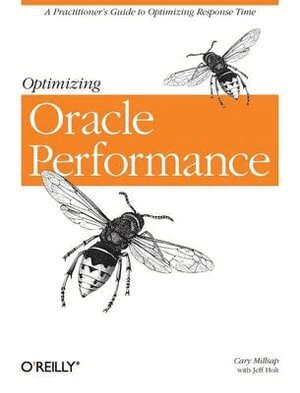
    Optimizing Oracle Performance

    AvCary Millsap

    Häftad, Engelska, 2003

    Del i serien O'Reilly Ser.

    300 kr

    Beställningsvara. Skickas inom 5-8 vardagar. Fri frakt över 249 kr.

    Beskrivning

    This text dispenses with database-centric metrics and instead shows how to use Oracle's response time statistics to diagnose performance problems in an Oracle application system. Former VP of Oracle's System Performance Group, Cary Millsap, clearly shows how eliminating requests for unneeded work improves performance dramatically. He also shows how the mathematical discipline of queueing theory can be combined with response time metrics to accurately predict the impact of system changes and upgrades. This text clearly and concisely explains how to use Oracle's response time statistics to diagnose and repair performance problems. It also shows how "queueing theory" can be applied to response time statistics to predict the impact of upgrades and other system changes. The book aims to eliminate the time-consuming, trial-and-error guesswork inherent in most conventional approaches to tuning. You can determine exactly where a system's performance problem is, and with equal importance,where it is not, in just a few minutes - even if the problem is several years old.It also intends to cut a path through the complexity of current tuning methods, and streamline an approach that focuses on optimization techniques that any DBA can use quickly and successfully to make noticeable - even dramatic - improvements. For example, the one thing database users care most about is response time. Naturally, DBAs focus much of their time and effort towards improving response time. But it is entirely too easy to spend hundreds of hours to improve important system metrics such as hit ratios, average latencies, and wait times, only to find users are unable to perceive the difference. And an expensive hardware upgrade may not help either.

    Produktinformation

    • Utgivningsdatum:2003-10-21
    • Mått:1720 x 250 x 2380 mm
    • Vikt:640 g
    • Format:Häftad
    • Språk:Engelska
    • Serie:O'Reilly Ser.
    • Antal sidor:390
    • Förlag:O'Reilly Media
    • ISBN:9780596005276

    Utforska kategorier

    • Databaser inom Data och IT

    Mer om författaren

    Cary Millsap is the former Vice President of Oracle's System Performance Group and the cofounder of Hotsos (http://www.hotsos.com), a company dedicated to Oracle system performance. Hotsos provides performance-improvement tools for Oracle environments and also delivers training in the form of clinics and symposiums. Cary is also a founding member of the Oak Table Network (http://www.oaktable.net), an informal association of "Oracle Scientists" well known throughout the Oracle community. Jeff Holt is one of the world's most productive Oracle performance optimization specialists. He has tremendous experience in constructing training programs and software tools to optimize the system performance management process. He is a former support analyst and consultant at Oracle Corporation, where he served as a technology leader in the System Performance Group. He is the Hotsos Tools lead designer and developer, the author of several technical papers, a Hotsos founding employee, and a Hotsos Clinic principal developer.

    Innehållsförteckning

    • Part I. Method 1. A Better Way to Optimize "You're Doing It Wrong" Requirements of a Good Method Three Impor tant Advances Tools for Analyzing Response Time Method R 2. Targeting the Right User Actions Specification Reliability Making a Good Specification Specification Over-Constraint 3. Targeting the Right Diagnostic Data Expectations About Data Collection Data Scope Oracle Diagnostic Data Sources For More Information 4. Targeting the Right Improvement Activity A New Standard of Customer Care How to Find the Economically Optimal Performance Improvement Activity Making Sense of Your Diagnostic Data Forecasting Project Net Payoff Part II. Reference 5. Interpreting Extended SQL Trace Data Trace File Walk-Through Extended SQL Trace Data Reference Response Time Accounting Evolution of the Res ponse Time Model Walking the Clock Forward Attribution Detailed Trace File Walk-Through Exercises 6. Collecting Extended SQL Trace Data Understanding Your Application Activating Extended SQL Trace Finding Your Trace File(s) Eliminating Collection Error Exercises 7. Oracle Kernel Timings Operating System Process Management Oracle Kernel Timings How Software Measures Itself Unaccounted-for Time Measurement Intrusion Effect CPU Consumption Double- Counting Quantization Error Time Spent Not Executing Un-Instrumented Oracle Kernel Code Exercises 8. Oracle Fixed View Data Deficiencies of Fixed View Data Fixed View Reference Useful Fixed View Queries The Oracle "Wait Interface" Exercises 9. Queueing Theory for the Oracle Practitioner Performance Models Queueing Queueing Theory The M/M/m Queueing Model Perspective Exercises Part III. Deployment10. Working the Resource Profile How to Work a Resource Profile How to Forecast Improvement How to Tell When Your Work Is Done 11. Responding to the Diagnosis Beyond the Resource Profile Response Time Components Eliminating Wasteful Work Attributes of a Scalable Application 12. Case Studies Case 1: Misled by System-Wide Data Case 2: Large CPU Service Duration Case 3 : Large SQL*Net Event Duration Case 4: Large Read Event Duration Conclusion Part IV. Appendixes A. Glossary B. Greek Alphabet C. Optimizing Your Database Buffer Cache Hit Ratio D. M/M/m Queueing Theory Formulas E. References.