• Fri frakt över 249 kr
  • •
  • Snabba leveranser
  • •
  • Billiga böcker
Kundservice

Du är på sajten för privatpersoner.

Företag, bibliotek eller offentlig verksamhet?

Du handlar på classic.bokus.com, där alla dina funktioner finns intakta.
Till classic.bokus.com
Bokus logotyp. Gå till startsidan.
  • Erbjudanden
  • Nyheter
  • Student
  • Topplistor
  • Barn & ungdom
  • Bokus Play
  • E-böcker
  • Pocketböcker
  • Spel & pussel

10% rabatt på allt med kod: NYSTART10 →

Sidfot

Mina sidor

    Hjälp

    • Kundservice
    • Vanliga frågor och svar
    • Frakt och leverans
    • Retur vid ångerrätt
    • Reklamera vara
    • Betalning
    • Köpvillkor
    • Allmänna villkor
    • Information om webbplatsens tillgänglighet

    Om Bokus

    • Om oss
    • Pressrum
    • För studenter
    • För företag
    • För bibliotek och offentlig verksamhet
    • För leverantörer
    • Hållbarhet

    Populärt

    • Aktuella erbjudanden
    • Presentkort
    • Studentlitteratur
    • Nya böcker
    • Topplistor
    • Signerade böcker
    • Engelska böcker

    Inspiration

    • Boktips
    • BookTok
    • Populära bokserier
    • Barnbokskaraktärer
    • Populära författare
    Logotyp för Bokus
    Följ oss på Facebook (extern länk)Följ oss på Instagram (extern länk)Följ oss på YouTube (extern länk)Följ oss på TikTok (extern länk)
    bokus @ CookiesAnpassa cookiesIntegritetspolicyKöpvillkor
    Till Citymail hemsida (extern länk)Till Budbee hemsida (extern länk)Till Postnord hemsida (extern länk)Till Schenker hemsida (extern länk)Till Early Bird hemsida (extern länk)Till Walleys hemsida (extern länk)
    1. Språk och ordböcker
    2. Språkundervisning och språkinlärning

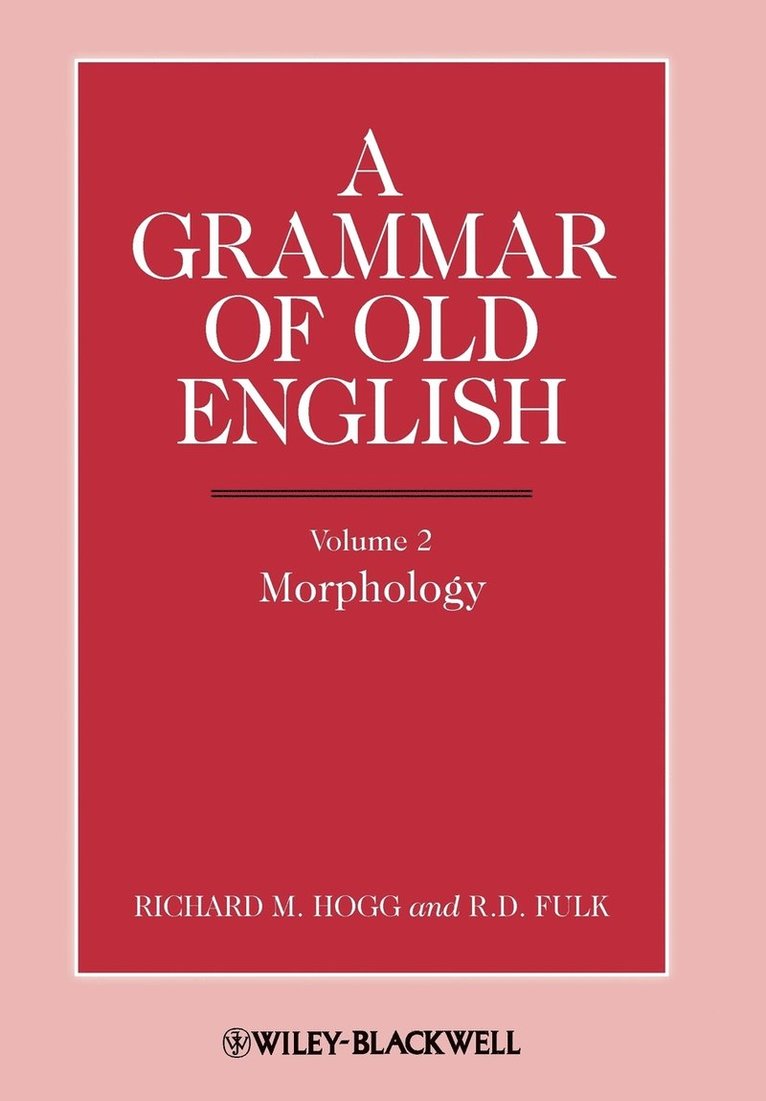
    Grammar of Old English, Volume 2

    Morphology

    AvRichard M. Hogg,R. D. Fulk

    Inbunden, Engelska, 2011

    1 479 kr

    Beställningsvara. Skickas inom 5-8 vardagar. Fri frakt över 249 kr.

    Beskrivning

    A Grammar of Old English, Volume II: Morphology completes Richard M. Hogg's two-volume analysis of the sounds and grammatical forms of the Old English language. Incorporates insights derived from the latest theoretical and technological advances, which post-date most Old English grammarsUtilizes the databases of the Toronto Dictionary of Old English project - a digital corpus comprising at least one copy of each text surviving in Old EnglishFeatures separation of diachronic and synchronic considerations in the sometimes complicated analysis of Old English noun morphologyIncludes extensive bibliographical coverage of Old English morphology

    Produktinformation

    • Utgivningsdatum:2011-01-28
    • Mått:163 x 236 x 33 mm
    • Vikt:748 g
    • Format:Inbunden
    • Språk:Engelska
    • Antal sidor:410
    • Förlag:John Wiley and Sons Ltd
    • ISBN:9780631136712

    Utforska kategorier

    • Språkundervisning och språkinlärning inom Språk och ordböcker

    Mer om författaren

    The late Richard M. Hogg was Professor of English Language at the University of Manchester. He was the General Editor of the Cambridge History of the English Language and author, with C. B. McCully, of Metrical Phonology: A Coursebook (1987), and editor, with David Denison, of A History of the English Language (2008). R. D. Fulk is Chancellor's Professor of English at Indiana University. His books include The Origins of Indo-European Quantitative Ablaut (1986), A History of Old English Meter (1992), and as editor, with Robert E. Bjork and John D. Niles, Klaeber's Beowulf and the Fight at Finnsburg, 4th Edition (2008).

    Recensioner i media

    “Above all, A Grammar of Old English. Volume 2: Morphology definitely serves its purpose as a work of reference. Its paragraphs are numbered separately and the inclusion of indexes of words as well as of subjects makes the work easy to consult. These features, combined with the undisputed quality of its contents, make this volume the reference work of choice for all Old English scholars and their overly ambitious students.”  (English Studies, 1 October 2013“Old English has a new authoritative grammar that will take its place as a reliable resource for decades to come and inspire more studies on the language.  It is a striking accomplishment.”  (English Language and Linguistics, 1 January 2013)

    Innehållsförteckning

    • Preface xAcknowledgments xiiList of abbreviations xiii1 Preliminaries 12 Nouns: Stem Classes 7I Early backgrounds (§§1–9) 7II Vocalic stems (§§10–77) 141 a-stem nouns (§§10–33) 14(a) Simple a-stems (§§11–18) 14(b) ja-stems (§§19–26) 18(c) wa-stems (§§27–33) 222 d-stem nouns (§§34 –54) 26(a) Simple d-stems (§§35– 44) 26(b) jd-stems (§§45–51) 32(c) wd-stems (§§52– 4) 363 i-stem nouns (§§55–70) 374 u-stem nouns (§§71–7) 46III Consonantal stems (§§78–114) 481 n-stem nouns (§§78–90) 48(a) dn-stems (§§80–7) 49(b) cn-stems (§§88–90) 542 r-stem nouns (§§91– 4) 553 s-stem nouns (§§95–101) 584 þ-stem nouns (§§102–3) 615 nd-stem nouns (§§104 –8) 626 Root-stem nouns (§§109–14) 643 Nouns: Declensions 69I Introduction (§§1–6) 69II as-declension (§§7–72) 721 Inflexions (§§8–11) 732 Allomorphic variation (§§12–72) 75(a) Restoration of A (§§14 –17) 76(b) Palatalization (§§18–20) 77(c) Back umlaut (§§21– 4) 78(d) Loss of [h] (§§25–9) 80(e) Devoicing (§§30–1) 83(f) Nominative singular in -e (§§32–8) 83(g) Geminate consonants (§§39– 41) 86(h) Nominative singular in -u (§42) 88(i) Nominative singular in -w (§§43–9) 88(j) Apocope (§§50–1) 92(k) Double plurals (§§52–5) 93(l) Disyllabic nouns (§§56–72) 95III a-declension (§§73–104) 1091 Inflexions (§§74 –80) 1092 Allomorphic variation (§§81–104) 112(a) Restoration of A (§§83– 4) 113(b) Palatalization (§85) 114(c) Back umlaut (§§86–7) 114(d) Loss of [h] and final devoicing (§§88–9) 115(e) Geminate consonants (§§90–1) 116(f) Stem-final /w/ (§§92– 4) 117(g) Apocope (§§95–9) 119(h) Disyllabic nouns (§§100– 4) 122IV an-declension (§§105–16) 1241 Inflexions (§§106–15) 1242 Allomorphic variation (§116) 129V Minor declensions (§§117–31) 1291 Minor a-plurals (§§117–21) 1292 Mutation plurals (§§122–7) 1323 Miscellanea (§§128–31) 136VI Gender and declension (§§132– 43) 1381 Gender (§§133–9) 1382 Declension (§§140–3) 142VII Nominal compounding (§§144 –7) 1434 Adjectives, Adverbs and Numerals 146I Introduction (§§1–3) 146II Indefinite (strong) adjectives (§§4 –56) 1471 Historical origins (§§4 –8) 1472 Inflexions (§§9–20) 1493 Allomorphic variation (§§21–56) 154(a) Restoration of A (§§22– 4) 154(b) Loss of [x] (§§25–30) 155(c) Nominative singular in -e (§§31–5) 159(d) Geminate consonants (§§36–7) 162(e) Nominative singular masculine in -u (§§38–9) 162(f) Nominative singular in -w (§40) 163(g) Apocope (§§41–3) 164(h) Disyllabic and polysyllabic stems (§§44 –52) 165(i) Past participles (§§53–6) 171III Definite (weak) adjectives (§§57–60) 1721 Historical origins and inflexions (§§57–9) 1722 Allomorphic variation (§60) 173IV Comparison of adjectives (§§61–75) 1741 Historical origins (§§61– 4) 1742 Variation in Old English (§§65–75) 177V Adverbs (§§76–9) 183VI Numerals (§§80–91) 1851 Cardinals (§§80–9) 1852 Ordinals (§§90–1) 1895 Pronouns 191I Introduction (§§1–2) 191II Demonstrative pronouns (§§3–13) 192III The anaphoric pronoun (§§14 –17) 197IV Interrogative pronouns (§§18–21) 200V Personal pronouns (§§22–32) 202VI Indefinite pronouns (§§33–7) 207VII Other pronominal types (§§38–9) 2096 Verbs 210I Early background (§§1–5) 210II Strong verbs (§§6–76) 2131 Inflexions (§§6–30) 213(a) Indicative present (§§11–20) 216(b) Indicative preterite (§§21–2) 222(c) Subjunctive (§§23–5) 223(d) Imperative (§26) 224(e) Non-finite forms (§§27–30) 2242 Stems (§§31–76) 225(a) Ablaut patterns (§§33–6) 227(b) Variant stem types (§§37– 42) 231(i) Weak presents (§37) 231(ii) Contracted verbs (§§38– 41) 231(iii) Alternations under Verner’s Law (§42) 234(c) Classes of strong verbs (§§43–76) 234(i) Class 1 (§§43–6) 234(ii) Class 2 (§§47–50) 236(iii) Class 3 (§§51–7) 239(iv) Class 4 (§§58–60) 243(v) Class 5 (§§61– 4) 246(vi) Class 6 (§§65–8) 248(vii) Class 7 (§§69–76) 251III Weak verbs (§§77–130) 2581 Weak class I (§§78–103) 258(a) Inflexions (§§80–8) 260(b) Stems (§§89–103) 265(i) Stems with original geminate (§92) 266(ii) Stems in dental consonant (§§93–5) 267(iii) Stems in original final sonorant (§§96–8) 268(iv) Contracted verbs with loss of [h] (§99) 272(v) Stems in final velar consonant (§§100–3) 2732 Weak class II (§§104 –20) 279(a) Inflexions (§§106–13) 279(b) Stems (§§114 –20) 2843 Weak class III (§§121–30) 289(a) Inflexions (§122–26) 290(b) Stems (§§127–30) 294IV Preterite-present verbs (§§131– 44) 2991 Inflexion and classes (§§132– 40) 300(a) Classes 1 and 2 (§§133– 4) 300(b) Class 3 (§§135–6) 302(c) Classes 4 and 5 (§§137–8) 303(d) Classes 6 and 7 (§§139– 40) 3052 Historical development (§§141– 4) 306V Athematic verbs (§§145–63) 3081 The verb bbon, wesan (§§146–51) 3092 The verb ddn (§§152–5) 3143 The verb gan (§§156–9) 3174 The verb willan (§§160–3) 320References 323Word index 342Subject index 383