• Fri frakt över 249 kr
  • •
  • Snabba leveranser
  • •
  • Billiga böcker
Kundservice

Du är på sajten för privatpersoner.

Företag, bibliotek eller offentlig verksamhet?

Du handlar på classic.bokus.com, där alla dina funktioner finns intakta.
Till classic.bokus.com
Bokus logotyp. Gå till startsidan.
  • Erbjudanden
  • Student
  • Topplistor
  • Barn & ungdom
  • Bokus Play
  • E-böcker
  • Ljudböcker
  • Pocketböcker
  • Spel och pussel

Pocketfynda! Hundratals böcker för 49 kr/st →

Sidfot

Mina sidor

    Hjälp

    • Kundservice
    • Vanliga frågor och svar
    • Frakt och leverans
    • Retur vid ångerrätt
    • Reklamera vara
    • Betalning
    • Köpvillkor
    • Allmänna villkor
    • Information om webbplatsens tillgänglighet

    Om Bokus

    • Om oss
    • Pressrum
    • För studenter
    • För företag
    • För bibliotek och offentlig verksamhet
    • För leverantörer
    • Hållbarhet

    Populärt

    • Aktuella erbjudanden
    • Presentkort
    • Studentlitteratur
    • Nya böcker
    • Topplistor
    • Signerade böcker
    • Engelska böcker

    Inspiration

    • Boktips
    • BookTok
    • Barnbokskaraktärer
    • Populära författare
    Logotyp för Bokus
    Följ oss på Facebook (extern länk)Följ oss på Instagram (extern länk)Följ oss på YouTube (extern länk)Följ oss på TikTok (extern länk)
    bokus @ CookiesAnpassa cookiesIntegritetspolicyKöpvillkor
    Till Citymail hemsida (extern länk)Till Budbee hemsida (extern länk)Till Postnord hemsida (extern länk)Till Schenker hemsida (extern länk)Till Early Bird hemsida (extern länk)Till Walleys hemsida (extern länk)
    1. Ekonomi och Ledarskap
    2. Nationalekonomi
    3. Makroekonomi

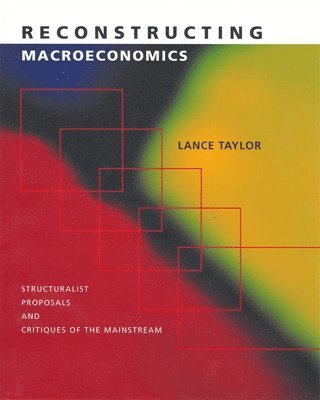
    Reconstructing Macroeconomics

    Structuralist Proposals and Critiques of the Mainstream

    AvLance Taylor

    Inbunden, Engelska, 2004

    845 kr

    Beställningsvara. Skickas inom 5-8 vardagar. Fri frakt över 249 kr.

    Beskrivning

    Macroeconomics is in disarray. No one approach is dominant, and an increasing divide between theory and empirics is evident. This book presents both a critique of mainstream macroeconomics from a structuralist perspective and an exposition of modern structuralist approaches. The fundamental assumption of structuralism is that it is impossible to understand a macroeconomy without understanding its major institutions and distributive relationships across productive sectors and social groups. Lance Taylor focuses his critique on mainstream monetarist, new classical, new Keynesian, and growth models. He examines them from a historical perspective, tracing monetarism from its eighteenth-century roots and comparing current monetarist and new classical models with those of the post-Wicksellian, pre-Keynesian generation of macroeconomists. He contrasts the new Keynesian vision with Keynes's General Theory, and analyzes contemporary growth theories against long traditions of thought about economic development and structural change.

    Produktinformation

    • Utgivningsdatum:2004-03-22
    • Mått:178 x 254 x 41 mm
    • Vikt:993 g
    • Format:Inbunden
    • Språk:Engelska
    • Antal sidor:456
    • Förlag:Harvard University Press
    • ISBN:9780674010734

    Utforska kategorier

    • Makroekonomi inom Ekonomi och Ledarskap

    Mer om författaren

    Lance Taylor is Arnhold Professor of International Cooperation and Development at the New School for Social Research.

    Recensioner i media

    Reconstructing Macroeconomics is a stunning intellectual achievement. It surveys an astonishing range of macroeconomic problems and approaches in a compact, coherent critical framework with unfailing depth, wit, and subtlety. Lance Taylor's pathbreaking work in structural macroeconomics and econometrics sets challenging standards of rigor, realism, and insight for the field. Taylor shows why the structuralist and Keynesian insistence on putting accounting consistency, income distribution, and aggregate demand at the center of macroeconomic analysis is indispensable to understanding real-world macroeconomic events in both developing and developed economies. The book is full of new results, modeling techniques, and shrewd suggestions for further research. Taylor's scrupulous and balanced appraisal of the whole range of macroeconomic schools of thought will be a source of new perspectives to macroeconomists of every persuasion.

    Innehållsförteckning

    • Acknowledgments Introduction 1. Social Accounts and Social Relations 1. A Simple Social Accounting Matrix 2. Implications of the Accounts 3. Disaggregating Effective Demand 4. A More Realistic SAM 5. Stock-Flow Relationships 6. A SAM and Asset Accounts for the United States 7. Further Thoughts 2. Prices and Distribution 1. Classical Macroeconomics 2. Classical Theories of Price and Distribution 3. Neoclassical Cost-Based Prices 4. Hat Calculus, Measuring Productivity Growth, and Full Employment Equilibrium 5. Mark-up Pricing in the Product Market 6. Efficiency Wages for Labor 7. New Keynesian Crosses and Methodological Reservations 8. First Looks at Inflation 3. Money, Interest, and Inflation 1. Money and Credit 2. Diverse Interest Theories 3. Interest Rate Cost-Push 4. Real Interest Rate Theory 5. The Ramsey Model 6. Dynamics on a Flying Trapeze 7. The Overlapping Generations Growth Model 8. Wicksell's Cumulative Process Inflation Model 9. More on Inflation Taxes 4. Effective Demand and Its Real and Financial Implications 1. The Commodity Market 2. Macro Adjustment via Forced Saving and Real Balance Effects 3. Real Balances, Input Substitution, and Money Wage Cuts 4. Liquidity Preference and Marginal Efficiency of Capital 5. Liquidity Preference, Fisher Arbitrage, and the Liquidity Trap 6. The System as a Whole 7. The IS/LM Model 8. Keynes and Friends on Financial Markets 9. Financial Markets and Investment 10. Consumption and Saving 11 "Disequilibrium" Macroeconomics 12. A Structuralist Synopsis 5. Short-Term Model Closure and Long-Term Growth 1. Model "Closures" in the Short Run 2. Graphical Representations and Supply-Driven Growth 3. Harrod, Robinson, and Related Stories 4. More Stable Demand-Determined Growth 6. Chicago Monetarism, New Classical Macroeconomics, and Mainstream Finance 1. Methodological Caveats 2. A Chicago Monetarist Model 3. A Cleaner Version of Monetarism 4. New Classical Spins 5. Dynamics of Government Debt 6. Ricardian Equivalence 7. The Business Cycle Conundrum 8. Cycles from the Supply Side 9. Optimal Behavior under Risk 10. Random Walk, Equity Premium, and the Modigliani-Miller Theorem 11. More on Modigliani-Miller 12. The Calculation Debate and Super-Rational Economics 7. Effective Demand and the Distributive Curve 1. Initial Observations 2. Inflation, Productivity Growth, and Distribution 3. Absorbing Productivity Growth 4. Effects of Expansionary Policy 5. Financial Extensions 6. Dynamics of the System 7. Comparative Dynamics 8. Open Economy Complications 8. Structuralist Finance and Money 1. Banking History and Institutions 2. Endogenous Finance 3. Endogenous Money via Bank Lending 4. Money Market Funds and the Level of Interest Rates 5. Business Debt and Growth in a Post-Keynesian World 6. New Keynesian Approaches to Financial Markets 9. A Genus of Cycles 1. Goodwin's Model 2. A Structuralist Goodwin Model 3. Evidence for the United States 4. A Contractionary Devaluation Cycle 5. An Inflation Expectations Cycle 6. Confidence and Multiplier 7. Minsky on Financial Cycles 8. Excess Capacity, Corporate Debt Burden, and a Cold Douche 9. Final Thoughts 10. Exchange Rate Complications 1. Accounting Conundrums 2. Determining Exchange Rates 3. Asset Prices, Expectations, and Exchange Rates 4. Commodity Arbitrage and Purchasing Power Parity 5. Portfolio Balance 6. Mundell-Fleming 7. IS/LM Comparative Statics 8. UIP and Dynamics 9. Open Economy Monetarism 10. Dornbusch 11. Other Theories of the Exchange Rate 12. A Developing Country Debt Cycle 13. Fencing in the Beast 11. Growth and Development Theories 1. New Growth Theories and Say's Law 2. Distribution and Growth 3. Models with Binding Resource or Sectoral Supply Constraints 4. Accounting for Growth 5. Other Perspectives 6. The Mainstream Policy Response 7. Where Theory Might Sensibly Go References Index