• Fri frakt över 249 kr
  • •
  • Snabba leveranser
  • •
  • Billiga böcker
Kundservice

Du är på sajten för privatpersoner.

Företag, bibliotek eller offentlig verksamhet?

Du handlar på classic.bokus.com, där alla dina funktioner finns intakta.
Till classic.bokus.com
Bokus logotyp. Gå till startsidan.
  • Erbjudanden
  • Student
  • Topplistor
  • Barn & ungdom
  • Bokus Play
  • E-böcker
  • Ljudböcker
  • Pocketböcker
  • Spel och pussel

5% studentrabatt – använd koden KURSBOK27 →

Sidfot

Mina sidor

    Hjälp

    • Kundservice
    • Vanliga frågor och svar
    • Frakt och leverans
    • Retur vid ångerrätt
    • Reklamera vara
    • Betalning
    • Köpvillkor
    • Allmänna villkor
    • Information om webbplatsens tillgänglighet

    Om Bokus

    • Om oss
    • Pressrum
    • För studenter
    • För företag
    • För bibliotek och offentlig verksamhet
    • För leverantörer
    • Hållbarhet

    Populärt

    • Aktuella erbjudanden
    • Presentkort
    • Studentlitteratur
    • Nya böcker
    • Topplistor
    • Signerade böcker
    • Engelska böcker

    Inspiration

    • Boktips
    • BookTok
    • Barnbokskaraktärer
    • Populära författare
    Logotyp för Bokus
    Följ oss på Facebook (extern länk)Följ oss på Instagram (extern länk)Följ oss på YouTube (extern länk)Följ oss på TikTok (extern länk)
    bokus @ CookiesAnpassa cookiesIntegritetspolicyKöpvillkor
    Till Citymail hemsida (extern länk)Till Budbee hemsida (extern länk)Till Postnord hemsida (extern länk)Till Schenker hemsida (extern länk)Till Early Bird hemsida (extern länk)Till Walleys hemsida (extern länk)
    1. Juridik
    2. Särskilda rättsområden

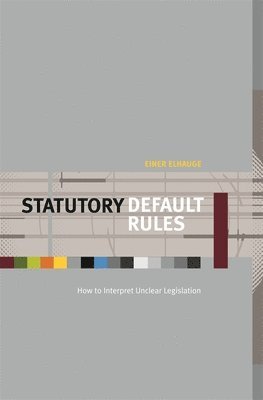
    Statutory Default Rules

    How to Interpret Unclear Legislation

    AvEiner Elhauge

    Inbunden, Engelska, 2008

    736 kr

    Beställningsvara. Skickas inom 10-15 vardagar. Fri frakt över 249 kr.

    Beskrivning

    Most new law is statutory law; that is, law enacted by legislators. An important question, therefore, is how should this law be interpreted by courts and agencies, especially when the text of a statute is not entirely clear. There is a great deal of scholarly literature on the rules and legal materials courts should use in interpreting statutes. This book takes a fresh approach by focusing instead on what judges should do once the legal materials fail to resolve the interpretive question. It challenges the common assumption that in such cases judges should exercise interstitial lawmaking power. Instead, it argues that--wherever one believes the interpretive inquiry has failed to resolve the statutory meaning--judges can and should use statutory default rules that are designed to maximize the satisfaction of enactable political preferences; that is, the political preferences of the polity that are shared among enough elected officials that they could and would be enacted into law if the issue were on the legislative agenda.These default rules explain many recent high-profile cases, including the Guantánamo detainees case, the sentencing guidelines case, the decision denying the FDA authority to regulate cigarettes, and the case that refused to allow the attorney general to criminalize drugs used in physician-assisted suicide.

    Produktinformation

    • Utgivningsdatum:2008-02-28
    • Mått:156 x 235 x 34 mm
    • Vikt:802 g
    • Format:Inbunden
    • Språk:Engelska
    • Antal sidor:400
    • Förlag:Harvard University Press
    • ISBN:9780674024601

    Utforska kategorier

    • Särskilda rättsområden inom Juridik

    Mer om författaren

    Einer Elhauge is Professor of Law at Harvard Law School.

    Recensioner i media

    Statutory Default Rules is an important contribution to the debate over legal interpretation. It rehabilitates the imaginative-reconstruction approach of Learned Hand and gives it new intellectual foundations, including a sophisticated appreciation of relevant social science.

    Innehållsförteckning

    • 1. Introduction and Overview 2. Why Courts Should Maximize Enactable Preferences when Statutes Are Unclear Part I. Current Preferences Default Rules 3. The General Theory for Current Preferences Default Rules 4. Inferring Current Preferences from Recent Legislative Action 5. Inferring Current Preferences from Agency Action Part II. Enactor Preferences Default Rules 6. From Legislative Intent to Probabilistic Estimates of Enactable Preferences 7. Moderation, Changed or Uncontemplated Circumstances, and a Theory of Meaning Part III. Preference-Eliciting Default Rules 8. Eliciting Legislative Preferences 9. Canons Favoring the Politically Powerless 10. Linguistic Canons of Statutory Construction 11. Interpretations that May Create International Conflict 12. Explaining Seeming Inconsistencies in Statutory Stare Decisis Part IV. Supplemental Default Rules 13. Tracking the Preferences of Political Subunits 14. Tracking High Court Preferences Part V. Objections 15. The Fit with Prior Political Science Models and Empirical Data 16. The Critiques of Politics by Interest Group Theory and Collective Choice Theory 17. Alternative Default Rules that Protect Reliance or Avoid Change or Effect 18. Rebutting Operational and Jurisprudential Objections Notes Index