• Fri frakt över 249 kr
  • •
  • Snabba leveranser
  • •
  • Billiga böcker
Kundservice

Du är på sajten för privatpersoner.

Företag, bibliotek eller offentlig verksamhet?

Du handlar på classic.bokus.com, där alla dina funktioner finns intakta.
Till classic.bokus.com
Bokus logotyp. Gå till startsidan.
  • Erbjudanden
  • Student
  • Topplistor
  • Barn & ungdom
  • Bokus Play
  • E-böcker
  • Ljudböcker
  • Pocketböcker
  • Spel och pussel

5% studentrabatt – använd koden KURSBOK27 →

Sidfot

Mina sidor

    Hjälp

    • Kundservice
    • Vanliga frågor och svar
    • Frakt och leverans
    • Retur vid ångerrätt
    • Reklamera vara
    • Betalning
    • Köpvillkor
    • Allmänna villkor
    • Information om webbplatsens tillgänglighet

    Om Bokus

    • Om oss
    • Pressrum
    • För studenter
    • För företag
    • För bibliotek och offentlig verksamhet
    • För leverantörer
    • Hållbarhet

    Populärt

    • Aktuella erbjudanden
    • Presentkort
    • Studentlitteratur
    • Nya böcker
    • Topplistor
    • Signerade böcker
    • Engelska böcker

    Inspiration

    • Boktips
    • BookTok
    • Barnbokskaraktärer
    • Populära författare
    Logotyp för Bokus
    Följ oss på Facebook (extern länk)Följ oss på Instagram (extern länk)Följ oss på YouTube (extern länk)Följ oss på TikTok (extern länk)
    bokus @ CookiesAnpassa cookiesIntegritetspolicyKöpvillkor
    Till Citymail hemsida (extern länk)Till Budbee hemsida (extern länk)Till Postnord hemsida (extern länk)Till Schenker hemsida (extern länk)Till Early Bird hemsida (extern länk)Till Walleys hemsida (extern länk)
    1. Juridik
    2. Rättsvetenskap
    3. Juridisk kompetens och praktik

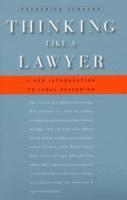
    Thinking Like a Lawyer

    A New Introduction to Legal Reasoning

    AvFrederick Schauer

    Häftad, Engelska, 2012

    201 kr

    Beställningsvara. Skickas inom 5-8 vardagar. Fri frakt över 249 kr.

    Beskrivning

    This primer on legal reasoning is aimed at law students and upper-level undergraduates. But it is also an original exposition of basic legal concepts that scholars and lawyers will find stimulating. It covers such topics as rules, precedent, authority, analogical reasoning, the common law, statutory interpretation, legal realism, judicial opinions, legal facts, and burden of proof.In addressing the question whether legal reasoning is distinctive, Frederick Schauer emphasizes the formality and rule-dependence of law. When taking the words of a statute seriously, when following a rule even when it does not produce the best result, when treating the fact of a past decision as a reason for making the same decision again, or when relying on authoritative sources, the law embodies values other than simply that of making the best decision for the particular occasion or dispute. In thus pursuing goals of stability, predictability, and constraint on the idiosyncrasies of individual decision-makers, the law employs forms of reasoning that may not be unique to it but are far more dominant in legal decision-making than elsewhere.Schauer’s analysis of what makes legal reasoning special will be a valuable guide for students while also presenting a challenge to a wide range of current academic theories.

    Produktinformation

    • Utgivningsdatum:2012-04-16
    • Mått:156 x 235 x 17 mm
    • Vikt:340 g
    • Format:Häftad
    • Språk:Engelska
    • Antal sidor:256
    • Förlag:Harvard University Press
    • ISBN:9780674062481

    Utforska kategorier

    • Juridisk kompetens och praktik inom Juridik

    Mer om författaren

    Frederick Schauer was the David and Mary Harrison Distinguished Professor of Law at the University of Virginia and the author of Free Speech: A Philosophical Enquiry; Playing by the Rules; Profiles, Probabilities, and Stereotypes; Thinking Like a Lawyer; and The Force of Law. He was a Fellow of the British Academy and of the American Academy of Arts and Sciences, was the Frank Stanton Professor of the First Amendment at Harvard University for twenty years, and was a founding editor of the journal Legal Theory.

    Recensioner i media

    A welcome complement to [Edward] Levi’s approach, as well as being easier for the legal novice to understand. Yet Schauer’s book also offers the lawyer and scholar useful perspective on what he or she does.

    Innehållsförteckning

    • * Preface * Is There Legal Reasoning? * Rules--in Law and Elsewhere 2.1 Of Rules in General 2.2 The Core and the Fringe 2.3 The Generality of Rules 2.4 The Formality of Law * The Practice and Problems of Precedent 3.1 Precedent in Two Directions 3.2 Precedent--The Basic Idea 3.3 A Strange Idea 3.4 On Identifying a Precedent 3.5 On the Force of Precedent--Overruling, Distinguishing, and Other Types of Avoidance * Authority and Authorities 4.1 The Idea of Authority 4.2 On Binding and So-Called Persuasive Authority 4.3 Why Real Authority Need Not be "Binding" 4.4 Can There Be Prohibited Authorities? 4.5 How Authorities Become Authoritative * The Use and Abuse of Analogies 5.1 On Distinguishing Precedent from Analogy 5.2 On the Determination of Similarity 5.3 The Skeptical Challenge 5.4 Analogy and the Speed of Legal Change * The Idea of the Common Law 6.1 Some History and a Comparison 6.2 On the Nature of the Common Law 6.3 How Does the Common Law Change? 6.4 Is the Common Law Law? 6.5 A Short Tour of the Realm of Equity * The Challenge of Legal Realism 7.1 Do Rules and Precedents Decide cases? 7.2 Does Doctrine Constrain Even if It Does Not Direct? 7.3 An Empirical Claim 7.4 Realism and the Role of the Lawyer 7.5 Critical Legal Studies and Realism in Modern Dress * The Interpretation of Statutes 8.1 Statutory Interpretation in the Regulatory State 8.2 The Role of the Text 8.3 When the Text Provides No Answer 8.4 When the Text Provides a Bad Answer 8.5 The Canons of Statutory Construction * The Judicial Opinion 9.1 The Causes and Consequences of Judicial Opinions 9.2 Giving Reasons 9.3 On Holding and Dicta 9.4 The Declining Frequency of Opinions * Making Law with Rules and Standards 10.1 The Basic Distinction 10.2 Rules, Standards, and the Question of Discretion 10.3 Stability and Flexibility 10.4 Rules and Standards in Judicial Opinions * Law and Fact 11.1 On the Idea of a Fact 11.2 Determining Facts at Trial--The Law of Evidence and Its Critics 11.3 Facts and the Appellate Process * The Burden of Proof and Its Cousins 12.1 The Burden of Proof 12.2 Presumptions 12.3 Deference and the Allocation of Decision-Making Responsibility * Index