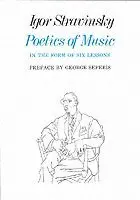
Häftad, Engelska, 1970
Poetics of Music in the Form of Six Lessons
Del 30 i serien Charles Eliot Norton Lectures
438 kr
Tillfälligt slut
Beskrivning
Produktinformation
- Utgivningsdatum: 1970-02-26
- Mått: 127 x 184 x 13 mm
- Vikt: 159 g
- Format: Häftad
- Språk: Engelska
- Serie: Charles Eliot Norton Lectures
- Antal sidor: 160
- Förlag: Harvard University Press
- ISBN: 9780674678569
- Översättare: Arthur Knodel, Ingolf Dahl
Utforska kategorier
Mer om författaren
Igor Stravinsky (1882–1971) was one of the twentieth century’s most admired and influential composers, conductors, and music theorists. His ballets and symphonies, including The Firebird, Petrushka, and The Rite of Spring, cemented his central place in the evolution of musical modernism. George Seferis (1900–1971) was a Nobel Prize–winning Greek poet, essayist, and diplomat. One of the most influential Greek authors of his generation, he received honorary doctorates from Cambridge, Oxford, and Princeton, and was made an honorary foreign member of the American Academy of Arts and Sciences. From 1957 to 1962, he served as Greek Ambassador to the United Kingdom.
Recensioner i media
[These lessons] provide penetrating glimpses into the thought processes of Stravinsky's mind. While dealing with his chosen topics--the phenomenon of music, the composition of music, musical typology, the avatars of Russian music, and the performance of music--he reveals his reverence for tradition, order and discipline. He believes "the more art is controlled, limited, worked over, the more it is free." His opinions about Wagner, Verdi, Berlioz, Hindemith, Weber, Beethoven, Glinka, Tchaikovsky, Moussorgsky and Bach are refreshing. He also analyzes the function of the critic, the requirements of the interpreter, the state of Russian music, and musical taste and snobbery.
Betyg & recensioner
0 recensioner
Inga recensioner tillgängliga.