• Fri frakt över 249 kr
  • •
  • Snabba leveranser
  • •
  • Billiga böcker
Kundservice

Du är på sajten för privatpersoner.

Företag, bibliotek eller offentlig verksamhet?

Du handlar på classic.bokus.com, där alla dina funktioner finns intakta.
Till classic.bokus.com
Bokus logotyp. Gå till startsidan.
  • Erbjudanden
  • Nyheter
  • Student
  • Topplistor
  • Barn & ungdom
  • Bokus Play
  • E-böcker
  • Pocketböcker
  • Spel & pussel

10% rabatt på allt med kod NYSTART10 →

Sidfot

Mina sidor

    Hjälp

    • Kundservice
    • Vanliga frågor och svar
    • Frakt och leverans
    • Retur vid ångerrätt
    • Reklamera vara
    • Betalning
    • Köpvillkor
    • Allmänna villkor
    • Information om webbplatsens tillgänglighet

    Om Bokus

    • Om oss
    • Pressrum
    • För studenter
    • För företag
    • För bibliotek och offentlig verksamhet
    • För leverantörer
    • Hållbarhet

    Populärt

    • Aktuella erbjudanden
    • Presentkort
    • Studentlitteratur
    • Nya böcker
    • Topplistor
    • Signerade böcker
    • Engelska böcker

    Inspiration

    • Boktips
    • BookTok
    • Populära bokserier
    • Barnbokskaraktärer
    • Populära författare
    Logotyp för Bokus
    Följ oss på Facebook (extern länk)Följ oss på Instagram (extern länk)Följ oss på YouTube (extern länk)Följ oss på TikTok (extern länk)
    bokus @ CookiesAnpassa cookiesIntegritetspolicyKöpvillkor
    Till Citymail hemsida (extern länk)Till Budbee hemsida (extern länk)Till Postnord hemsida (extern länk)Till Schenker hemsida (extern länk)Till Early Bird hemsida (extern länk)Till Walleys hemsida (extern länk)
    1. Samhälle och politik
    2. Krig och försvar

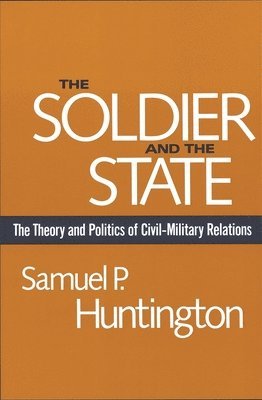
    Soldier and the State

    The Theory and Politics of Civil–Military Relations

    AvSamuel P. Huntington

    Häftad, Engelska, 1981

    422 kr

    Skickas . Fri frakt över 249 kr.

    Beskrivning

    In a classic work, Samuel P. Huntington challenges most of the old assumptions and ideas on the role of the military in society. Stressing the value of the military outlook for American national policy, Huntington has performed the distinctive task of developing a general theory of civil–military relations and subjecting it to rigorous historical analysis.Part One presents the general theory of the "military profession," the "military mind," and civilian control. Huntington analyzes the rise of the military profession in western Europe in the eighteenth and nineteenth centuries, and compares the civil–military relations of Germany and Japan between 1870 and 1945.Part Two describes the two environmental constants of American civil–military relations, our liberal values and our conservative constitution, and then analyzes the evolution of American civil–military relations from 1789 down to 1940, focusing upon the emergence of the American military profession and the impact upon it of intellectual and political currents.Huntington describes the revolution in American civil–military relations which took place during World War II when the military emerged from their shell, assumed the leadership of the war, and adopted the attitudes of a liberal society. Part Three continues with an analysis of the problems of American civil–military relations in the era of World War II and the Korean War: the political roles of the Joint Chiefs of Staff, the difference in civil–military relations between the Truman and Eisenhower administrations, the role of Congress, and the organization and functioning of the Department of Defense. Huntington concludes that Americans should reassess their liberal values on the basis of a new understanding of the conservative realism of the professional military men.

    Produktinformation

    • Utgivningsdatum:1981-09-15
    • Mått:155 x 230 x 35 mm
    • Vikt:580 g
    • Format:Häftad
    • Språk:Engelska
    • Antal sidor:560
    • Förlag:Harvard University Press
    • ISBN:9780674817364

    Utforska kategorier

    • Krig och försvar inom Samhälle och politik

    Mer om författaren

    Samuel P. Huntington was Clarence Dillon Professor of International Affairs at Harvard University and the author of The Clash of Civilizations, The Soldier and the State, Political Order in Changing Societies, and American Politics: The Promise of Disharmony, among other books.

    Recensioner i media

    The book contains many insights about both America and its soldiers, and the thought behind many of its conclusions is hard and clean… It also disposes of a number of prejudices about the military that still clog the policy process… Here is a book to make one think.

    Innehållsförteckning

    • Introduction: National Security and Civil-Military Relations PART I MILITARY INSTITUTIONS AND THE STATE: THEORETICAL AND HISTORICAL PERSPECTIVES 1. Officership as a Profession Professionalism and the Military The Concept of Profession The Military Profession 2. The Rise of the Military Profession in Western Society A New Social Type Mercenary and Aristocratic Officership Eighteenth-Century Aristocratic Institutions Preprofessional Meals: The Military Craft and the Natural Genius The Origins of Professionalism The Emergence of Professional Institutions, 1800-1875 European Professionalism: General Upton's Summary, 1875 Formulation of the Professional Ethic: The Autonomy and Sub-Ordination of War In Clausewitz's Vom Kriege 3. The Military Mind: Conservative Realism of the Professional Military Ethic The Meaning of the Military Mind The Professional Military Ethic 4. Power, Professionalism, and Ideology: Civil-Military Relations In Theory The Varieties of Civilian Control The Two Levels of Civil-Military Relations The Equilibrium of Objective Civilian Control The Patterns of Civil-Military Relations 5. Germany and Japan: Civil-Military Relations In Practice The German and Japanese Patterns Germany: The Tragedy of Professional Militarism Japan: The Continuity of Political Militarism PART II MILITARY POWER IN AMERICA: THE HISTORICAL EXPERIENCE, 1789-1940 6. The Ideological Constant: The Liberal Society Versus Military Professionalism The Historical Constants of American Civil-Military Relations The Prevalence of Liberalism in the United States The Liberal Approach to Military Affairs The Military Hero in Liberal Politics 7. The Structural Constant: The Conservative Constitution Versus Civilian Control The Constitutional Absence of Objective Civilian Control The Framers and Civilian Control The Militia Clauses and Military Federalism: The Empire Within an Empire The Separation of Powers: Dual Control Over the National Forces The Commander in Chief Clause: The Political-Military Hierarchy Civilian Control and Constitutional Government 8. The Roots of the American Military Tradition Before the Civil War The Three Strands of American Militarism The Failure of Federalism: Hamilton's Abortive Professionalism Technicism Popularism Professionalism 9. The Creation of the American Military Profession The Dominance of Business Pacifism: Industrialism Versus Militarism Years of Isolation: The Dark and the Bright The Creative Core: Sherman, Upton, Luce The Institutions of Professionalism The Making of the American Military Mind 10. The Failure of the Neo-Hamiltonian Compromise, 1890-1920 The Nature of Neo-Hamiltonianism Mahan And Wood: The Tragedy of the Military Publicist The Abortive Identification With Society, 1918-1925 11. The Constancy of Interwar Civil-Military Relations Business-Reform Hostility and Military Professionalism Reform Liberalism: The Pragmatic Usages of Militarism Military Institutions The American Military Ethic, 1920-1941 PART III THE CRISIS OF AMERICAN CIVIL-MILITARY RELATIONS, 1940-1955 12. World War II: The Alchemy of Power Civil-Military Relations in Total War Military Authority and Influence in Grand Strategy The Military Adjustment to Wartime Power Civil-Military Relations in Economic Mobilization The Fruits of Harmony and Acrimony 13. Civil-Military Relations in the Postwar Decade The Alternatives of Civil-Military Relations Postwar Perspectives on Civil-Military Relations Military Influence in American Society 14. The Political Roles of the Joint Chiefs Political Roles: Substantive and Advocatory The Joint Chiefs in the Truman Administration The Korean War: the Generals, the Troops, and the Public The Joint Chiefs in the First Two Years of the Eisenhower Administration Conclusion 15. The Separation of Powers and Cold War Defense The Impact of the Separation of Powers The Separation of Powers Versus the Separation of Functions The Separation of Powers Versus Military Professionalism The Separation of Powers Versus Strategic Monism 16. Departmental Structure of Civil-Military Relations The Organization Problems of the Postwar Decade The Joint Chiefs of Staff: Legal Form and Political Reality The Comptroller: Superego of the Department of Defense The Role of the Secretary The Needs of the Office 17. Toward a New Equilibrium The Requisite For Security Changes in the Ideological Environment Conservatism and Security The Worth of the Military Ideal Notes Index