• Fri frakt över 249 kr
  • •
  • Snabba leveranser
  • •
  • Billiga böcker
Kundservice

Du är på sajten för privatpersoner.

Företag, bibliotek eller offentlig verksamhet?

Du handlar på classic.bokus.com, där alla dina funktioner finns intakta.
Till classic.bokus.com
Bokus logotyp. Gå till startsidan.
  • Erbjudanden
  • Nyheter
  • Student
  • Topplistor
  • Barn & ungdom
  • Bokus Play
  • E-böcker
  • Pocketböcker
  • Spel & pussel

10% rabatt på allt med kod NYSTART10 →

Sidfot

Mina sidor

    Hjälp

    • Kundservice
    • Vanliga frågor och svar
    • Frakt och leverans
    • Retur vid ångerrätt
    • Reklamera vara
    • Betalning
    • Köpvillkor
    • Allmänna villkor
    • Information om webbplatsens tillgänglighet

    Om Bokus

    • Om oss
    • Pressrum
    • För studenter
    • För företag
    • För bibliotek och offentlig verksamhet
    • För leverantörer
    • Hållbarhet

    Populärt

    • Aktuella erbjudanden
    • Presentkort
    • Studentlitteratur
    • Nya böcker
    • Topplistor
    • Signerade böcker
    • Engelska böcker

    Inspiration

    • Boktips
    • BookTok
    • Populära bokserier
    • Barnbokskaraktärer
    • Populära författare
    Logotyp för Bokus
    Följ oss på Facebook (extern länk)Följ oss på Instagram (extern länk)Följ oss på YouTube (extern länk)Följ oss på TikTok (extern länk)
    bokus @ CookiesAnpassa cookiesIntegritetspolicyKöpvillkor
    Till Citymail hemsida (extern länk)Till Budbee hemsida (extern länk)Till Postnord hemsida (extern länk)Till Schenker hemsida (extern länk)Till Early Bird hemsida (extern länk)Till Walleys hemsida (extern länk)
    1. Psykologi och pedagogik
    2. Pedagogik

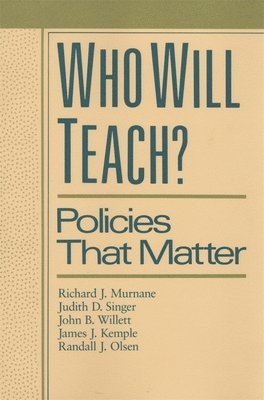
    Who Will Teach?

    Policies That Matter

    AvRichard J. Murnane,Judith D. Singer

    Inbunden, Engelska, 1991

    682 kr

    Beställningsvara. Skickas inom 10-15 vardagar. Fri frakt över 249 kr.

    Beskrivning

    Will America find enough good teachers to staff its public schools? How can we ensure that all our children will be taught by skilled professionals? The policies that determine who teaches today are a confusing and often conflicting array that includes tougher licensing requirements, higher salaries, mandatory master's degrees, merit pay, and alternative routes to certification. Who Will Teach? examines these policies and separates those that work from those that backfire.The authors present an intriguing portrait of America's teachers and reveal who they are, who they have been, and who they will be. Using innovative statistical methods to track the professional lives of more than 50,000 college graduates, the book describes, in many cases for the first time, just how prospective, current, and former teachers respond to the incentives and disincentives they face. The authors, a group of noted educators, economists, and statisticians, find cause for serious concern. Few academically talented college graduates even try teaching, and many of those who do leave quickly, never to return. Current licensing requirements stifle innovation in training and dissuade many potentially talented teachers at the outset.But Who Will Teach? shows that we can reverse these trends if we get the incentives right. Although better salaries are essential, especially for new teachers, money is not enough. Potential teachers should be offered alternative paths into the classroom. School districts should improve their recruiting strategies. Licensing criteria should assess teaching skills, not just academic achievement and number of courses completed. The authors offer a promising strategy based on high standards and substantial rewards.

    Produktinformation

    • Utgivningsdatum:1991-11-01
    • Mått:156 x 235 x 20 mm
    • Vikt:408 g
    • Format:Inbunden
    • Språk:Engelska
    • Antal sidor:192
    • Förlag:Harvard University Press
    • ISBN:9780674951921

    Utforska kategorier

    • Pedagogik inom Psykologi och pedagogik

    Mer om författaren

    Judith D. Singer is Associate Professor at the Graduate School of Education, Harvard University. John B. Willett is Associate Professor at the Graduate School of Education, Harvard University.

    Innehållsförteckning

    • Part 1 The teaching profession at a turning point: carrots and sticks; critical questions; incentives; an opportunity for change. Part 2 Who prepares to teach?: the shrinking personnel pool; the changing demographic profile of new licensees; different teaching specialities for different times. Part 3 Who becomes a teacher?: national trends; North Carolina trends; incentives matter. Part 4 Finding skilled teachers - hiring practices make a difference: hiring new teachers - two case studies; problems and solutions. Part 5 How long do teachers stay in teaching?: attrition is high in the first years; race makes a difference; mature women stay, young women leave; elementary school teachers stay the longest, chemistry and physics teachers the shortest; teachers with high test scores leave; teachers who are paid more stay longer; staffing the schools in the 1990s. Part 6 Who returns to teaching?: most career interruptions are short; women are more likely to return than men; elementary teachers are the most likely to return, chemistry and physics teachers the least likely; teachers with higher test scores are less likely to return; the reserve pool in the future. Part 7 Revising licensing requirements: the economics of occupational licensing; why traditional licensing requirements for teachers are flawed; why licensing of teachers is necessary; evidence informing the redisign of licensing requirements; directions for new licensing requriements; trade-offs in the design of performance assessments; the National Board for Professional Teaching Standards; alternative assessment approaches; using performance assessments in teacher licensing - evidence from Connecticut; reforming licensing requirements - necessary, but not enough. Part 8 Getting the incentives right: fruitless policies; elements of a promising strategy; stimulating change; critical questions. Appendices: research context - whom did we study?; methodology.