• Fri frakt över 249 kr
  • •
  • Snabba leveranser
  • •
  • Billiga böcker
Kundservice

Du är på sajten för privatpersoner.

Företag, bibliotek eller offentlig verksamhet?

Du handlar på classic.bokus.com, där alla dina funktioner finns intakta.
Till classic.bokus.com
Bokus logotyp. Gå till startsidan.
  • Erbjudanden
  • Student
  • Topplistor
  • Barn & ungdom
  • Bokus Play
  • Bokus Play
  • E-böcker
  • Ljudböcker
  • Pocketböcker
  • Spel & pussel

10% rabatt på allt med kod NYSTART10 →

Sidfot

Mina sidor

    Hjälp

    • Kundservice
    • Vanliga frågor och svar
    • Frakt och leverans
    • Retur vid ångerrätt
    • Reklamera vara
    • Betalning
    • Köpvillkor
    • Allmänna villkor
    • Information om webbplatsens tillgänglighet

    Om Bokus

    • Om oss
    • Pressrum
    • För studenter
    • För företag
    • För bibliotek och offentlig verksamhet
    • För leverantörer
    • Hållbarhet

    Populärt

    • Aktuella erbjudanden
    • Presentkort
    • Studentlitteratur
    • Nya böcker
    • Topplistor
    • Signerade böcker
    • Engelska böcker

    Inspiration

    • Boktips
    • BookTok
    • Populära bokserier
    • Barnbokskaraktärer
    • Populära författare
    Logotyp för Bokus
    Följ oss på Facebook (extern länk)Följ oss på Instagram (extern länk)Följ oss på YouTube (extern länk)Följ oss på TikTok (extern länk)
    bokus @ CookiesAnpassa cookiesIntegritetspolicyKöpvillkor
    Till Citymail hemsida (extern länk)Till Budbee hemsida (extern länk)Till Postnord hemsida (extern länk)Till Schenker hemsida (extern länk)Till Early Bird hemsida (extern länk)Till Walleys hemsida (extern länk)
    1. Ekonomi och Ledarskap
    2. Nationalekonomi

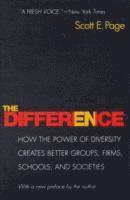
    Difference

    How the Power of Diversity Creates Better Groups, Firms, Schools, and Societies - New Edition

    AvScott Page

    Häftad, Engelska, 2008

    299 kr

    Tillfälligt slut

    Fler format och utgåvor

    Häftad

    185 kr

    Beskrivning

    In this landmark book, Scott Page redefines the way we understand ourselves in relation to one another. The Difference is about how we think in groups--and how our collective wisdom exceeds the sum of its parts. Why can teams of people find better solutions than brilliant individuals working alone? And why are the best group decisions and predictions those that draw upon the very qualities that make each of us unique? The answers lie in diversity--not what we look like outside, but what we look like within, our distinct tools and abilities. The Difference reveals that progress and innovation may depend less on lone thinkers with enormous IQs than on diverse people working together and capitalizing on their individuality. Page shows how groups that display a range of perspectives outperform groups of like-minded experts. Diversity yields superior outcomes, and Page proves it using his own cutting-edge research. Moving beyond the politics that cloud standard debates about diversity, he explains why difference beats out homogeneity, whether you're talking about citizens in a democracy or scientists in the laboratory.He examines practical ways to apply diversity's logic to a host of problems, and along the way offers fascinating and surprising examples, from the redesign of the Chicago "El" to the truth about where we store our ketchup. Page changes the way we understand diversity--how to harness its untapped potential, how to understand and avoid its traps, and how we can leverage our differences for the benefit of all.

    Produktinformation

    • Utgivningsdatum:2008-08-31
    • Mått:155 x 235 x 27 mm
    • Vikt:640 g
    • Format:Häftad
    • Språk:Engelska
    • Antal sidor:456
    • Förlag:Princeton University Press
    • ISBN:9780691138541

    Utforska kategorier

    • Nationalekonomi inom Ekonomi och Ledarskap

    Mer om författaren

    Scott E. Page is professor of complex systems, political science, and economics at the University of Michigan and an external faculty member at the Santa Fe Institute. He is the coauthor, with John Miller, of "Complex Adaptive Systems".

    Recensioner i media

    "Rather than ponder moral questions like, 'Why can't we all get along?' Dr. Page asks practical ones like, 'How can we all be more productive together?' The answer, he suggests, is in messy, creative organizations and environments with individuals from vastly different backgrounds and life experiences."--Claudia Dreifus, New York Times "The Difference is brimming with so many intriguing insights and findings that I cannot do justice to them all."--Philip E. Tetlock, Science "A fascinating and important book... The Difference is a thought-provoking and stimulating read."--Diane Coyle, Business Economist "[Page] redefines the way we understand ourselves in relation to one another. The Difference is about how we think in groups...and how our collective wisdom exceeds the sum of its parts. Why can teams of people find better solutions than brilliant individuals working alone? And why are the best group decisions and predictions those that draw upon the very qualities that make each of us unique? The answers lie in diversity...not what we look like outside, but what we look like within, our distinct tools and abilities."--Education Digest "In The Difference, Page reveals how groups that display a range of perspectives outperform groups of like-minded experts. Diversity yields superior outcomes, and he proves it using his own cutting-edge research. Moving beyond the politics that often clouds standard debates about diversity, Page explains why difference beats out homogeneity. And he examines practical ways to apply diversity's logic to a host of problems."--Here is the City "Page has written a book that offers a pragmatic defense of diversity practices, where having a diverse set of points of view in a group equates to better decision making. The book ...illustrates the benefits of a different way of thinking about problem solving, providing people with conceptual tools to understand what lies behind some of the more popular treatments of topics and to reshape the public debate about the benefits and disadvantages of diversity."--Henry Farrell, Quality World "The Difference is a very good book. I recommend it to all intelligent readers, especially to those who have not gone beyond the 'diversity' of political correctness... Read this book."--Will Carrington Heath, Independent Review "Though filled with three dimensional graphs, computer simulations, and other quantitative exercises that some will find intimidating, the book has the great advantage of being accessible to the nontechnical reader, at least one willing to invest considerable time and effort in following its clear but often complex reasoning. Where The Difference clearly succeeds is in bridging the gap between the more arcane technical literature found in the professional economics journals and writing intended for a general audience."--Russell K. Nieli, Academic Questions

    Innehållsförteckning

    • Preface to the Paperback Edition Prufrock Avoided xiii Acknowledgments The Continuous Life xix Prologue How Diversity Trumps Ability Fun at Caltech xxv Introduction Unpacking Our Differences 1 PART ONE: UNPACKING THE TOOLBOX CHAPTER 1: Diverse Perspectives How We See Things 23 CHAPTER 2: Heuristics Do the Opposite 52 CHAPTER 3: Interpretations Our Own Private Flatland 73 CHAPTER 4: Predictive Models Judging Books by Their Covers 90 CHAPTER 5: Measuring Sticks and Toolboxes Calipers for the Brain 103 PART TWO: DIVERSITY'S BENEFITS: BUILDING FROM TOOLS CHAPTER 6: Diversity and Problem Solving Darwin's Brass Tacks 131 CHAPTER 7: Models of Information Aggregation Mindless Signals 175 CHAPTER 8: Diversity and Prediction The Crowd of Models 197 PART THREE: DIVERSE VALUES: A CONFLICT OF INTERESTS (OR IS IT)? CHAPTER 9: Diverse Preferences Why Tapas 239 CHAPTER 10: Preference Aggregation Four (Not So) Depressing Results 255 CHAPTER 11: Interacting Toolboxes and Preferences Go Ask Alice 285 PART FOUR: THE PUDDING: DOES DIVERSITY GENERATE BENEFITS? CHAPTER 12: The Causes of Cognitive Diversity Family Vacations, College, or Identity? 299 CHAPTER 13: The Empirical Evidence The Pudding 313 PART FIVE: GOING ON THE OFFENSIVE CHAPTER 14: A Fertile Logic Putting Ideas to Work 339 Epilogue: The Ketchup Questions 371 Notes 377 Index 411