• Fri frakt över 249 kr
  • •
  • Snabba leveranser
  • •
  • Billiga böcker
Kundservice

Du är på sajten för privatpersoner.

Företag, bibliotek eller offentlig verksamhet?

Du handlar på classic.bokus.com, där alla dina funktioner finns intakta.
Till classic.bokus.com
Bokus logotyp. Gå till startsidan.
  • Erbjudanden
  • Nyheter
  • Student
  • Topplistor
  • Barn & ungdom
  • Bokus Play
  • E-böcker
  • Pocketböcker
  • Spel & pussel

10% rabatt på allt med kod: NYSTART10 →

Sidfot

Mina sidor

    Hjälp

    • Kundservice
    • Vanliga frågor och svar
    • Frakt och leverans
    • Retur vid ångerrätt
    • Reklamera vara
    • Betalning
    • Köpvillkor
    • Allmänna villkor
    • Information om webbplatsens tillgänglighet

    Om Bokus

    • Om oss
    • Pressrum
    • För studenter
    • För företag
    • För bibliotek och offentlig verksamhet
    • För leverantörer
    • Hållbarhet

    Populärt

    • Aktuella erbjudanden
    • Presentkort
    • Studentlitteratur
    • Nya böcker
    • Topplistor
    • Signerade böcker
    • Engelska böcker

    Inspiration

    • Boktips
    • BookTok
    • Populära bokserier
    • Barnbokskaraktärer
    • Populära författare
    Logotyp för Bokus
    Följ oss på Facebook (extern länk)Följ oss på Instagram (extern länk)Följ oss på YouTube (extern länk)Följ oss på TikTok (extern länk)
    bokus @ CookiesAnpassa cookiesIntegritetspolicyKöpvillkor
    Till Citymail hemsida (extern länk)Till Budbee hemsida (extern länk)Till Postnord hemsida (extern länk)Till Schenker hemsida (extern länk)Till Early Bird hemsida (extern länk)Till Walleys hemsida (extern länk)
    1. Samhälle och politik
    2. Krig och försvar

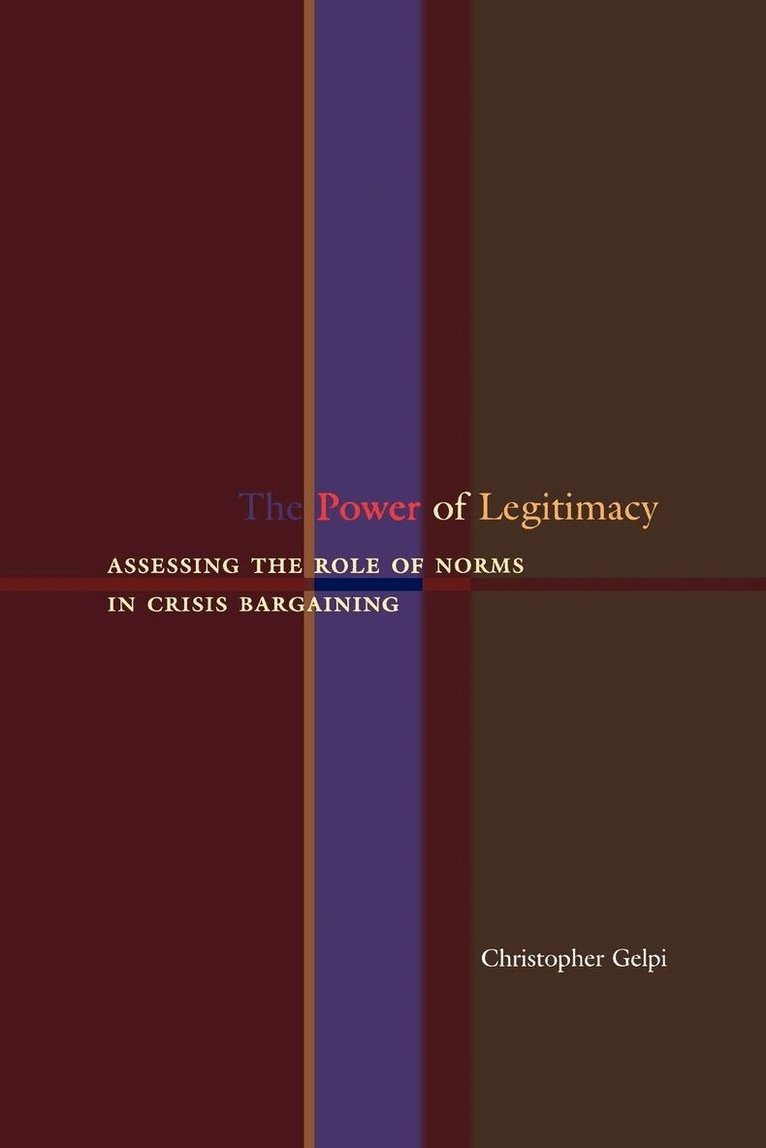
    Power of Legitimacy

    Assessing the Role of Norms in Crisis Bargaining

    AvChristopher Gelpi

    Häftad, Engelska, 2010

    653 kr

    Beställningsvara. Skickas inom 3-6 vardagar. Fri frakt över 249 kr.

    Beskrivning

    A major departure from mainstream security studies, this book mounts a thoughtful challenge to realist theories of crisis bargaining. It tests the proposition that normative standards of behavior influence state actions in security-related conflicts. Specifically, it examines the construction of bilateral norms as the settlements of security-related disputes and the effects these settlements have on subsequent interactions over the same issue. Drawing on institutionalist arguments about the informational impact of norms, Christopher Gelpi contends that norms act as signals that give meaning to other states' behavior in at least two important ways. First, they provide a mutually acceptable focal point for limiting both demands and concessions. Second, security norms change the context in which coercive behavior is interpreted. That is, norms can cause coercive behavior to be interpreted as punishment rather than aggression. Gelpi tests this argument against its most prominent competitor--a realist model of crisis bargaining--in three stages.First, he uses a probit analysis to perform a quantitative test on the population of 122 reinitiated international crises between 1929 and 1979. Second, he conducts detailed case studies of the Cienfuegos Submarine Conflict and the Six Day War. Finally, he conducts a second statistical analysis examining the conditions under which security norms will succeed or fail. While hypotheses derived from realist coercion theory receive only mixed support, Gelpi finds strong evidence that states can and do construct normative standards that guide their behavior in international crises.

    Produktinformation

    • Utgivningsdatum:2010-01-10
    • Mått:152 x 235 x 12 mm
    • Vikt:312 g
    • Format:Häftad
    • Språk:Engelska
    • Antal sidor:224
    • Förlag:Princeton University Press
    • ISBN:9780691146713

    Utforska kategorier

    • Krig och försvar inom Samhälle och politik
    • Internationella relationer inom Samhälle och politik

    Mer om författaren

    Christopher Gelpi is Assistant Professor of Political Science at Duke University.

    Recensioner i media

    "Too little attention has been given to the role of norms in guiding state behavior, and Gelpi has found a creative way of conducting an empirical test of their role. His is a book I enjoyed reading—a well-constructed professional investigation with intriguing findings. It provides welcome empirical ammunition for institutionalists in their ongoing debate with realists."—Russell Leng, Middlebury College