• Fri frakt över 249 kr
  • •
  • Snabba leveranser
  • •
  • Billiga böcker
Kundservice

Du är på sajten för privatpersoner.

Företag, bibliotek eller offentlig verksamhet?

Du handlar på classic.bokus.com, där alla dina funktioner finns intakta.
Till classic.bokus.com
Bokus logotyp. Gå till startsidan.
  • Erbjudanden
  • Nyheter
  • Student
  • Topplistor
  • Barn & ungdom
  • Bokus Play
  • E-böcker
  • Pocketböcker
  • Spel & pussel

10% rabatt på allt med kod: NYSTART10 →

Sidfot

Mina sidor

    Hjälp

    • Kundservice
    • Vanliga frågor och svar
    • Frakt och leverans
    • Retur vid ångerrätt
    • Reklamera vara
    • Betalning
    • Köpvillkor
    • Allmänna villkor
    • Information om webbplatsens tillgänglighet

    Om Bokus

    • Om oss
    • Pressrum
    • För studenter
    • För företag
    • För bibliotek och offentlig verksamhet
    • För leverantörer
    • Hållbarhet

    Populärt

    • Aktuella erbjudanden
    • Presentkort
    • Studentlitteratur
    • Nya böcker
    • Topplistor
    • Signerade böcker
    • Engelska böcker

    Inspiration

    • Boktips
    • BookTok
    • Populära bokserier
    • Barnbokskaraktärer
    • Populära författare
    Logotyp för Bokus
    Följ oss på Facebook (extern länk)Följ oss på Instagram (extern länk)Följ oss på YouTube (extern länk)Följ oss på TikTok (extern länk)
    bokus @ CookiesAnpassa cookiesIntegritetspolicyKöpvillkor
    Till Citymail hemsida (extern länk)Till Budbee hemsida (extern länk)Till Postnord hemsida (extern länk)Till Schenker hemsida (extern länk)Till Early Bird hemsida (extern länk)Till Walleys hemsida (extern länk)
    1. Filosofi och religion
    2. Filosofi
    3. Filosofiska discipliner

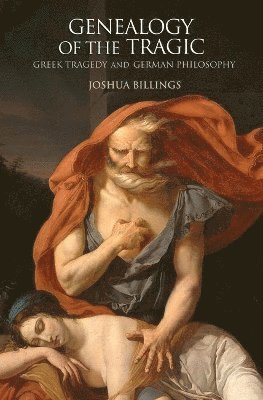
    Genealogy of the Tragic

    Greek Tragedy and German Philosophy

    AvJoshua Billings

    Inbunden, Engelska, 2014

    519 kr

    Tillfälligt slut

    Fler format och utgåvor

    Häftad

    374 kr

    E-bok

    509 kr

    Beskrivning

    Why did Greek tragedy and "the tragic" come to be seen as essential to conceptions of modernity? And how has this belief affected modern understandings of Greek drama? In Genealogy of the Tragic, Joshua Billings answers these and related questions by tracing the emergence of the modern theory of the tragic, which was first developed around 1800 by thinkers associated with German Idealism. The book argues that the idea of the tragic arose in response to a new consciousness of history in the late eighteenth century, which spurred theorists to see Greek tragedy as both a unique, historically remote form and a timeless literary genre full of meaning for the present. The book offers a new interpretation of the theories of Schiller, Schelling, Hegel, Holderlin, and others, as mediations between these historicizing and universalizing impulses, and shows the roots of their approaches in earlier discussions of Greek tragedy in Germany, France, and England.By examining eighteenth-century readings of tragedy and the interactions between idealist thinkers in detail, Genealogy of the Tragic offers the most comprehensive historical account of the tragic to date, as well as the fullest explanation of why and how the idea was used to make sense of modernity. The book argues that idealist theories remain fundamental to contemporary interpretations of Greek tragedy, and calls for a renewed engagement with philosophical questions in criticism of tragedy.

    Produktinformation

    • Utgivningsdatum:2014-10-26
    • Mått:152 x 235 x undefined mm
    • Vikt:539 g
    • Format:Inbunden
    • Språk:Engelska
    • Antal sidor:280
    • Förlag:Princeton University Press
    • ISBN:9780691159232

    Utforska kategorier

    • Filosofiska discipliner inom Filosofi och religion
    • Litteraturvetenskap inom Skönlitteratur

    Mer om författaren

    Joshua Billings is assistant professor of classics and humanities at Yale University.

    Recensioner i media

    Winner of a 2015 Charles Goodwin Award of Merit, Society for Classical Studies "[Billings'] Genealogy is an impressive study that pinpoints distinctions, elucidates complexities and helps to show how they arose and why they matter. His readings are adroit and scrupulously contextualized... Here is a book whose subtlety and scope prompt further reflection on profoundly important matters."--Michael Silk, Times Literary Supplement

    Innehållsförteckning

    • Preface xi Note on Translations, Citations, and Abbreviations xv INTRODUCTION: Tragedy and Philosophy around 1800 1 TRAGIC MODERNITIES Chapter 1: Quarreling over Tragedy 19 Ancients and Moderns on Tragedy 21 Nach Athen: Literary Models in Germany 32 Chapter 2: The Antiquity of Tragedy 45 Guillaume Dubois de Rochefort: Tragedy and Cultural Difference 46 Johann Gottfried Herder: Tragedy for the Volk 53 Returns to the Greek: Translation, Philology, Performance 59 TRAGIC THEMES Chapter 3: Revolutionary Freedom 75 The Tragic Sublime: Schiller and Schelling 80 Schiller's System of Tragic Freedom 88 Criticism and Scholarship: A. W. Schlegel and Gottfried Hermann 97 Chapter 4: Greek and Modern Tragedy 105 Friedrich Schlegel: Nature, Art, Revolution 107 Schiller: "The Limits of Ancient and Modern Tragedy" 113 Schelling: Identity and History in the Philosophy of Art 123 Chapter 5: Tragic Theologies 133 A Poetic Religion 135 "Problems of Fate": "The Spirit of Christianity" and Empedocles 139 The Power of the Sacrifice: The Natural Law Essay 150 TRAGIC TEXTS Chapter 6: Hegel's Phenomenology: The Fate of Tragedy 161 The Ethical World of Tragedy 163 Error and Recognition 171 Tragic Knowing and Forgetting 177 The End of Tragedy 184 Chapter 7: Holderlin's Sophocles: Tragedy and Paradox 189 Tragedy and Vaterland 191 Sophocles, Ancient and Modern 196 "The Lawful Calculus" 200 "The Boldest Moment" 205 Vaterlandische Umkehr 212 Exodos: Births of the Tragic 222 Bibliography 235 Index 251