• Fri frakt över 249 kr
  • •
  • Snabba leveranser
  • •
  • Billiga böcker
Kundservice

Du är på sajten för privatpersoner.

Företag, bibliotek eller offentlig verksamhet?

Du handlar på classic.bokus.com, där alla dina funktioner finns intakta.
Till classic.bokus.com
Bokus logotyp. Gå till startsidan.
  • Erbjudanden
  • Nyheter
  • Student
  • Topplistor
  • Barn & ungdom
  • Bokus Play
  • E-böcker
  • Pocketböcker
  • Spel & pussel

10% rabatt på allt med kod: NYSTART10 →

Sidfot

Mina sidor

    Hjälp

    • Kundservice
    • Vanliga frågor och svar
    • Frakt och leverans
    • Retur vid ångerrätt
    • Reklamera vara
    • Betalning
    • Köpvillkor
    • Allmänna villkor
    • Information om webbplatsens tillgänglighet

    Om Bokus

    • Om oss
    • Pressrum
    • För studenter
    • För företag
    • För bibliotek och offentlig verksamhet
    • För leverantörer
    • Hållbarhet

    Populärt

    • Aktuella erbjudanden
    • Presentkort
    • Studentlitteratur
    • Nya böcker
    • Topplistor
    • Signerade böcker
    • Engelska böcker

    Inspiration

    • Boktips
    • BookTok
    • Populära bokserier
    • Barnbokskaraktärer
    • Populära författare
    Logotyp för Bokus
    Följ oss på Facebook (extern länk)Följ oss på Instagram (extern länk)Följ oss på YouTube (extern länk)Följ oss på TikTok (extern länk)
    bokus @ CookiesAnpassa cookiesIntegritetspolicyKöpvillkor
    Till Citymail hemsida (extern länk)Till Budbee hemsida (extern länk)Till Postnord hemsida (extern länk)Till Schenker hemsida (extern länk)Till Early Bird hemsida (extern länk)Till Walleys hemsida (extern länk)
    1. Samhälle och politik
    2. Krig och försvar
    3. Vapen och utrustning
    4. Kärnvapen

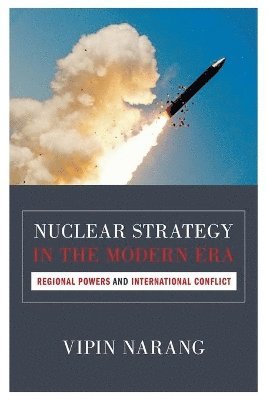
    Nuclear Strategy in the Modern Era

    Regional Powers and International Conflict

    AvVipin Narang

    Häftad, Engelska, 2014

    Del i serien Princeton Studies in International History and Politics

    341 kr

    Beställningsvara. Skickas inom 5-8 vardagar. Fri frakt över 249 kr.

    Fler format och utgåvor

    E-bok

    485 kr

    Beskrivning

    The world is in a second nuclear age in which regional powers play an increasingly prominent role. These states have small nuclear arsenals, often face multiple active conflicts, and sometimes have weak institutions. How do these nuclear states--and potential future ones--manage their nuclear forces and influence international conflict? Examining the reasoning and deterrence consequences of regional power nuclear strategies, this book demonstrates that these strategies matter greatly to international stability and it provides new insights into conflict dynamics across important areas of the world such as the Middle East, East Asia, and South Asia. Vipin Narang identifies the diversity of regional power nuclear strategies and describes in detail the posture each regional power has adopted over time. Developing a theory for the sources of regional power nuclear strategies, he offers the first systematic explanation of why states choose the postures they do and under what conditions they might shift strategies. Narang then analyzes the effects of these choices on a state's ability to deter conflict.Using both quantitative and qualitative analysis, he shows that, contrary to a bedrock article of faith in the canon of nuclear deterrence, the acquisition of nuclear weapons does not produce a uniform deterrent effect against opponents. Rather, some postures deter conflict more successfully than others. Nuclear Strategy in the Modern Era considers the range of nuclear choices made by regional powers and the critical challenges they pose to modern international security.

    Produktinformation

    • Utgivningsdatum:2014-05-25
    • Mått:152 x 235 x 21 mm
    • Vikt:499 g
    • Format:Häftad
    • Språk:Engelska
    • Serie:Princeton Studies in International History and Politics
    • Antal sidor:360
    • Förlag:Princeton University Press
    • ISBN:9780691159836
    • Utmärkelser:Winner of International Studies Association International Security Studies Section Best Book Award 2015

    Utforska kategorier

    • Kärnvapen inom Samhälle och politik
    • Internationella relationer inom Samhälle och politik

    Mer om författaren

    Vipin Narang is assistant professor of political science and member of the Security Studies Program at the Massachusetts Institute of Technology.

    Recensioner i media

    Winner of the 2015 Best Book, International Security Studies Section of the International Studies Association "Narang adds importantly to the scholarly understanding of nuclear posture in a way that can inform policy. He studies an important topic, shatters false assumptions, provides insightful and useful new conceptual categories, offers apparently powerful theoretical explanations of important behaviors, provides a valuable set of case studies, and opens doors for additional scholarly research... The many avenues for additional research it suggests and worrisome possibilities it surfaces testify to the analytic strength and policy ambition of this important book."--Douglas B. Shaw, Arms Control Today "Narang explores an understudied aspect of nuclear strategy and doctrine. Rejecting conventional scholarly thinking that nuclear weapons have an inherent ability to deter conflict, Narang examines the nuclear postures of Pakistan, India, China, Israel, South Africa, and France."--Choice "Finally, we have a book on proliferation that is rooted in the discipline of Political Science with persuasive explanatory powers and great analytical value."--Michael Krepon, Arms Control Wonk "This book fills a gaping hole in the existing literature."--Jacques Hymans, Political Science Quarterly "Nuclear Strategy in the Modern Era impressively advances scholarship on nuclear proliferation and its consequences."--Dinshaw Mistry, Perspectives on Politics "With its combination of theoretical ambition, empirical rigor, and lucid writing, Narang's book deserves a place on the strategist's bookshelf alongside Brodie, Schelling, Jervis, Betts, and other classics."--Todd S. Sechser, Journal of Strategic Studies

    Innehållsförteckning

    • List of Figures and Tables vii Acknowledgments ix Chapter 1 Introduction 1 Chapter 2 The Sources of Regional Power Nuclear Postures: Posture Optimization Theory 13 Chapter 3 Pakistan 55 Chapter 4 India 94 Chapter 5 China 121 Chapter 6 France 153 Chapter 7 Israel 179 Chapter 8 South Africa 207 Chapter 9 Deterring Unequally I: A Large-n Analysis 222 Chapter 10 Deterring Unequally II: Regional Power Nuclear Postures and Crisis Behavior 253 Chapter 11 Conclusion 299 Bibliography 313 Index 333