• Fri frakt över 249 kr
  • •
  • Snabba leveranser
  • •
  • Billiga böcker
Kundservice

Du är på sajten för privatpersoner.

Företag, bibliotek eller offentlig verksamhet?

Du handlar på classic.bokus.com, där alla dina funktioner finns intakta.
Till classic.bokus.com
Bokus logotyp. Gå till startsidan.
  • Erbjudanden
  • Student
  • Topplistor
  • Barn & ungdom
  • Bokus Play
  • E-böcker
  • Ljudböcker
  • Pocketböcker
  • Spel & pussel

Upp till 25% på utvalda nyheter →

Sidfot

Mina sidor

    Hjälp

    • Kundservice
    • Vanliga frågor och svar
    • Frakt och leverans
    • Retur vid ångerrätt
    • Reklamera vara
    • Betalning
    • Köpvillkor
    • Allmänna villkor
    • Information om webbplatsens tillgänglighet

    Om Bokus

    • Om oss
    • Pressrum
    • För studenter
    • För företag
    • För bibliotek och offentlig verksamhet
    • För leverantörer
    • Hållbarhet

    Populärt

    • Aktuella erbjudanden
    • Presentkort
    • Studentlitteratur
    • Nya böcker
    • Topplistor
    • Signerade böcker
    • Engelska böcker

    Inspiration

    • Boktips
    • BookTok
    • Populära bokserier
    • Barnbokskaraktärer
    • Populära författare
    Logotyp för Bokus
    Följ oss på Facebook (extern länk)Följ oss på Instagram (extern länk)Följ oss på YouTube (extern länk)Följ oss på TikTok (extern länk)
    bokus @ CookiesAnpassa cookiesIntegritetspolicyKöpvillkor
    Till Citymail hemsida (extern länk)Till Budbee hemsida (extern länk)Till Postnord hemsida (extern länk)Till Schenker hemsida (extern länk)Till Early Bird hemsida (extern länk)Till Walleys hemsida (extern länk)
    1. Skönlitteratur
    2. Litteraturvetenskap
    3. Litteraturvetenskap

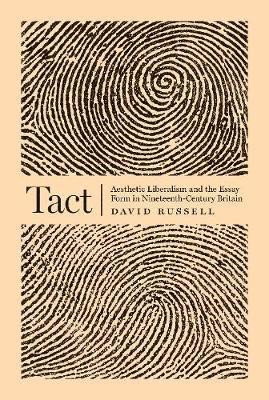
    Tact

    Aesthetic Liberalism and the Essay Form in Nineteenth-Century Britain

    AvDavid Russell

    Inbunden, Engelska, 2017

    457 kr

    Beställningsvara. Skickas inom 5-8 vardagar. Fri frakt över 249 kr.

    Fler format och utgåvor

    Häftad

    308 kr

    E-bok

    636 kr

    Beskrivning

    The social practice of tact was an invention of the nineteenth century, a period when Britain was witnessing unprecedented urbanization, industrialization, and population growth. In an era when more and more people lived more closely than ever before with people they knew less and less about, tact was a new mode of feeling one's way with others in complex modern conditions. In this book, David Russell traces how the essay genre came to exemplify this sensuous new ethic and aesthetic. Russell argues that the essay form provided the resources for the performance of tact in this period and analyzes its techniques in the writings of Charles Lamb, John Stuart Mill, Matthew Arnold, George Eliot, and Walter Pater. He shows how their essays offer grounds for a claim about the relationship among art, education, and human freedom--an "aesthetic liberalism"--not encompassed by traditional political philosophy or in literary criticism. For these writers, tact is not about codes of politeness but about making an art of ordinary encounters with people and objects and evoking the fullest potential in each new encounter.Russell demonstrates how their essays serve as a model for a critical handling of the world that is open to surprises, and from which egalitarian demands for new relationships are made. Offering fresh approaches to thinking about criticism, sociability, politics, and art, Tact concludes by following a legacy of essayistic tact to the practice of British psychoanalysts like D. W. Winnicott and Marion Milner.

    Produktinformation

    • Utgivningsdatum:2017-12-11
    • Mått:152 x 235 x 20 mm
    • Vikt:476 g
    • Format:Inbunden
    • Språk:Engelska
    • Antal sidor:216
    • Förlag:Princeton University Press
    • ISBN:9780691161198

    Utforska kategorier

    • Litteraturvetenskap inom Skönlitteratur
    • Essäer inom Skönlitteratur

    Mer om författaren

    David Russell is associate professor of English at the University of Oxford and a tutorial fellow of Corpus Christi College.

    Recensioner i media

    "One of the brilliances of this book is to suggest that tact as a mode of thinking can be linked to a type of independence, and imaginative intelligence. . . . [It is] at once provocative and generously open-ended, raising questions about what is at stake in any attempt to read and interpret."---Kirsty Martin, Times Literary Supplement