• Fri frakt över 249 kr
  • •
  • Snabba leveranser
  • •
  • Billiga böcker
Kundservice

Du är på sajten för privatpersoner.

Företag, bibliotek eller offentlig verksamhet?

Du handlar på classic.bokus.com, där alla dina funktioner finns intakta.
Till classic.bokus.com
Bokus logotyp. Gå till startsidan.
  • Erbjudanden
  • Nyheter
  • Student
  • Topplistor
  • Barn & ungdom
  • Bokus Play
  • E-böcker
  • Pocketböcker
  • Spel & pussel

10% rabatt på allt med kod: NYSTART10 →

Sidfot

Mina sidor

    Hjälp

    • Kundservice
    • Vanliga frågor och svar
    • Frakt och leverans
    • Retur vid ångerrätt
    • Reklamera vara
    • Betalning
    • Köpvillkor
    • Allmänna villkor
    • Information om webbplatsens tillgänglighet

    Om Bokus

    • Om oss
    • Pressrum
    • För studenter
    • För företag
    • För bibliotek och offentlig verksamhet
    • För leverantörer
    • Hållbarhet

    Populärt

    • Aktuella erbjudanden
    • Presentkort
    • Studentlitteratur
    • Nya böcker
    • Topplistor
    • Signerade böcker
    • Engelska böcker

    Inspiration

    • Boktips
    • BookTok
    • Populära bokserier
    • Barnbokskaraktärer
    • Populära författare
    Logotyp för Bokus
    Följ oss på Facebook (extern länk)Följ oss på Instagram (extern länk)Följ oss på YouTube (extern länk)Följ oss på TikTok (extern länk)
    bokus @ CookiesAnpassa cookiesIntegritetspolicyKöpvillkor
    Till Citymail hemsida (extern länk)Till Budbee hemsida (extern länk)Till Postnord hemsida (extern länk)Till Schenker hemsida (extern länk)Till Early Bird hemsida (extern länk)Till Walleys hemsida (extern länk)
    1. Skönlitteratur
    2. Litteraturvetenskap
    3. Litteraturvetenskap

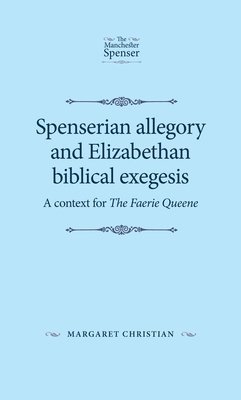
    Spenserian Allegory and Elizabethan Biblical Exegesis

    A Context for the Faerie Queene

    AvMargaret Christian

    Inbunden, Engelska, 2016

    Del i serien Manchester Spenser

    1 367 kr

    Beställningsvara. Skickas inom 5-8 vardagar. Fri frakt över 249 kr.

    Fler format och utgåvor

    Häftad

    414 kr

    Beskrivning

    Edmund Spenser famously conceded to his friend Walter Raleigh that his method in The Faerie Queene 'will seeme displeasaunt' to those who would 'rather have good discipline delivered plainly in way of precepts, or sermoned at large'. Spenser's allegory and Elizabethan biblical exegesis is the first book-length study to clarify Spenser's comparison by introducing readers to the biblical typologies of contemporary sermons and liturgies. The result demonstrates that 'precepts ... sermoned at large' from lecterns and pulpits were themselves often 'clowdily enwrapped in allegoricall devises'. In effect, routine churchgoing prepared Spenser's first readers to enjoy and interpret The Faerie Queene.A wealth of relevant quotations invites readers to adopt an Elizabethan mindset and encounter the poem afresh. The 'chronicle history' cantos, Florimell's adventures, the Souldan episode, Mercilla's judgment on Duessa and even the two stanzas that close the Mutabilitie fragment, all come into sharper focus when juxtaposed with contemporary religious rhetoric.

    Produktinformation

    • Utgivningsdatum:2016-09-28
    • Mått:138 x 216 x 19 mm
    • Vikt:494 g
    • Format:Inbunden
    • Språk:Engelska
    • Serie:Manchester Spenser
    • Antal sidor:272
    • Förlag:Manchester University Press
    • ISBN:9780719083846

    Utforska kategorier

    • Litteraturvetenskap inom Skönlitteratur

    Mer om författaren

    Margaret Christian is Associate Professor of English at the Pennsylvania State University, Lehigh Valley Campus

    Innehållsförteckning

    • Introduction: A context for The Faerie QueenePart I: Backgrounds: allegorical reading in Spenser's England1. Traditional scriptural interpretation and sixteenth-century allegoresis: old and new 2. Allegorical reading in occasional Elizabethan liturgies 3. Allegorical reading in sermon references to history and current eventsPart II: The preachers' Bible and Spenser's Faerie Queene: alternate allegories4. 'The ground of Storie': genealogy in biblical exegesis and the Legend of Temperance5. 'Waues of weary wretchednesse': Florimell and the sea6. Saracens, Assyrians and Spaniards: allegories of the Armada7. 'a goodly amiable name for mildness': Mercilla and other Elizabethan types8. Court and courtesy: sermon contexts for Spenser's Book VI 9. 'Now lettest thou thy servant depart': scriptural tradition and the close of The Faerie QueeneConclusionWorks citedIndex