• Fri frakt över 249 kr
  • •
  • Snabba leveranser
  • •
  • Billiga böcker
Kundservice

Du är på sajten för privatpersoner.

Företag, bibliotek eller offentlig verksamhet?

Du handlar på classic.bokus.com, där alla dina funktioner finns intakta.
Till classic.bokus.com
Bokus logotyp. Gå till startsidan.
  • Erbjudanden
  • Nyheter
  • Student
  • Topplistor
  • Barn & ungdom
  • Bokus Play
  • E-böcker
  • Pocketböcker
  • Spel & pussel

10% rabatt på allt med kod NYSTART10 →

Sidfot

Mina sidor

    Hjälp

    • Kundservice
    • Vanliga frågor och svar
    • Frakt och leverans
    • Retur vid ångerrätt
    • Reklamera vara
    • Betalning
    • Köpvillkor
    • Allmänna villkor
    • Information om webbplatsens tillgänglighet

    Om Bokus

    • Om oss
    • Pressrum
    • För studenter
    • För företag
    • För bibliotek och offentlig verksamhet
    • För leverantörer
    • Hållbarhet

    Populärt

    • Aktuella erbjudanden
    • Presentkort
    • Studentlitteratur
    • Nya böcker
    • Topplistor
    • Signerade böcker
    • Engelska böcker

    Inspiration

    • Boktips
    • BookTok
    • Populära bokserier
    • Barnbokskaraktärer
    • Populära författare
    Logotyp för Bokus
    Följ oss på Facebook (extern länk)Följ oss på Instagram (extern länk)Följ oss på YouTube (extern länk)Följ oss på TikTok (extern länk)
    bokus @ CookiesAnpassa cookiesIntegritetspolicyKöpvillkor
    Till Citymail hemsida (extern länk)Till Budbee hemsida (extern länk)Till Postnord hemsida (extern länk)Till Schenker hemsida (extern länk)Till Early Bird hemsida (extern länk)Till Walleys hemsida (extern länk)
    1. Ekonomi och Ledarskap
    2. Nationalekonomi

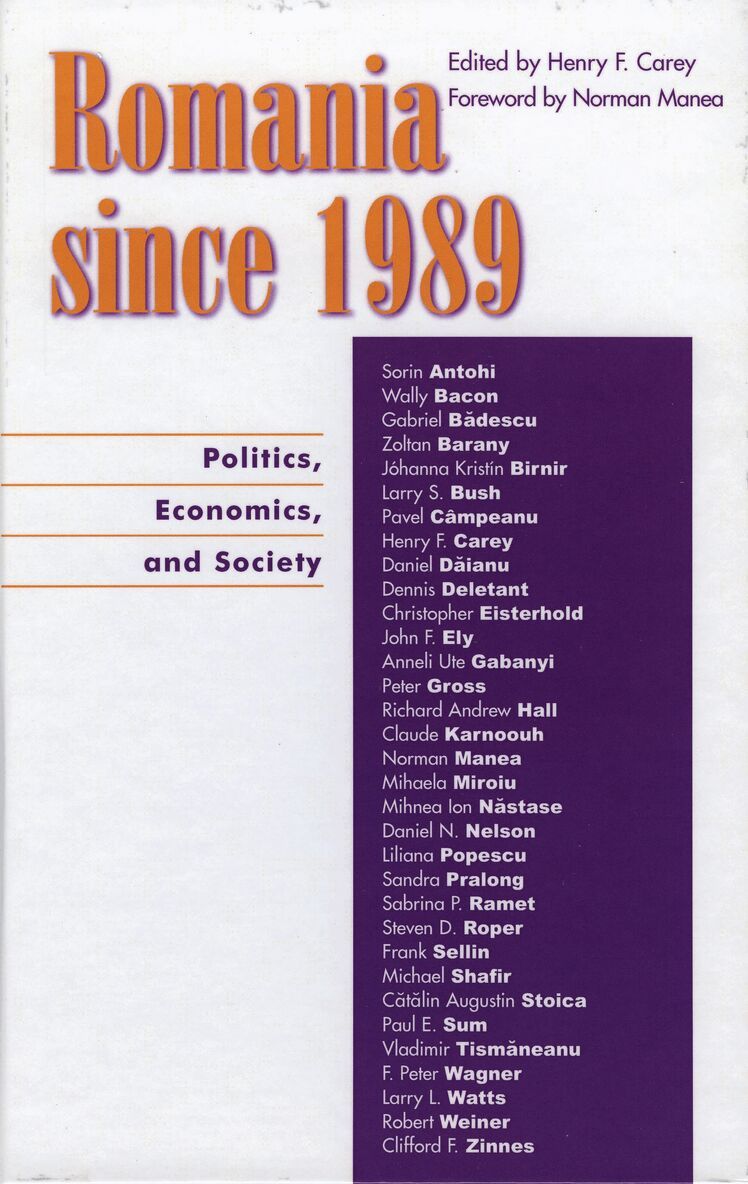
    Romania since 1989

    Politics, Economics, and Society

    AvHenry F. Carey

    Inbunden, Engelska, 2004

    2 152 kr

    Beställningsvara. Skickas inom 10-15 vardagar. Fri frakt över 249 kr.

    Beskrivning

    Those who study Romania must confront the theoretical challenges posed by a country that is undergoing a profound transformation from a repressive totalitarianism regime to a hazy and as yet unrealized democratic government. The most comprehensive survey of Romanian politics and society ever published abroad, this volume represents an effort to collect and analyze data on the complex problems of Romania's past and its transition into an uncertain future. Henry F. Carey has brought together the world's leading scholars on Romania to discuss key aspects of the country's sites of conflict in a groundbreaking work that includes six resident Romanian authors who rarely publish in the global academic press. Romania since 1989 is must for anyone seeking either a basic understanding or a sophisticated analysis of contemporary Romania. The book is also an invaluable resource for those who study the economies and governments of other countries in transition, as it presents an ideal case study with lessons that can be applied elsewhere.

    Produktinformation

    • Utgivningsdatum:2004-05-24
    • Mått:168 x 234 x 45 mm
    • Vikt:1 161 g
    • Format:Inbunden
    • Språk:Engelska
    • Antal sidor:664
    • Förlag:Bloomsbury Publishing Plc
    • ISBN:9780739105924

    Utforska kategorier

    • Nationalekonomi inom Ekonomi och Ledarskap

    Mer om författaren

    Henry F. (Chip) Carey is assistant professor of political science at Georgia State University. He is the author of many essays on East European politics, international human rights, and democratization.

    Recensioner i media

    Henry Carey's collection Romania since 1989: Politics, Economics, and Society captures with great precision the complex, contradictory reality of contemporary Romania. Bringing together Romanian, west European, and American authors from fields as diverse as anthropology, political science, economics, law, print and broadcast journalism, social work, and literature, the volume covers vast ground, but with striking detail and scholarship and a common core approach concerned with the nature of Romanian exceptionalism. The essays range widely across the spectrum of post-socialist Romanian events and conditions, from labor and government to environment and social issues. Together they provide perhaps the most comprehensive view of the continuing, murky, contested reality that is Romania today. The book is a must-read for any scholar of modern Romania, of East-Central Europe, and of the uncertain, troubled times that is post-socialism.

    Innehållsförteckning

    • Chapter 1 ForewardChapter 2 PrefaceChapter 3 IntroductionChapter 3 Memory, Memorials, and Membership: Romania's Utilitarian Anti-Semitism and Marshal AntonescuPart 5 Part I: Romanian Exceptionalism?Chapter 6 Understanding National Stalinism: Legacies of Ceausescu SocialismChapter 7 Sonderweg Romania?Chapter 8 Re-membering RomaniaChapter 9 Democratization in the Shadows: Post-Communist PatrimonialismPart 10 Part II: The State and PoliticsChapter 11 Institutionalizing the Party SystemChapter 12 Parlimentary DevelopmentChapter 13 An Evaluation of Six Forms of Political ParticipationChapter 14 Media in the First Post-Communist DecadeChapter 15 Political Culture in Post-Ceausescu RomaniaPart 16 Part III: Civil Society and Social IssuesChapter 17 NGOs and the Development of Civil SocietyChapter 18 Multi-Culturalism and Ethnic Relations in TransylvaniaChapter 19 Romani Marginality and PoliticsChapter 20 Church and State in Romania before and after 1989Chapter 21 Post-Totalitarian Pre-FeminismChapter 22 Gay and Lesbian RightsChapter 23 Higher Education and the Post-Communist Generation of StudentsPart 24 Part IV: Economics and EnvironmentChapter 25 The New Business Elite: From Nomenklatura to OligarchyChapter 26 Economic ReformChapter 27 Fiscal and Monetary PoliciesChapter 28 Trade Unions and Labor RelationsChapter 29 The Environment in TransitionPart 30 Part V: SecurityChapter 31 Romanian SecurityChapter 32 Romanian Bilateral Relations with Russia and with HungaryChapter 33 The Security Services since 1989: Turning Over a New LeafChapter 34 Civil-Military Relations: Continuity or Exceptionialism?Chapter 35 Conclusion: Ambiguous Democratization?Chapter 36 Afterword: Ten Points, Ten Years After