• Fri frakt över 249 kr
  • •
  • Snabba leveranser
  • •
  • Billiga böcker
Kundservice

Du är på sajten för privatpersoner.

Företag, bibliotek eller offentlig verksamhet?

Du handlar på classic.bokus.com, där alla dina funktioner finns intakta.
Till classic.bokus.com
Bokus logotyp. Gå till startsidan.
  • Erbjudanden
  • Nyheter
  • Student
  • Topplistor
  • Barn & ungdom
  • Bokus Play
  • E-böcker
  • Pocketböcker
  • Spel & pussel

10% rabatt på allt med kod NYSTART10 →

Sidfot

Mina sidor

    Hjälp

    • Kundservice
    • Vanliga frågor och svar
    • Frakt och leverans
    • Retur vid ångerrätt
    • Reklamera vara
    • Betalning
    • Köpvillkor
    • Allmänna villkor
    • Information om webbplatsens tillgänglighet

    Om Bokus

    • Om oss
    • Pressrum
    • För studenter
    • För företag
    • För bibliotek och offentlig verksamhet
    • För leverantörer
    • Hållbarhet

    Populärt

    • Aktuella erbjudanden
    • Presentkort
    • Studentlitteratur
    • Nya böcker
    • Topplistor
    • Signerade böcker
    • Engelska böcker

    Inspiration

    • Boktips
    • BookTok
    • Populära bokserier
    • Barnbokskaraktärer
    • Populära författare
    Logotyp för Bokus
    Följ oss på Facebook (extern länk)Följ oss på Instagram (extern länk)Följ oss på YouTube (extern länk)Följ oss på TikTok (extern länk)
    bokus @ CookiesAnpassa cookiesIntegritetspolicyKöpvillkor
    Till Citymail hemsida (extern länk)Till Budbee hemsida (extern länk)Till Postnord hemsida (extern länk)Till Schenker hemsida (extern länk)Till Early Bird hemsida (extern länk)Till Walleys hemsida (extern länk)
    1. Psykologi och pedagogik
    2. Pedagogik
    3. Pedagogisk psykologi

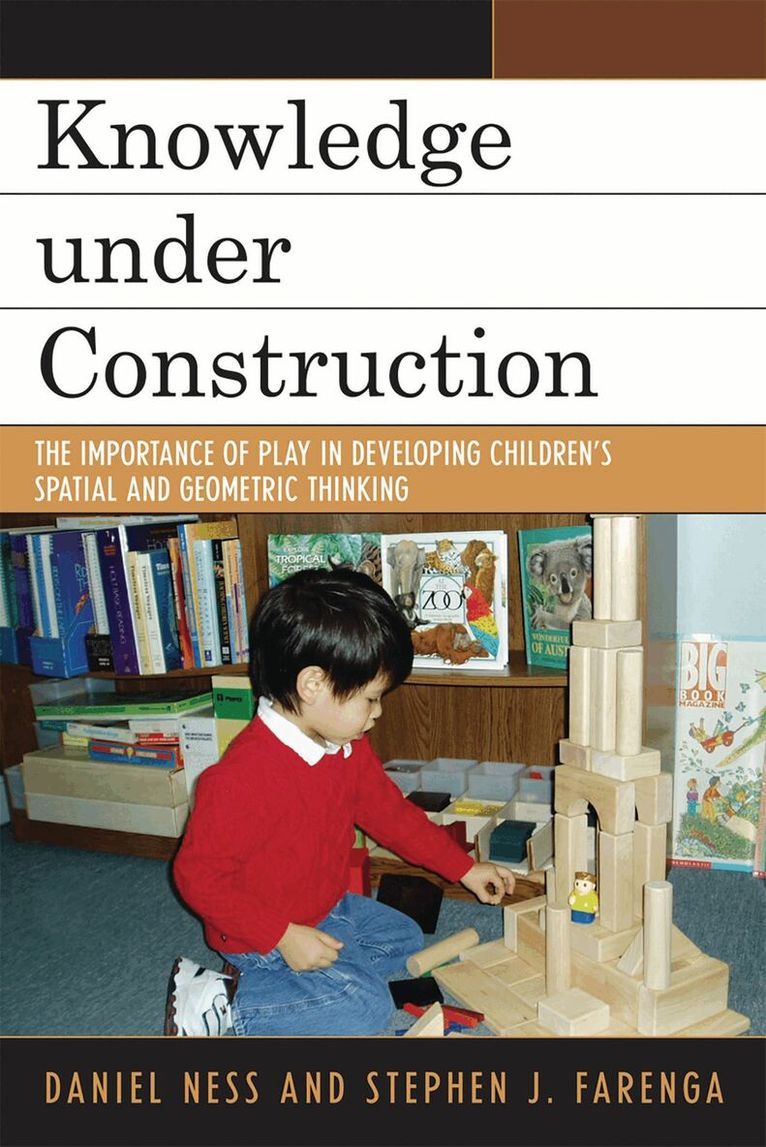
    Knowledge under Construction

    The Importance of Play in Developing Children's Spatial and Geometric Thinking

    AvDaniel Ness,Stephen J. Farenga

    Inbunden, Engelska, 2007

    1 626 kr

    Beställningsvara. Skickas inom 10-15 vardagar. Fri frakt över 249 kr.

    Fler format och utgåvor

    Häftad

    749 kr

    E-bok

    855 kr

    Beskrivning

    Knowledge under Construction investigates how young children develop spatial, geometric, and scientific thinking skills-particularly those associated with architecture. Based on original research and analysis of videotapes of children's play with blocks, the authors' findings suggest that such play is anything but pointless. Their conclusions fill in gaps in our current understanding of how children learn to think spatially and scientifically even while challenging portions of that understanding, including some of Piaget's thesis about the primacy of topological space in children's learning. A system of measurement developed to identify and categorize children's spontaneous behavior at play allows adults to observe patterns of behavior as children play and record the development of process skills and cognitive abilities, enhancing our understanding of how children begin to learn about space and architectural relationships. The book also examines the educational implications of our enhanced understanding. One possible development is a new, alternative way to measure cognitive abilities and development in children based on their work with blocks.

    Produktinformation

    • Utgivningsdatum:2007-03-29
    • Mått:160 x 239 x 23 mm
    • Vikt:576 g
    • Format:Inbunden
    • Språk:Engelska
    • Antal sidor:282
    • Förlag:Bloomsbury Publishing Plc
    • ISBN:9780742547889

    Utforska kategorier

    • Pedagogisk psykologi inom Psykologi och pedagogik

    Mer om författaren

    Daniel Ness, Ph.D. Columbia University, is an assistant professor in the Department of Human Development and Learning at Dowling College where he teaches courses in mathematics curriculum and instruction and cognitive development. He has taught mathematics at all levels, and his 10 years of clinical practice extends from teaching mathematics to conducting clinical interviews and diagnosing mathematical behaviors. Dr. Ness is the author of numerous articles on mathematics cognition and the development of spatial and geometric thinking. He is a contributing co-editor of "After the Bell" in Science Scope, a contributing author of Trivializing Teacher Education: The Accreditation Squeeze (Rowman & Littlefield), and co-editor of the Encyclopedia on Education and Human Development (M.E. Sharpe).Stephen J. Farenga, Ed.D. Columbia University, is an associate professor and former chairperson of the Department of Human Development and Learning at Dowling College. His research has appeared in major journals in science education, technology, and education of the gifted. Dr. Farenga has taught science for 15 years at the elementary and secondary levels and has served on the Commissioner's Advisory Council on the Arts in Education in New York State. Dr. Farenga has established an educational research clinic to examine methods of best practice and has served as a consultant for urban and suburban school districts. He is a contributing co-editor of "After the Bell" in Science Scope, a contributing author to Trivializing Teacher Education: The Accreditation Squeeze (Rowman & Littlefield), and co-editor of the Encyclopedia on Education and Human Development (M.E. Sharpe).

    Recensioner i media

    For preschool educators as well as interested developmental researchers, Knowledge under Construction offers a succinct, useful introduction to the topic, delineating various aspects of spatial, geometric, and architectural thinking and related theoretical perspectives that can be brought to bear on children's construction play. The book also contains helpful pedagogical features such as a set of topics and questions at the end of each chapter for discussion. Major contributions of the book are in situating this important developmental topic in natural settings (young children's spontaneous construction play) and in pointing to some promising directions regarding how this knowledge can shed light on preschool and elementary education, particularly in science and mathematics.

    Innehållsförteckning

    • Chapter 1 Spatial, Geometric, and Architectural Thinking: The Big PictureChapter 2 Developmental Perspectives on Spatial and Geometric ThinkingChapter 3 Children as Architects: The Identification of Architectural Principles Underlying Young Children's Geometric ConstructionsChapter 4 Contextual Observation: The Assessment for Measuring Spatial, Geometric, and Architectural Thinking of Young Children (SPAGAR)Chapter 5 Age, Gender, Socioeconomic Status Factors in Spatial, Geometric, and Architectural ThinkingChapter 6 Constructing Alone: Cases 1 and 2Chapter 7 Constructing Interactively: Cases 3 and 4Chapter 8 Beyond the Blocks: Implementing Praxis